The Day-One Test: Will Your Technicians Use Lift Software?
The Day-One Test: Will Your Technicians Actually Use Lift Software?
By Mr. Sumeet Katariya, ElevatorPlus ·
In short: Software for a lift company does not fail in the demo and it does not fail in the contract. It fails on a technician's phone, on the first day, when the app asks for more than the paper slip did and gives nothing back. The day-one test is simple: on the first day, does the technician do less work or more? If more, with nothing visible in return, the app is closed by week three and the office is back on WhatsApp by month four. This page sets out what passes the test, what to run in week one, and what to watch in month two.
Key takeaways
- The technician decides. Owners sign; technicians adopt. If the app is not open at the site, the data the office is paying for does not exist.
- Day one must be a trade, not a tax. The technician gives up the paper slip and gets something back the same day: the lift's history, the checklist already on the phone, no evening paperwork.
- Language is the first wall. A technician who reads Marathi or Tamil or Arabic will not use an English-only app for long. The technician app runs in 18 languages, on Android and iOS, for this reason.
- Week one is set up for the technician, not the owner. Lift data in the system before the first visit (your office fills one pre-formatted Excel and imports it in a click), the checklist matching the state's rules, one coordinator the technician can call.
- Month two is where the second failure happens. The owner stops checking, the office stops reconciling, the technicians notice nobody looks. Fix that with one weekly report somebody actually reads.
What this guide covers: Why technicians reject software · The day-one test · What week one looks like · The month-two drift · What a client says · FAQs
Why do technicians reject lift software?
Not because they dislike phones. The same technician who ignores the service app answers WhatsApp in eleven seconds. They reject software for three reasons, in this order.
| Reason | What it looks like | What fixes it |
|---|---|---|
| It adds work on day one | Fill the paper slip and then type the same thing into the app | Retire the paper slip the same day; the app is the slip |
| It is in the wrong language | English menus for a technician who reads Hindi or Tamil | A technician app in the technician's language |
| Nothing comes back | The technician enters data and never sees it used | The lift's history, the last visit's notes and the checklist on the phone before the visit |
The first reason is the one owners underestimate. A pilot in which technicians keep the paper slips "just for now" is a pilot designed to fail, because the app is now a second job.
What is the day-one test?
Three questions, asked about the technician's first working day on the system, before you sign anything.
- What does the technician stop doing on day one? If the answer is "nothing yet", the system has failed the test before it starts. The paper slip, the evening call to the office, the handwritten parts note: at least one goes on day one.
- What does the technician see on the phone that they could not see before? The lift's last three visits. The open complaint. The checklist for this lift type. If the phone shows nothing the technician did not already know, there is no reason to open it.
- Can the technician do it in their own language, offline, with one hand? Lift shafts have no signal. The app must work in the shaft and sync when the technician is out.
A system that passes all three can still fail, but a system that fails any of them will fail.
What does week one actually look like?
Week one is an office exercise that the technician never sees, and that is the point. By the time the technician opens the app, the work has been done.
| Day | What happens | Who does it |
|---|---|---|
| Before day one | All lift data in the system: sites, lifts, contracts, visit schedules | Your nominated person fills the pre-formatted Excel and imports it in one click; the coordinator guides |
| Day one | Technicians see their own lifts and today's visits in their own language; paper slips withdrawn | Owner withdraws the slips; coordinator checks the first entries |
| Days two to five | Virtual training by role: technician, office, owner, each separately | Coordinator |
| End of week one | First visits logged, first complaint closed on the system, first owner view of the week | Owner looks, and says so |
ElevatorPlus goes live in 2 to 7 days from the data being supplied, which is a range we see, not a promise, and the technician app runs in 18 languages. For the office, the admin panel is in English, Arabic and Dutch. Full onboarding runs up to 45 days when the data is supplied on time, with a dedicated coordinator and virtual training by role; a week on site is available at no extra cost if the client covers travel, accommodation and food.
What is the month-two drift?
The second failure is quieter. The technicians are using the app. The office is reconciling. Then, in week six or seven, the owner stops opening the report, the office stops chasing the missing entries, and the technicians notice. Entries get shorter. A visit gets logged the next morning instead of at the site. By month four the paper slips are back, unofficially, and the owner says the software "did not work for us".
The fix is one weekly report that one named person reads and acts on, every week, in front of the technicians. Visits logged versus scheduled, complaints open past the response time, entries made away from the site. Nothing else. Why month four is where most systems fail is in Why Elevator Software Fails in Month Four.
👉 Want to see what a technician sees on day one? Book the 30-minute Revenue Leak Walk-Through →
What does a client say?
Elevating Solutions Pvt. Ltd. in Kathmandu runs 50 or more people and moved from paper service slips to the system with onboarding done fully online. Mr. Akshat's advice to other owners is the day-one test in one line: "don't try to bend the system" to the old paper habits. The short clip from his recorded testimonial is in Monday's video, embedded below.
How ElevatorPlus handles day one ?
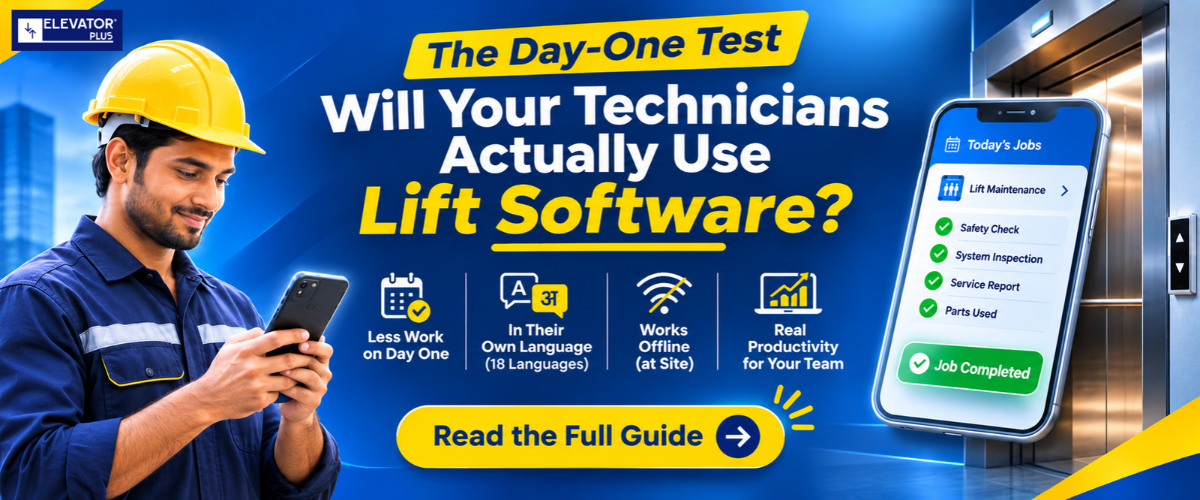
The technician app runs in 18 languages on Android and iOS, works offline in the shaft and syncs when the signal returns. The technician's own lifts, today's visits, the last visit's notes and the checklist for the lift type are on the phone before the first visit, because the lift data goes in before day one through one pre-formatted Excel. Mark-in and mark-out, the checklist, parts used and the customer's acknowledgement replace the paper slip the same day. The office sees it in the admin panel as it happens.
Frequently asked questions
1. Should we run a pilot with a few technicians first?
Only if the pilot technicians stop using paper slips completely. A pilot where the app is a second job proves nothing except that second jobs are unpopular.
2. What if some technicians cannot read well in any language?
Checklists with icons, voice notes for the job description, and a buddy on the first week. Ask any vendor to show you the technician app with the text at its largest and the checklist as tick boxes.
3. How long before technicians stop needing the office?
Most technicians are independent on the app within the first week if the lift data was in the system before they started. It is the filled sheet, not the training, that decides this.
4. What do we do with the old paper slips?
Keep the archive for your record-keeping period; stop producing new ones on day one.
5. Does the owner need to use the app?
The owner needs to read one weekly report and be seen to act on it. That is the whole requirement, and the one most often skipped.
📲 Join our WhatsApp channel for compliance tips, updates: ElevatorPlus - Business Automation Tool
The technician decides whether software works. Pass the day-one test (less work, something back, their own language, offline), do the import before day one, withdraw the paper slips the same day, and read one weekly report in month two. That is the entire difference between a company on a system and a company that "tried software once".
Related reading
- Why Elevator Software Fails in Month Four
- The Handover: Paper Records into a System
- What Does Elevator Software Really Cost in Year One?
- Elevator Onboarding: What the First 45 Days Look Like (live 20 November)
- The Elevator Business Brief on LinkedIn: Before You Buy, Part 2 (11 November) and Part 3 (18 November)
About the author. Mr. Sumeet Katariya is the Founder of Accucia Softwares Pvt Ltd and the Creator of ElevatorPlus, the Elevator Business Operating System used by 200+ elevator companies across 20+ countries.
Sources: Drawn from ElevatorPlus onboarding work with 200+ elevator companies across 20+ countries. Go-live, language, onboarding and on-site figures are ElevatorPlus standing commitments. · Elevating Solutions Pvt. Ltd. from the recorded testimonial of Mr. Akshat (ElevatorPlus Rule of One, Case Study 15).
👉 Follow ElevatorPlus on,
Instagram LinkedIn Facebook YouTube Qoura Substack Twitter