
Powering Elevator Businesses Worldwide
Trusted by Fastest-Growing Elevator Companies
Most elevator companies do not lose AMC revenue to competitors. They lose it to a renewal date nobody looked at. A contract lapses quietly, the lift keeps running, the technician keeps visiting, and nine months later somebody notices the invoices stopped.
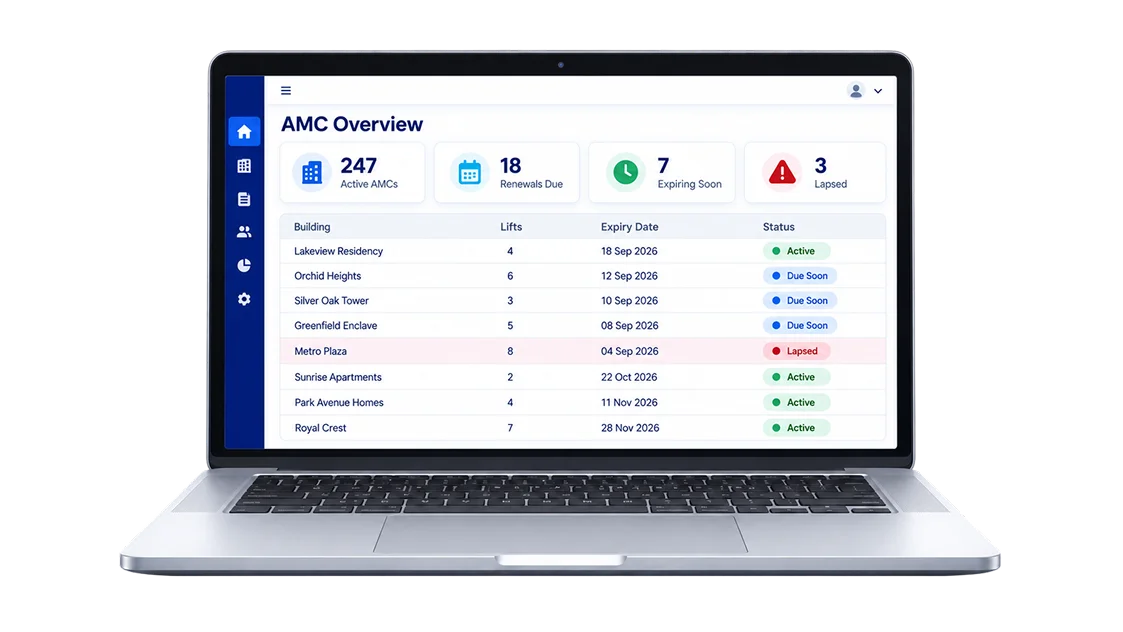
ElevatorPlus tracks every contract against every lift, reminds your customer before it expires, and turns the row red on your dashboard if they still have not renewed.
Trusted by Fastest-Growing Elevator Companies
In most elevator companies the AMC is set up separately from the installation, by a different person, sometimes weeks later, and sometimes not at all. That gap is where the first year of maintenance revenue quietly disappears.
In ElevatorPlus, handover creates the lift record and the lift record carries the contract. Site details, lift specifications, warranty position and documentation are already there because the installation team entered them. Nobody re-types anything, and nothing is waiting on somebody remembering.
The installation team hands the lift over.
Handover creates the lift record.
The lift record carries the AMC.
Elevator companies rarely run one kind of contract. A twenty-year-old building on POG, a new tower on comprehensive, a hospital on semi-comprehensive with parts capped, and each of them billing differently.
ElevatorPlus holds all of them in the same portfolio without forcing you to pick one model. Each contract carries its own scope, its own billing cycle, its own parts position and its own escalation terms. When a technician replaces a part, the system already knows whether it is covered under that specific contract or chargeable to the customer.
A new tower.
A hospital, with parts capped.
A twenty-year-old building.
Escalation and revision
Annual escalation clauses are held on the contract and applied at renewal, so the price revision is not a negotiation somebody forgot to have. Multi-currency is supported for companies operating across borders.
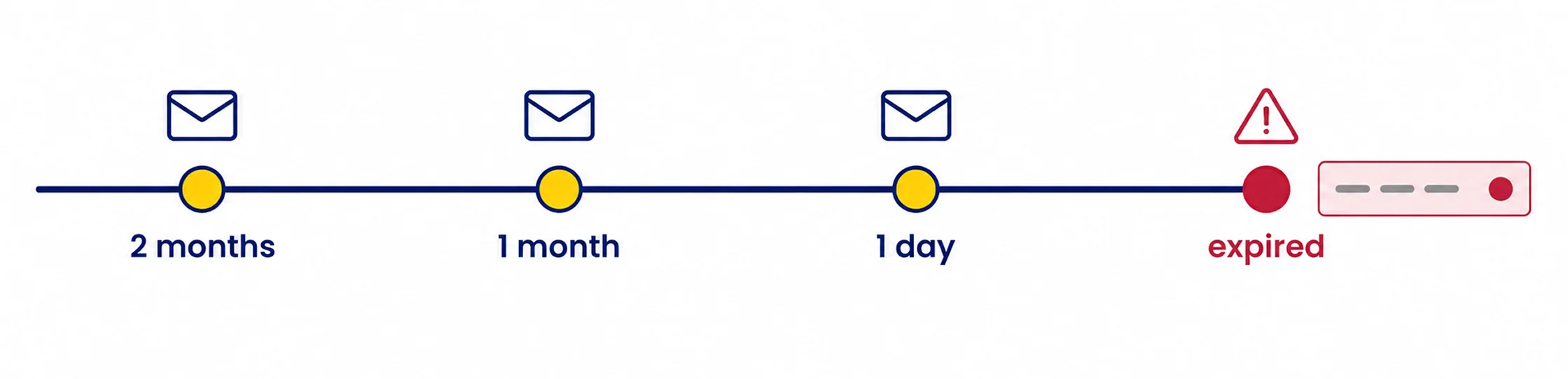
Renewal reminders go to your customer automatically, on a fixed sequence, by email, and over WhatsApp where the WhatsApp Business API is connected.
The first reminder. Early enough that a building committee has time to put it on an agenda and release a budget.
The second. Enough time for a revised quotation and a conversation.
The final reminder, to the customer.
Not buried in a report somebody runs monthly. Red, on the screen your team already looks at, until somebody deals with it. By this point your customer has already been told three times.
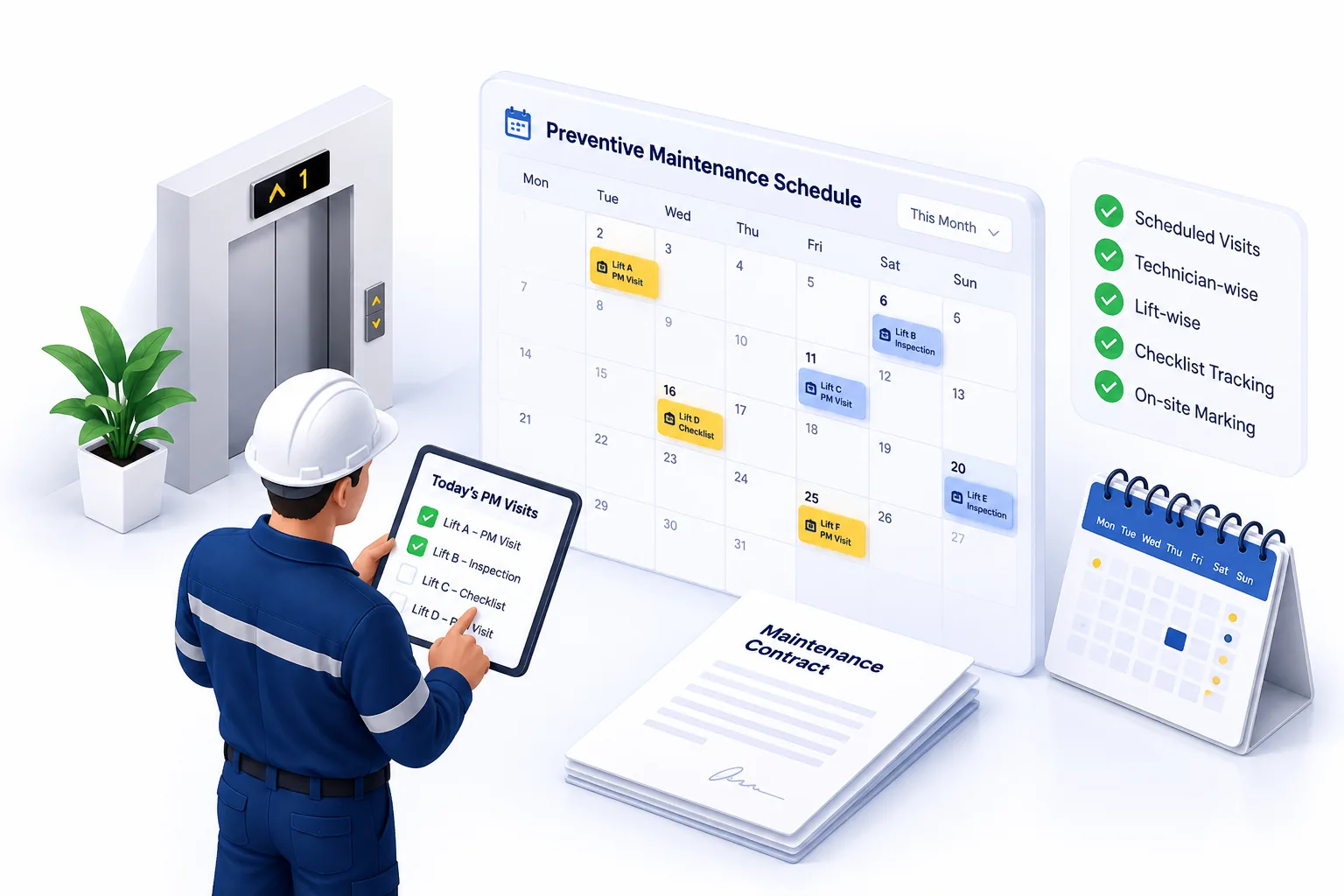
Some companies want every preventive maintenance visit for the year planned in advance, by lift, by technician, by date. Others prefer to allocate week by week because their teams move around. ElevatorPlus supports both, and scheduling is optional rather than compulsory.
If you use it, the schedule is built from the contract: visit frequency, lift type, and the checklist that applies to it. Visits appear in the technician's daily list, get marked in and out on site, and close against the contract. If a visit is missed, it is visible as a missed visit rather than disappearing.
If you do not use it, nothing else stops working. The contract, the reminders, the history and the reports all run regardless.
The most expensive thing in elevator service is a technician rediscovering a problem somebody already solved. A door fault that recurs every monsoon, a controller that was replaced under warranty four years ago, a customer who has been complaining about the same noise since 2019.
That knowledge normally lives in one person's head, and it leaves when they do.
ElevatorPlus keeps the complete history against the lift, not against the person. Every breakdown, every preventive maintenance visit, every part changed, every complaint raised, going back as far as the record goes, no matter how many years that contract has been with you. A technician assigned to that site for the first time opens the lift record on his phone and sees all of it before he touches anything.
It also means a handover between technicians is a reassignment rather than a briefing.
"Tracking breakdown calls and AMC expiries for multiple lifts used to mean digging through registers. ElevatorPlus puts all of it on the app."
Sujit Tiwari
Once several years of history sit against every lift, patterns become visible that nobody could see from paper.
Which lifts are consuming disproportionate technician time. Which ones generate repeat callbacks for the same fault. Which contracts are costing more to service than they earn. Which parts are approaching the end of their warranty position, so you find out before you invoice a customer for something they believe is covered.
That is what predictive maintenance means in a service business. Not sensors on a machine and not failure prediction, but pattern analysis over your own service record, showing you where the cost is concentrated so you can decide where to intervene.
To be precise about what this is: ElevatorPlus analyses the service history you have built up. It does not predict equipment failure. It does not read IoT telemetry from the equipment, monitor energy consumption, or connect to a building management system. Anyone offering you failure prediction from a lift with no sensors on it is describing something else.
Pattern analysis over your own service record tells you where the cost is concentrated.
Everything due in the next 30, 60 or 90 days, by branch, by value, by customer. This is the report that becomes next quarter's revenue forecast.
Every AMC that expired without being renewed. Most elevator companies discover they have more of these than they expected, and most of them are recoverable.
Contracts that ended and were not replaced. Who, when, which building, what they were worth. This is the report that tells you whether you have a service problem or a pricing problem.
What your installed base is worth annually, what proportion of it is under contract, and where the gaps are.
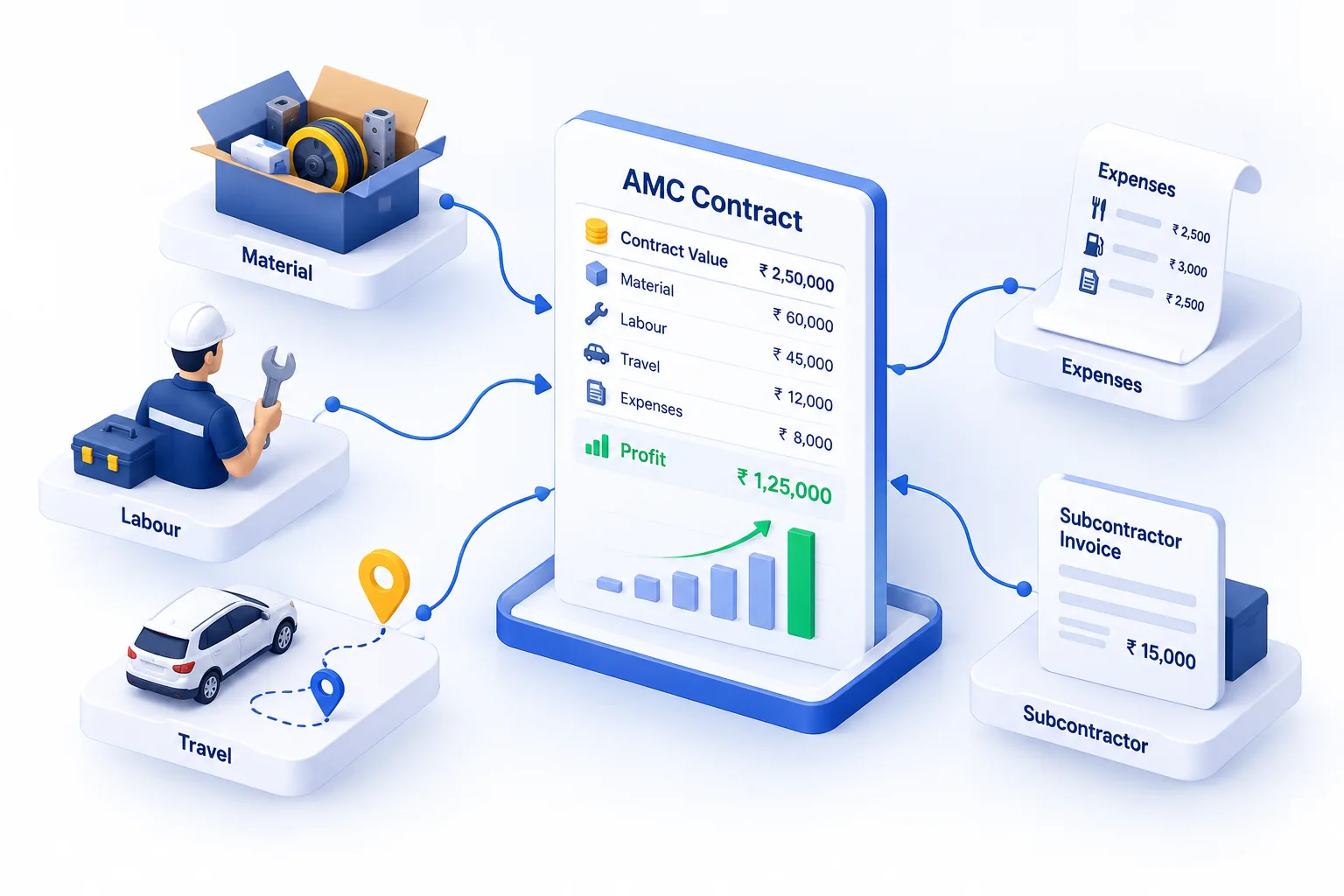
An AMC is only profitable if you know what it costs to service. In most companies that number does not exist, because the parts sit in one system, the labour in another and the travel claims in a spreadsheet.
In ElevatorPlus, material issued against an AMC project is booked against that contract, and so are expenses. A technician's travel to that site, an out-of-scope part, a subcontractor invoice: all of it attaches to the contract it belongs to.
Which means the question "is this contract making money?" has an answer, per contract, without anyone assembling it by hand.
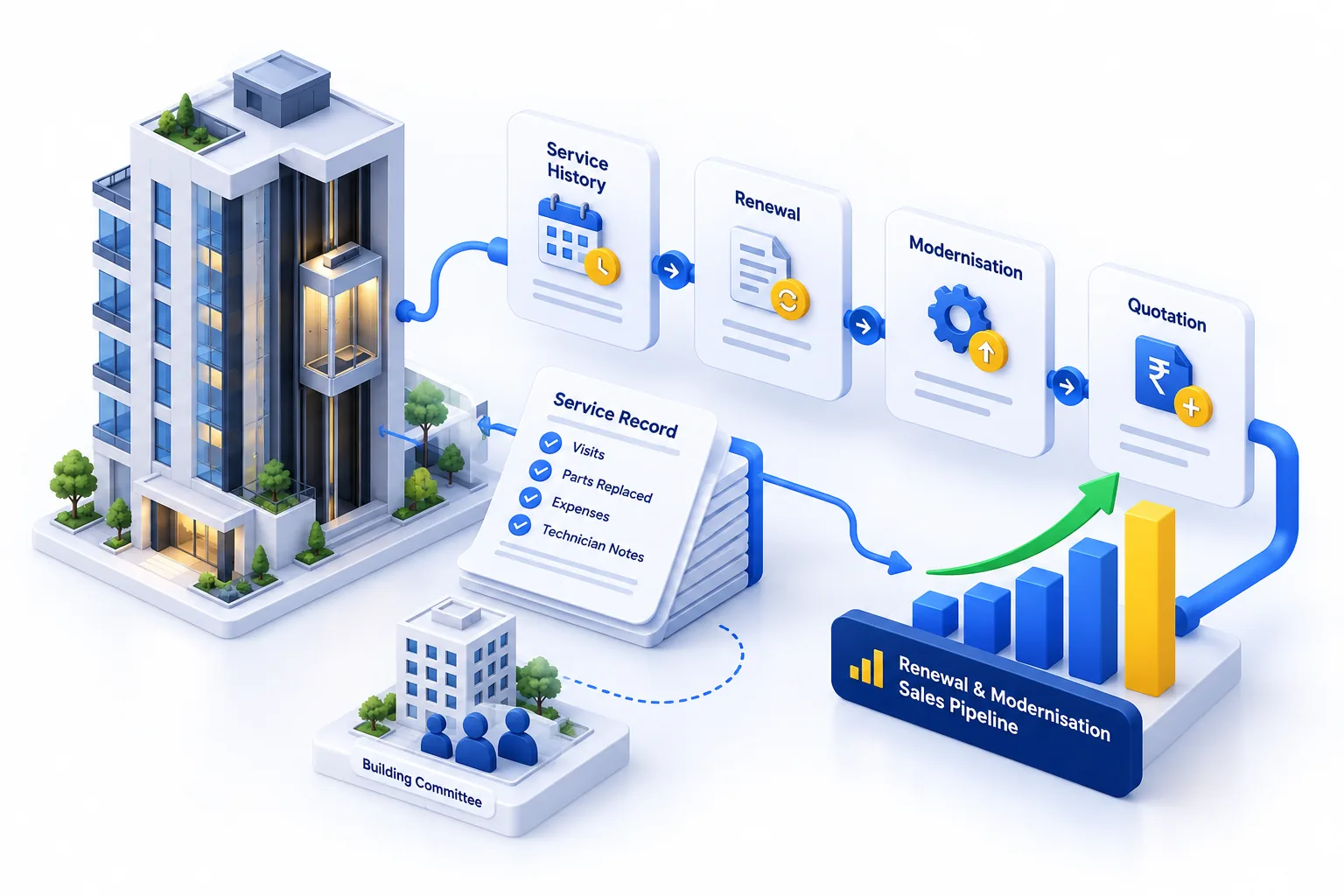
A renewal is not an administrative event. It is a sales opportunity with a warm customer, a known building and a documented year of service behind it.
In ElevatorPlus, renewals and modernisation opportunities flow back into the sales pipeline rather than sitting in a maintenance list. The quotation carries the escalation, the service history is available to justify it, and the whole thing is tracked like any other deal.
Twelve months of dated, photographed, signed service records is the most persuasive thing you can put in front of a building committee questioning your price. It is very hard to assemble that after the fact from paper.
How far in advance does it warn you about a renewal?
Your customer receives an automatic email reminder two months before expiry, one month before, and one day before if it is still not renewed. On the expiry date, if it is still not renewed, the contract is flagged red on your dashboard until it is dealt with.
Can one contract cover lifts in multiple buildings?
Yes. A contract can carry any number of lifts across any number of sites, which is how most managing agent and corporate contracts actually work.
How are escalation clauses handled?
The escalation is held on the contract and applied at renewal, so the revised price is calculated rather than negotiated from scratch each year.
Can we run comprehensive, semi-comprehensive and POG contracts side by side?
Yes. Each contract carries its own scope, billing cycle and parts position, and the system knows which parts are covered under which contract when a technician uses one.
Is preventive maintenance scheduling compulsory?
No. It is optional. Companies that want the full year planned in advance can do that, and companies that allocate week by week can work that way instead. Everything else on the contract runs either way.
What happens to the service history when a contract renews?
Nothing. The history belongs to the lift, not to the contract term, so it carries across renewals and across technicians indefinitely.
Can we see whether an individual AMC is profitable?
Yes. Material issued and expenses booked against that contract are tracked against it, so cost against contract value is visible per contract.
Does it handle multi-currency?
Yes, for companies operating across more than one country.
What reports are available?
Upcoming renewals, lapsed contracts, lost customers, and contract value and coverage, filterable by branch, value and period.
Bring the number of lifts you maintain and roughly how many contracts you think are under AMC. Most owners find the gap between those two numbers is larger than they expected, and that gap is the fastest revenue in the business to recover.
Book Your Revenue Leak Walk-Through