Powering Elevator Businesses Worldwide
Trusted by Fastest-Growing Elevator Companies
Think about the most capable person on your service team. The one who can diagnose a door fault from the sound it makes, who has been doing this for twenty years, who other technicians ring when they are stuck.
There is a reasonable chance he does not read English comfortably. He might work entirely in Marathi, or Gujarati, or Hindi. That has never affected his ability to do the job, and it should not decide whether he can use your software.
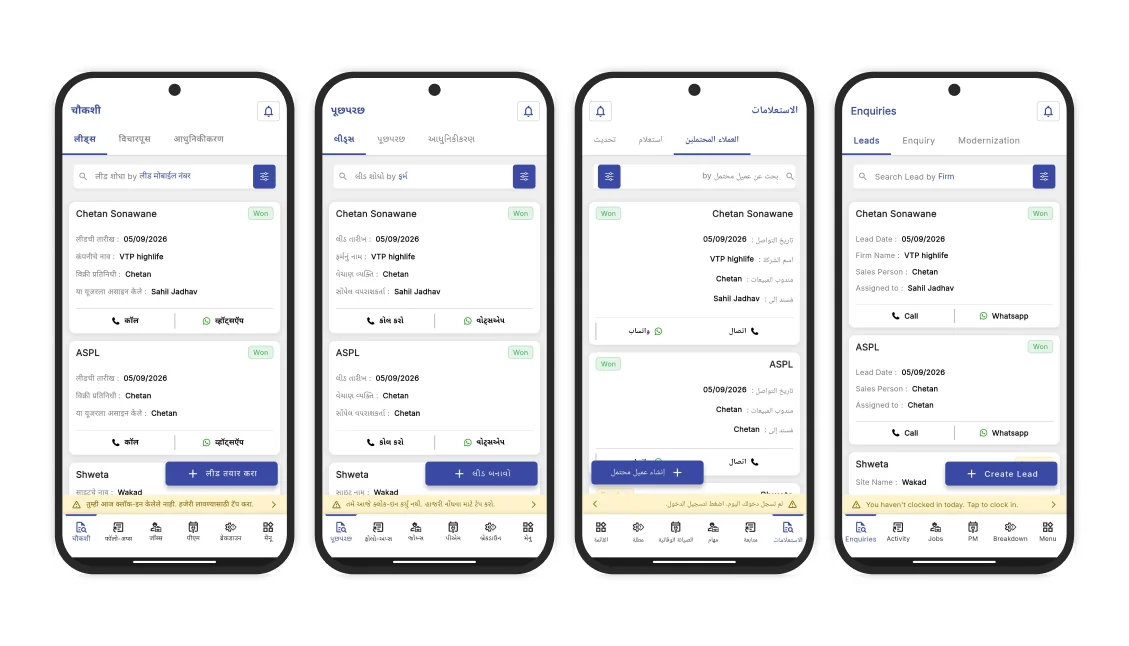
ElevatorPlus runs in 18 languages, in the mobile app and in the web admin panel.
Trusted by Fastest-Growing Elevator Companies
Elevator software fails for one reason more often than any other: the field team does not use it. The office buys it, the training happens, and within three months the technicians are back on paper and WhatsApp while somebody in the office types their notes in afterwards.
There are several reasons that happens, and language is the one nobody wants to discuss in front of the technicians.
A man who half-understands a checklist does not tell you he half-understands it. He completes it anyway, ticking what looks right, guessing at the fields he cannot read. The record that reaches your office looks complete and is not. Then somebody notices the data is unreliable and concludes the software does not work.
The data was never the problem. The language was.
He completes it anyway, ticking what looks right, guessing at the fields he cannot read.
The record that reaches your office looks complete and is not.
Then somebody notices the data is unreliable and concludes the software does not work.
Bolting a translation widget onto an English product is easy, and it is what most software does. It also produces text that a native speaker finds odd at best and incomprehensible at worst, particularly for technical vocabulary. Machine translation does not know that a specific part has a specific name in Marathi that the trade actually uses.
ElevatorPlus is translated string by string, and each one is verified against the actual language by someone who speaks it. That is slower and more expensive than a widget. It is also the difference between a technician using the app and a technician tolerating it.
The whole product is covered, not just the labels a visitor would see. Field names, checklist items, status values, error messages, notifications, and the reports that go out to your customers.
Field names
Checklist items
Status values
Error messages
Notifications
Reports to your customers
Indian languages
Rest of the world
New regional languages are added when customers ask for them. If the language your team works in is not on this list, tell us on the call.
Most products that offer regional languages offer them in the field app only, on the assumption that the office speaks English. In a lot of elevator companies that assumption is wrong. Branch coordinators, storekeepers and back-office staff often work in the local language too, and they are the people entering the majority of the data.
Each user picks their own language. A technician in Coimbatore works in Tamil, the coordinator in Pune works in Marathi, the owner works in English, and they are all looking at the same records.
Every screen a technician sees in the field: job lists, checklists, service history, parts used, signatures. All 18 languages.
The back office, approval screens, reporting, contract management and settings. Same 18 languages as the app.
Renewal reminders, service reports and customer notifications. The translation covers outbound communications, not only the interface.
Language support is what makes a single system workable for a company operating in more than one country. Arabic for the Gulf, French for West Africa, Swahili for East Africa, Turkish, German, Vietnamese, and the Indian languages for the domestic team.
Several ElevatorPlus customers run multiple countries on one system, with each office working in its own language, one set of contracts, and one dashboard for the owner.
Each office working in its own language.
One set of contracts.
One dashboard for the owner.
How many languages does ElevatorPlus support?
18, in both the mobile app and the web admin panel. Hindi, Marathi, Gujarati, Tamil, Telugu, Kannada, Bengali, Nepali, English, Arabic, Persian, Turkish, French, German, Vietnamese, Swahili, Bulgarian and Malayalam.
Is this Google Translate?
No. Every string is translated and verified against the actual language rather than machine-translated at runtime.
Does each user choose their own language?
Yes. A technician, a coordinator and an owner in the same company can each work in a different language, on the same records.
Is the admin panel translated too, or only the app?
Both. This matters because in most elevator companies the back office is entering more data than the field team is.
Can you add a language we need?
New regional languages are added on customer request. Tell us which one on the call.
Does the app handle right-to-left scripts?
Yes. Arabic and Persian are genuinely right-to-left, with the interface mirrored rather than the text simply substituted into a left-to-right layout. Buttons, navigation and form flow all reverse.
Do reports and customer notifications go out in the local language?
Yes. The translation covers notifications and reports, not only the interface labels.
The real test of this is not a demo to the management team. Put it in front of the technician you think is least likely to use software, in his own language, and watch what happens. We are happy to run the demo that way.
Book a Demo