Buying an Elevator Maintenance Book: Due Diligence List
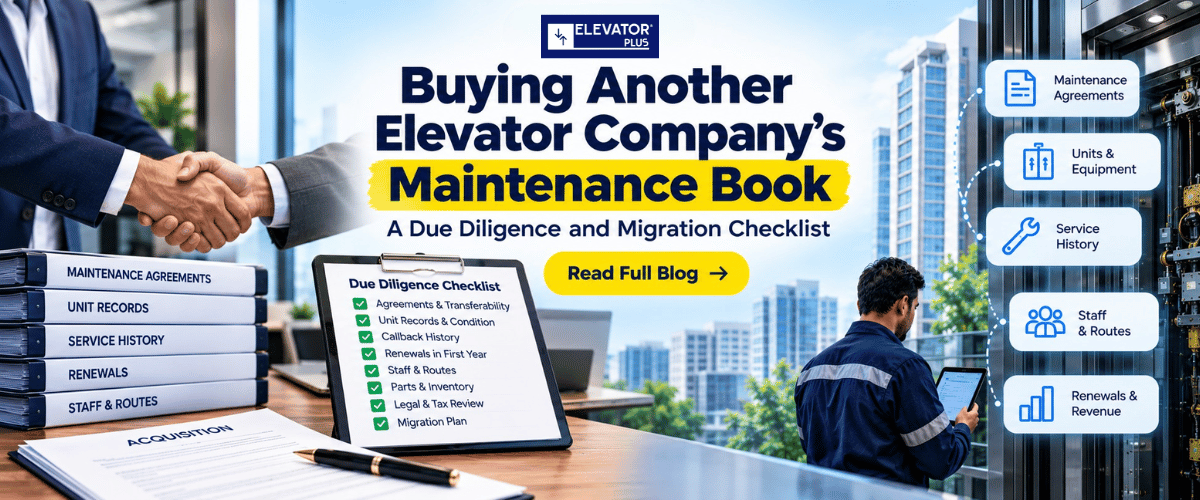
Buying Another Elevator Company's Maintenance Book: A Due Diligence and Migration Checklist
By Mr. Sujit Katariya, ElevatorPlus · Reviewed by Mr. Sumeet Katariya
In short: Buying an elevator maintenance company means buying units, agreements and records, not a customer list. Before closing, check which agreements can transfer, whether every unit has maintenance records, what the callback history shows, and which renewals fall in the first year. Send assignment, staff and tax questions to your attorney and accountant. After closing, write to every building owner on day one, load the data into its own branch, and get a mechanic to every unit within the first month.
Key takeaways
- You are buying units and agreements, not names. Value sits in how many agreements transfer, have usable records and renew.
- Ask for the records before the price is final. Per-unit records and 12 months of callbacks show the book's condition better than any summary.
- Assignment is the first legal question. Whether each maintenance agreement can pass to you is for your attorney, agreement by agreement.
- The first 30 days decide who stays. Building owners judge the new company by the first callback and the first maintenance visit.
- Migrate into a separate branch first. Merge routes once the data is clean.
What this guide covers: what you are buying · the due diligence table · the records test · questions for your attorney and accountant · planning the migration before closing · the first 30 days · running the book as its own branch · a note for India · FAQs
What are you actually buying when you buy a maintenance book?
A maintenance book is a set of promises with equipment attached. You are buying six things, and the seller's spreadsheet usually describes only the first:
- The customer and agreement list.
- The units under those agreements, and their condition.
- The records for each unit: maintenance visits, callbacks, tests and repairs.
- The mechanics who know the routes and the buildings.
- Parts on shelves and on trucks.
- The relationships with building owners and property managers.
If you want the wider picture of what software should do once the book is yours, read What Is Elevator Service Software? A Straight Answer.
What should due diligence on an elevator maintenance book cover?
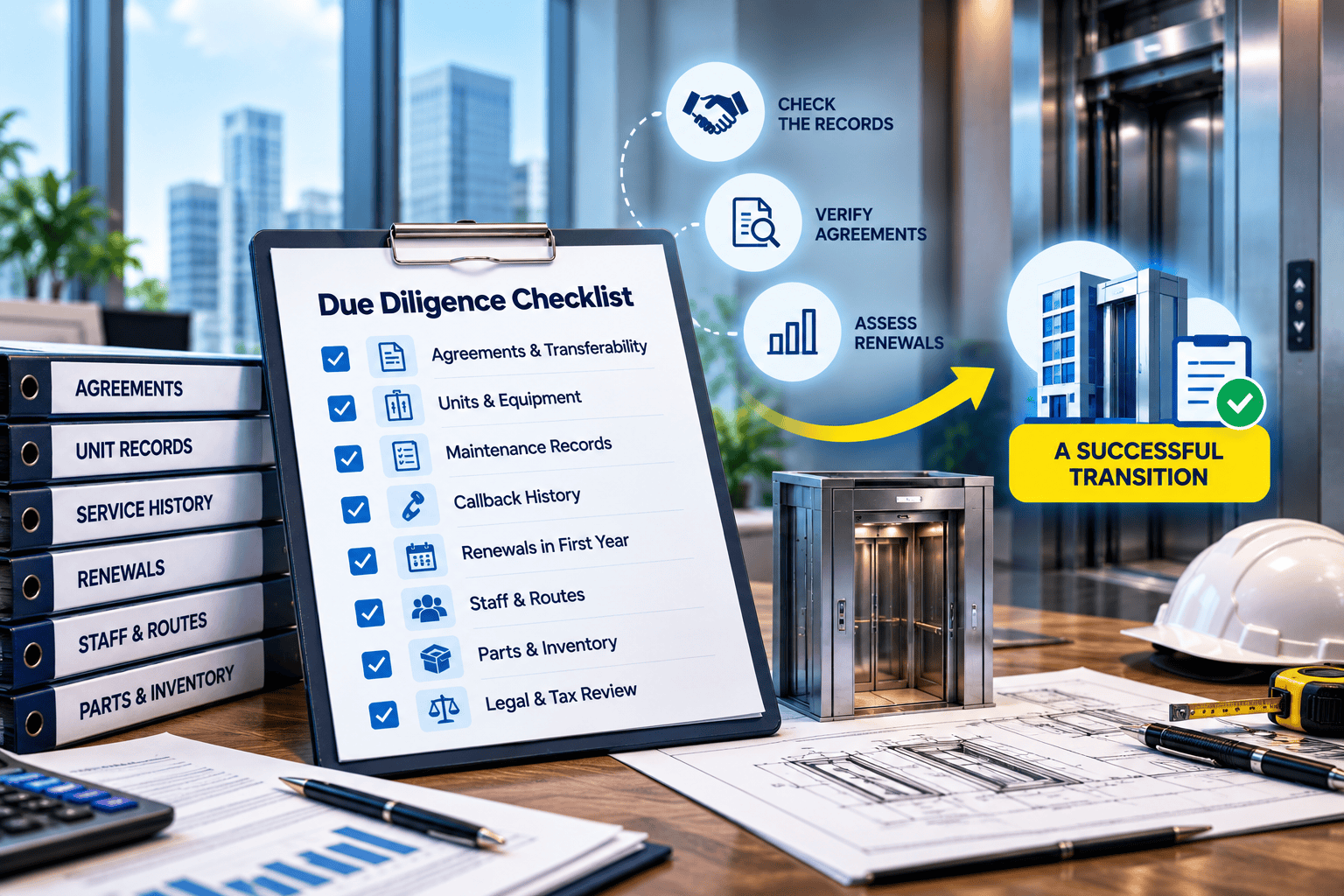
Work through this table before the price is final. Ask for every item in a file you can sort, not a printed report.
| Area | Ask the seller for | What it tells you | Red flag |
|---|---|---|---|
| Agreements | Every active agreement, with dates, rate and units covered | Recurring revenue, and when it is at risk | Verbal arrangements with no paper |
| Agreement terms | Cancellation notice, escalation clause, term and any assignment clause | How easily a customer can leave after you buy | Short cancellation notice across most of the book |
| Renewals | Every agreement ending in the next 12 months | How much of the book you must re-sell in year one | A cluster of renewals in your first quarter |
| Units | Unit list with jurisdiction unit numbers, equipment type, controller and age | What parts and skills the book needs | Buildings listed without units |
| Maintenance records | Per-unit maintenance records for at least the last year | Whether the work was done and can be shown | Records kept as one notebook per mechanic |
| Callbacks | Every callback and entrapment in the last 12 months, by unit | Which units will cost you more than their rate | A handful of units carrying most of the callbacks |
| Inspection items | Open findings and upcoming tests by unit | Work you inherit on day one | Findings past their due date |
| Mechanics | Who services which route, and which buildings each knows | Whether the knowledge leaves with one person | One mechanic holding most of the book |
| Customer concentration | Agreements grouped by owner or property manager | How much one relationship controls | One manager holding a large share of units |
The maintenance records row matters beyond the deal. If the book is under ASME A17.1, Section 8.6 calls for written maintenance records for each unit, kept for five years, and it permits electronic records. When you take over a unit, you take over keeping its records, so agree in the purchase terms what you will receive.
The records test: ten units, twelve months
Pick ten units at random from the seller's list. Ask for every maintenance visit and every callback on each one in the last 12 months.
Complete, dated records by unit mean the book was run on a system. Partial records, or records that need a call to a mechanic, mean you are buying units whose history you will have to rebuild. That work belongs in the price conversation.
Which questions belong to your attorney and accountant?
This is an operator's checklist, not legal or tax advice. Several questions decide what you actually own, and they need a professional who knows your state and your deal.
| Question | Who answers it |
|---|---|
| Can each maintenance agreement be assigned to us, and does the customer need to consent? | Your attorney |
| Do any agreements have change-of-control or termination rights on a sale? | Your attorney |
| What happens to the seller's mechanics, and on what terms do they join us? | Your attorney |
| What licensing do we and our mechanics need in each jurisdiction in the book? | Your attorney |
| Who is responsible for work done before closing if a claim arises later? | Your attorney |
| How should the purchase be structured, and what is the tax treatment? | Your accountant |
| Who collects invoices that are open on the closing date? | Your accountant, with your attorney |
| How are prepaid agreements treated at closing? | Your accountant |
Get these answers in writing before closing. The plan below depends on them.
How should you plan the migration before closing?
Plan the data before closing, while the seller still answers the phone. Agree in the purchase terms what data you receive, a test file before closing and the final file on closing day, and a named person on the seller's side to answer questions for the first few weeks.
| Data to request | Format | Why you need it on day one |
|---|---|---|
| Customers and billing contacts | Spreadsheet or export file | Day-one letters and billing |
| Buildings and units, with unit IDs | Spreadsheet or export file | Every visit and callback attaches to a unit |
| Agreements with dates, rates and covered units | Spreadsheet or export file | Renewals and billing schedules |
| Maintenance records and checklists by unit | Export with attachments | Continuity of the record |
| Callback history by unit | Export file | Knowing which units will call first |
| Open inspection findings and upcoming tests | Spreadsheet | Work you inherit immediately |
| Access notes and site contacts | Spreadsheet, sent securely | Your mechanics need them on the first callback |
| Parts list with locations | Spreadsheet | Stock you now own |
Then build one mapping sheet: the seller's field names against yours. Fix duplicate customers and units with no ID in the file before it is loaded. We cover the same cleanup in more depth in The Handover: Twenty Years of Paper Into a System.
What should happen in the first 30 days after closing?
Building owners chose the seller, not you, and the sale gives them a reason to look around. The first month is where you keep them.
| When | Task | Output |
|---|---|---|
| Day 1 | Send every building owner and property manager a letter: who you are, the new callback number, who their mechanic is | No customer hears about the sale second-hand |
| Days 1 to 7 | Load the cleaned data, set up the acquired book as its own branch and train its team | Every unit and agreement in one system |
| Week 1 | Put every mechanic from the acquired book on your app, on their existing routes | Visits and callbacks recorded from the first day |
| Week 1 | Route all callbacks for the acquired book through your dispatch | One number, one queue |
| Week 2 | Start maintenance visits on every unit, highest-callback units first | A first visit logged against every unit |
| Week 3 | Compare units visited with units under agreement | Units you are paying for but not servicing, and the reverse |
| Week 4 | List every agreement ending in the next 90 days and assign each to a person | A renewal call list with owners and dates |
The week 3 comparison is where surprises appear: units maintained without an agreement, or agreements covering units nobody has visited. Each is a billing or a renewal conversation.
👉 Taking on a second book of business and want it visible on its own until it is clean? See how multi-branch elevator management works in ElevatorPlus →
Should the acquired book run as its own branch?
At first, yes. Merging an acquired book straight into your routes hides its problems inside your numbers. Run it as a separate branch for the first few months, so its callbacks, renewals and outstanding payments sit on their own against the figures you were shown in due diligence. Merge when the data is clean.
How does ElevatorPlus handle an acquired book?
| Step | ElevatorPlus position |
|---|---|
| Data migration | Included in setup. Customers, units and agreements are imported, not re-keyed. For each agreement, setup brings in the contract signed date, services completed so far, services pending and the contract value. Anything else from the seller's files, such as old maintenance records, callback logs or access notes, goes into Important Documents, where the team on site can open it. |
| Time to live | Most customers are fully live within 2 to 7 days, with migration, configuration and team training included. |
| Separate branch | The acquired book can run as its own branch with its own clients, technicians, inventory and contracts. |
| Visibility | Branch managers see their branch, head office sees every branch, and field technicians see only their assigned jobs. Head office gets consolidated reports covering revenue, outstanding payments, technician utilization, callback volume and contract renewals, with drill-down to each branch. |
| Renewals | Renewal reminders 60 days, 30 days and 1 day before each agreement expires. |
| Checklists | Fully configurable checklists, set up aligned to the code you work under: ASME A17.1 in the US. |
| New mechanics | The technician app runs in 18 languages on Android and iOS. For international customers there is no per-user fee, and every module is included. |
| Accounting | Invoices stay in your own accounting software. ElevatorPlus logs every payment received and the next due date, and reminds your team when a collection follow-up is due. |
Pricing is set per company after the Revenue Leak Walk-Through. For more, see elevator service software for US contractors.
A note for India: buying an AMC book
The same checklist works for an Indian lift company buying another company's AMC book, with two changes. The attorney and accountant questions still apply: take them to your lawyer and your chartered accountant.
First, lift law is set state by state. Each state may have a different Act, inspection interval and log book position, and Telangana has no lift Act in force at all. Check the state position for every city before you price the book. Our summary is Lift Rules by State in India: What 15 States Actually Require (2026).
Second, the renewal clock is the financial year. List every AMC ending before 31 March and treat that list as the first thing you must re-sell.
Frequently asked questions
1. What should I check before buying an elevator maintenance company?
The agreement list and terms, the units and their IDs, per-unit maintenance records, 12 months of callbacks, open inspection items, which mechanics know which routes, parts stock and how concentrated the customers are.
2. Can elevator maintenance agreements be transferred to a buyer?
It depends on each agreement's wording and the law that applies. Ask your attorney to review assignment and change-of-control terms agreement by agreement before closing.
3. What records should the seller hand over?
Every customer, unit, agreement, maintenance record, callback, open inspection finding, access note and part, in a structured file with attachments.
4. How do I keep customers after buying a maintenance book?
Write to every building owner on day one with the new callback number and their mechanic's name. Then make sure every unit gets a logged maintenance visit within the first month.
5. Should an acquired book be merged straight into existing routes?
Not at first. Run it as its own branch so its callbacks, renewals and payments are visible on their own, then merge once the data is clean.
6. How long does it take to move an acquired book into ElevatorPlus?
Most ElevatorPlus customers are fully live within 2 to 7 days, with data migration, configuration and team training included.
7. Does the same checklist work for buying a lift AMC book in India?
Yes, with the state lift Act checked for every city in the book, AMC renewals before 31 March listed first, and the legal questions taken to your lawyer and chartered accountant.
📲 Join our WhatsApp channel for compliance tips, updates: ElevatorPlus - Business Automation Tool
The price of a maintenance book is set on the agreement list. Its value is decided by the records, the callbacks and the first month after closing.
Run the ten-unit test before you agree the number. If the seller cannot produce a year of history on ten units, you are buying the job of rebuilding it.
After closing, speed beats polish. A letter on day one, one callback number and a mechanic at every unit within the month keep more customers than any discount.
👉 See how an acquired book would look as its own branch. Book the Revenue Leak Walk-Through →
Related reading
- The Handover: Twenty Years of Paper Into a System
- What Happens to Your Lift Data If You Leave a Vendor?
- Elevator Maintenance Control Program (MCP) USA Explained
- Grow Your Elevator Maintenance Business (2026)
- Why Elevator Software Implementations Fail in Month Four
About the author. Mr. Sujit Katariya works with elevator companies implementing ElevatorPlus, the Elevator Business Operating System used by 200+ elevator companies across 20+ countries.
Sources: ASME A17.1, Safety Code for Elevators and Escalators, Section 8.6. · State lift Acts and Rules as read by ElevatorPlus, September 2026. · Drawn from ElevatorPlus onboarding work with 200+ elevator companies across 20+ countries.
👉 Follow ElevatorPlus on,
Instagram LinkedIn Facebook YouTube Qoura Substack Twitter