Lift Rules by State in India: 15 States Compared (2026)
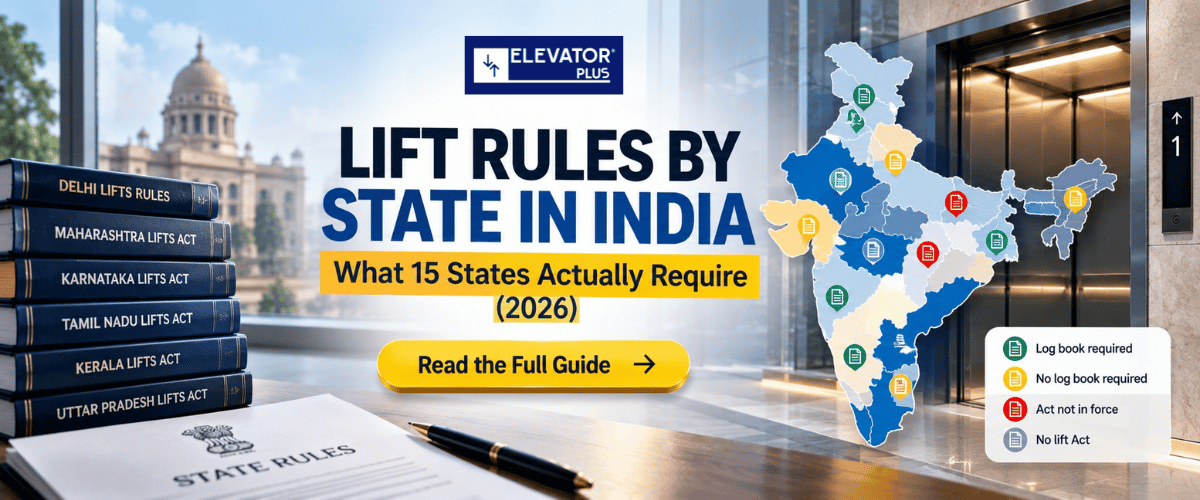
Lift Rules by State in India: What 15 States Actually Require (2026)
By Sumeet Katariya, ElevatorPlus ·
In short: India has no national lift law. Each state writes its own, and the states disagree on the three things a lift company runs on: which law applies, how often the government inspects, and whether a per-lift log book is required. We read the Acts and Rules of 15 states in September 2026. Delhi and Kerala carry no log book duty. Bihar and Jharkhand passed Acts that were never brought into force. Telangana has no lift Act at all.
Key takeaways
- There is no national lift law. Lifts are regulated state by state, so a company maintaining lifts in two states works under two rulebooks.
- Enacted is not in force. Bihar's 2024 Act and Jharkhand's 2017 Act were passed but never brought into force. Maharashtra's 2017 Act has never commenced either; the live law is the Maharashtra Lifts Act 1939 with the Bombay Lift Rules 1958.
- Government inspection runs from six months to five years. Delhi, Maharashtra and Himachal Pradesh inspect at least every six months. West Bengal inspects at least every five years. Uttar Pradesh inspects on complaint only.
- Two states have no log book duty. Delhi and Kerala. In Telangana, Bihar and Jharkhand, the only record duty is the one written into your own maintenance contract.
- Tamil Nadu changed on 3 February 2026. Its amended Act is in force, and visit records are uploaded at every visit.
What this guide covers: Is there a national lift law · The 15-state table · Acts that are not in force · Log books · Inspection intervals · What it means for your AMC book · FAQs
Is there a national lift law in India?
No. No central Act regulates lift licensing, inspection or maintenance records. Each state legislates for itself, and several have not legislated at all.
That matters more than it sounds. A company with AMCs in Pune and Bengaluru answers to the Maharashtra Lifts Act 1939 in one city and the Karnataka Act of 2012 in the other. The visit you log, the inspection you prepare for and the register you keep all change at the state border.
Lift rules in 15 Indian states, side by side
Read from Act and Rules text in September 2026. Rules change by notification, so check your state's current position before relying on any single cell.
| State | Law in force today | Government inspection | Per-lift log book |
|---|---|---|---|
| Andhra Pradesh | Lifts and Escalators Act 2025, Rules notified March 2025 | At licensing and at five-year renewal | Yes |
| Assam | Lifts and Escalators Act 2006, Rules 2010 | Every 3 years | Yes |
| Bihar | Lift and Escalators Act 2024, enacted but not in force | Not in force | Not in force |
| Delhi | Bombay Lifts Act 1939 as extended, Delhi Lifts Rules 1942 (amended 2017) | At least every 6 months | No |
| Gujarat | Lifts and Escalators Act 2000 as amended, Rules 2001 as amended | Every 5 years, plus the owner's yearly test by an authorised person | Yes |
| Haryana | Lifts and Escalators Act 2008 as amended, Rules 2009 | Every 3 years | Yes |
| Himachal Pradesh | Lifts Act 2007, Rules 2009 | At least every 6 months | Yes |
| Jharkhand | Lift and Escalators Act 2017, enacted but not in force | Not in force | Not in force |
| Karnataka | Lifts, Escalators and Passenger Conveyors Act 2012, Rules 2015 | Yearly | Yes |
| Kerala | Lifts and Escalators Act 2013 (amended 2018), Rules 2012 | Licence for 3 years, then yearly | No |
| Maharashtra | Maharashtra Lifts Act 1939, Bombay Lift Rules 1958 | At least every 6 months | Yes |
| Tamil Nadu | Lifts and Escalators Act 1997, amended 2025, in force 3 February 2026 | Allotted through the state portal | Yes, uploaded at every visit |
| Telangana | No lift Act | None | None |
| Uttar Pradesh | Lifts and Escalators Act 2024, Rules 2024 | On complaint only | Yes |
| West Bengal | Lifts, Escalators and Travelators Act 2019, Rules 2022 | At least every 5 years | Yes |
Which states have a Lift Act that is not in force?
Three Acts on this list describe nothing today.
An Act comes into force when the state notifies a commencement date. Until then, its licence periods, inspection cycles and penalties are text, not law.
- Bihar, Lift and Escalators Act 2024: passed, never brought into force.
- Jharkhand, Lift and Escalators Act 2017: passed, never brought into force.
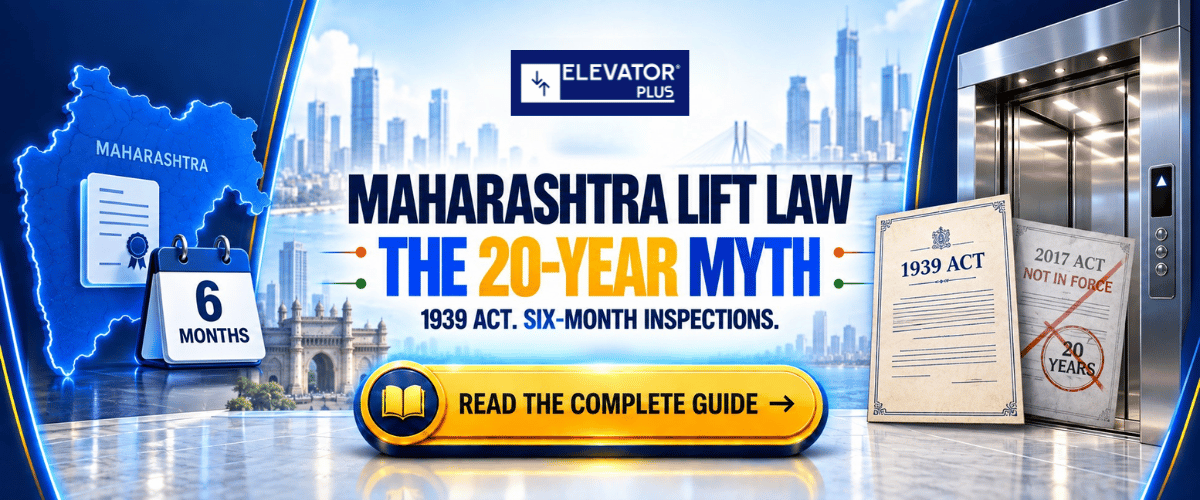
- Maharashtra, Lifts, Escalators and Moving Walks Act 2017: never commenced. Maharashtra still runs on the Maharashtra Lifts Act 1939, which requires every lift to be inspected at least once in six months (section 11). We traced this in full in The Maharashtra Lift Act Everyone Quotes Has Never Come Into Force.
Quoting a not-in-force Act as current law is the most common error in Indian lift compliance copy. It shows up in vendor brochures, tender documents and AMC proposals.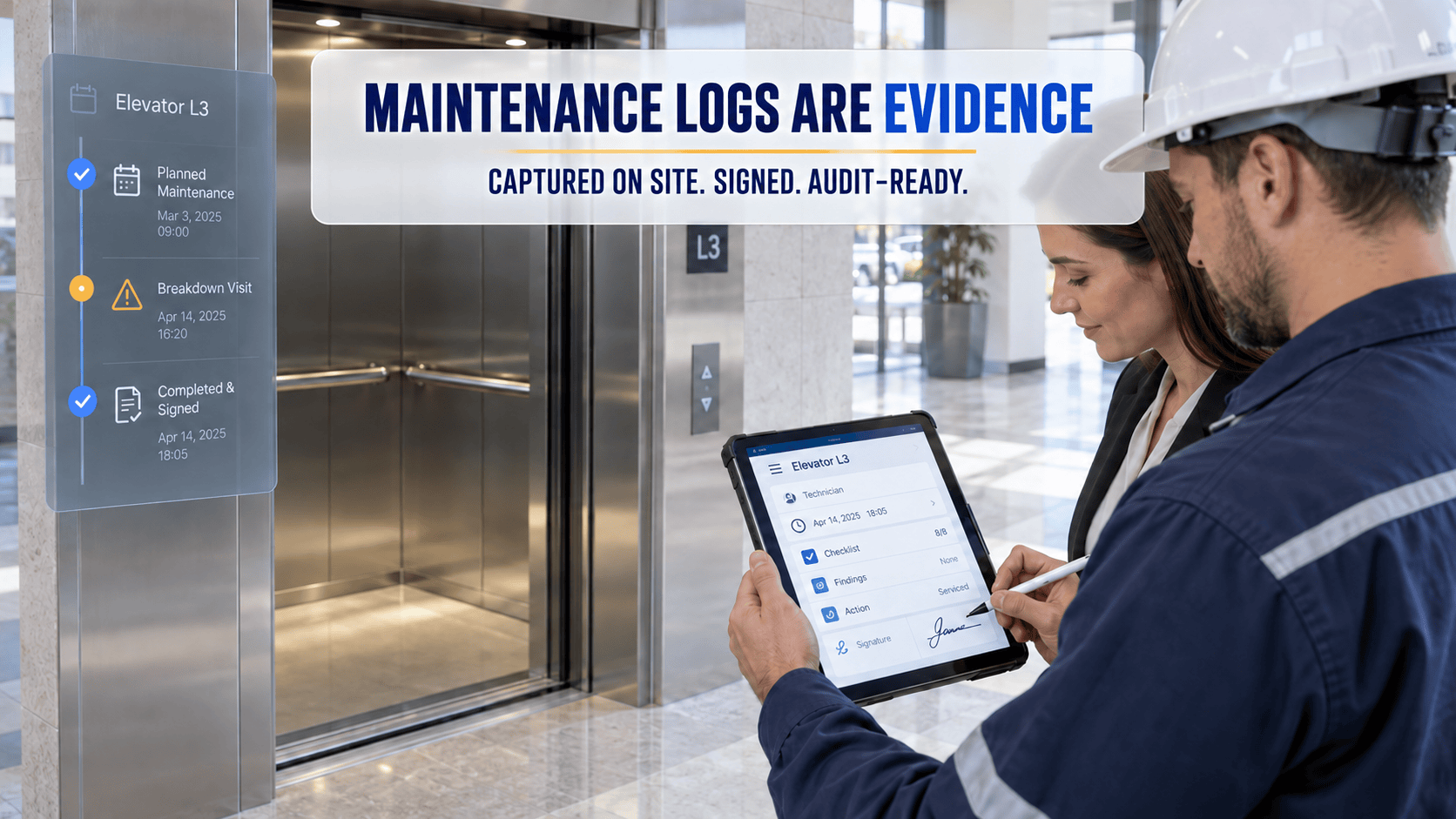
Which states do not require a per-lift log book?
Delhi and Kerala, of the 15 we read. Telangana, Bihar and Jharkhand have no Act in force, so they carry no statutory log book duty either.
In those five states, your maintenance contract is the only record rule. That is thinner protection than it sounds.
In 2026 the Supreme Court looked at what a lift maintenance contractor could produce after a fatal accident. It found the contractor "produced no attendance register, duty chart, log book, or other contemporaneous record". Its own contract had required all of them, and their absence "does not assist its case". The court held that a party undertaking the comprehensive maintenance of a lift owes its users a heightened duty of care.
No state rule forced that contractor to keep a register. Its contract did, and the missing records counted against it.
How often does the government inspect lifts in each state?
| Interval | States |
|---|---|
| At least every 6 months | Delhi, Maharashtra, Himachal Pradesh |
| Yearly | Karnataka; Kerala after the first three-year licence |
| Every 3 years | Assam, Haryana |
| Every 5 years or at least every 5 years | Gujarat, West Bengal |
| At licensing and five-year renewal | Andhra Pradesh |
| Allotted through the state portal | Tamil Nadu |
| On complaint only | Uttar Pradesh |
| None | Telangana; Bihar and Jharkhand until their Acts commence |
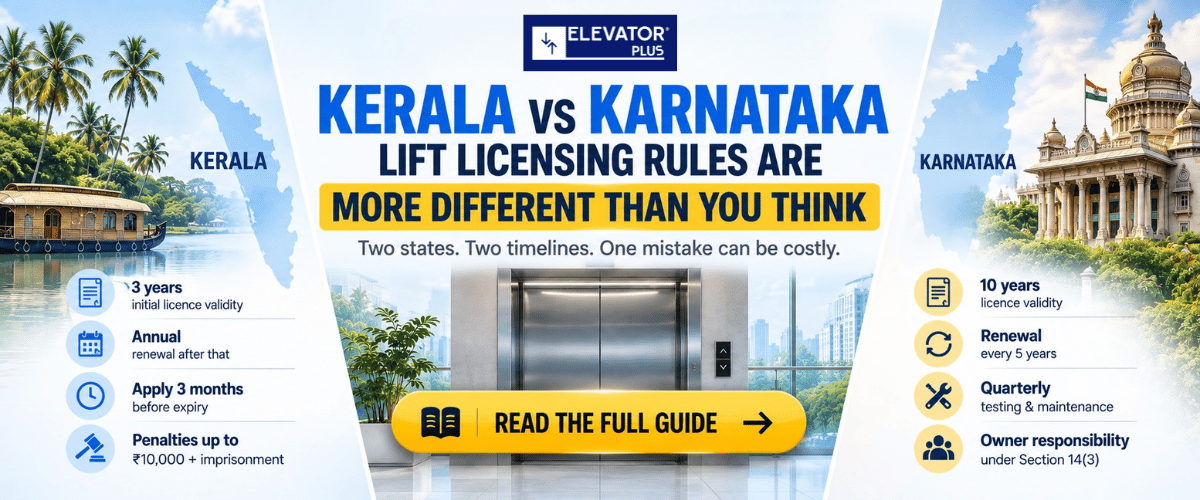
Karnataka is the state that catches people out. The government inspects once a year (Rules 2015, rule 17(1)). Separately, the owner must get the lift tested and maintained by a registered person once in every three months (Act 2012, section 14(3), carried into rule 12(4)(i)). Those are two clocks, not one.
Gujarat runs two clocks as well, and it is the state most often quoted wrongly. The 2000 Act said every three years. Since the Gujarat Lifts and Escalators (Amendment) Act 2013, a government Assistant Inspector inspects every five years from the grant of the licence (section 16(1)(b)), and the licence itself is valid for five years. Separately, the owner must get the lift inspected and tested by an authorised person once a year (section 16(2)), down from every six months in the original text. Anyone quoting three years or six months for Gujarat is reading the 2000 text.
What does this mean for a company running AMCs across states?
Three changes, in order of how much money they protect.
1. Build one checklist per state, not one national template. A Bengaluru visit and a Delhi visit should not capture the same fields. The Karnataka visit needs the quarterly test recorded. The Delhi visit has no statutory log book, so your own contract decides what gets written.
2. Record every visit, even where the state does not ask. In Delhi, Kerala and Telangana, the record you keep is the only record that exists. A court, an inspector or a customer's lawyer will ask for it whether or not a rule did.
3. Run the state's clock separately from your PM clock. Your preventive maintenance cycle is commercial. The state inspection cycle is statutory. When both live in one spreadsheet column, one of them gets missed.
👉 Running lifts in more than one state? See how inspection checklists are set up for each state →
In ElevatorPlus, each customer builds its own checklists and tracks AMC, breakdown and inspection visits against them. A company working in Maharashtra and Karnataka runs two checklists in one system. AMC renewal reminders go out 60 days, 30 days and 1 day before expiry.
Frequently asked questions
1. Is there a central lift Act in India?
No. Lift licensing, inspection and records are set by each state. Several states have no lift Act.
2. Which states require a per-lift log book?
Of the 15 states we read, every state with an Act in force requires one, except Delhi and Kerala.
3. Is the Maharashtra Lifts, Escalators and Moving Walks Act 2017 in force?
No. It has never commenced. Maharashtra operates under the Maharashtra Lifts Act 1939 and the Bombay Lift Rules 1958.
4. How often must lifts be inspected in Karnataka?
The government inspects once a year. The owner must also have the lift tested and maintained by a registered person once in every three months.
5. How often are lifts inspected in Gujarat?
A government Assistant Inspector inspects every five years from the grant of the licence, under the Act as amended in 2013. The owner must also get each lift inspected and tested by an authorised person once a year.
6. Does Telangana have a lift Act?
No lift Act was in force when we read the state's law in September 2026. The only record obligation is the one in your maintenance contract.
7. What changed in Tamil Nadu in 2026?
The amended Lifts and Escalators Act came into force on 3 February 2026. Inspections are allotted through the state portal, and records are uploaded at every visit.
8. Did the 2026 Supreme Court judgment create a national lift law?
No. It gave no direction to any government and ordered no legislation. It held that a lift is to be treated as a common carrier, and that a party undertaking comprehensive maintenance owes users a heightened duty of care.
📲 Join our WhatsApp channel for compliance tips, updates: ElevatorPlus - Business Automation Tool
India runs fifteen different lift rulebooks in the fifteen states we read, and more in the states we have not. The differences are not small print. They decide how often an inspector arrives, whether a log book is a legal duty, and whether the Act you are quoting exists at all.
The safest operating rule is also the simplest: write it down everywhere, whatever the state asks. Where a state requires records, you comply. Where it does not, you are the only one with evidence.
The cost of getting this right is a checklist per state. The cost of getting it wrong showed up in a courtroom in 2026.
👉 Find where your AMC book is leaking in 30 minutes. Book the Revenue Leak Walk-Through →
Related reading
- Kerala and Karnataka Lift Compliance: Two States, Two Completely Different Clocks
- The Maharashtra Lift Act Everyone Quotes Has Never Come Into Force
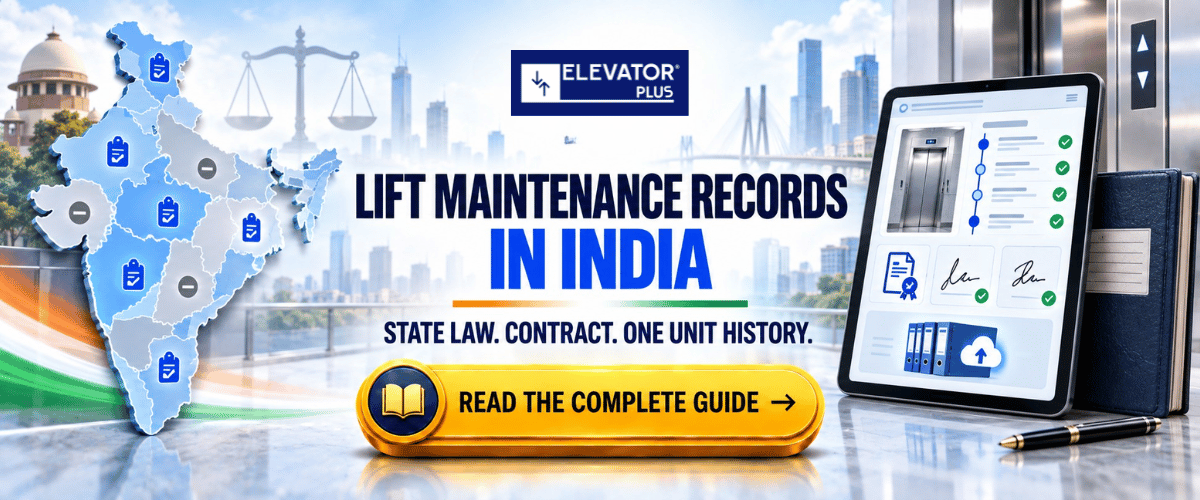
- What Records Must an Indian Elevator Company Keep?
- Lift AMC Rates in India, What Changed in 2026
- Elevator Service Software for India
About the author. Sumeet Katariya is the founder of ElevatorPlus, the Elevator Business Operating System used by 200+ elevator companies across 20+ countries.
Sources: Andhra Pradesh Lifts and Escalators Act 2025 · Assam Lifts and Escalators Act 2006 and Rules 2010 · Bihar Lift and Escalators Act 2024 · Bombay Lifts Act 1939 as extended to Delhi and Delhi Lifts Rules 1942 · Gujarat Lifts and Escalators Act 2000 and Rules 2001, as amended by the Gujarat Lifts and Escalators (Amendment) Act 2013 (Gujarat Act 13 of 2013) · Chief Electrical Inspector, Government of Gujarat, lift FAQs (read 2 October 2026) · Haryana Lifts and Escalators Act 2008 and Rules 2009 · Himachal Pradesh Lifts Act 2007 and Rules 2009 · Jharkhand Lift and Escalators Act 2017 · Karnataka Lifts, Escalators and Passenger Conveyors Act 2012 and Rules 2015 · Kerala Lifts and Escalators Act 2013 · Maharashtra Lifts Act 1939 and Bombay Lift Rules 1958 · Tamil Nadu Lifts and Escalators Act 1997 as amended · Uttar Pradesh Lifts and Escalators Act 2024 and Rules 2024 · West Bengal Lifts, Escalators and Travelators Act 2019 and Rules 2022 · Supreme Court of India, 2026 INSC 756, 29 July 2026.
👉 Follow ElevatorPlus on,
Instagram LinkedIn Facebook YouTube Qoura Substack Twitter