
Lift Licence Rules by State in India: 8 States Compared
Lift Licence Rules by State: Maharashtra, Karnataka, Delhi, Gujarat, West Bengal, Telangana, Kerala and Tamil Nadu
By Mr. Sumeet Katariya, ElevatorPlus ·
In short: India has no national lift law. Each state writes its own, and the eight states where most of our customers work disagree on the three things that matter to a lift company: which Act is actually in force, how often the state inspects, and whether a per-lift log book is a legal duty. Maharashtra still runs on its 1939 Act, because the 2017 Act was never brought into force. Delhi and Kerala have no log book duty at all. Telangana has no lift Act. Tamil Nadu's amended Act came into force on 3 February 2026 and expects the log to be uploaded at every visit. This page gives the position state by state, read from the Act and Rules text, and what a licence holder has to be able to produce whichever state they are in.
Key takeaways
- Enacted is not in force. An Act that was passed but never commenced describes nothing. Maharashtra's 2017 Act is the example everyone quotes wrongly; the live law is the Maharashtra Lifts Act 1939 with the Bombay Lift Rules 1958.
- The inspection clock is set by the state. At least every six months in Maharashtra and Delhi, yearly in Karnataka, every five years in Gujarat, at least every five years in West Bengal, allotted through the portal in Tamil Nadu, none in Telangana.
- Two of the eight have no log book duty. Delhi and Kerala. Anyone writing "every state requires a log book" is wrong.
- Where there is no Act, the contract is the law. In Telangana the only record obligation is the one in your own maintenance agreement.
- Whatever the state, the record is per lift. The question an inspector, a client auditor or a court asks is the same: show me this lift.
What this guide covers: Why state by state · The eight states in one table · One section per state · What a licence holder has to be able to produce · What this page does not give you · FAQs
Why is lift law in India set state by state?
Lifts are a state subject in practice. There is no central Lifts Act, so each state that wanted one passed its own, at its own time, with its own definitions of who is licensed, who inspects and what is recorded. Some states passed an Act and then never issued the commencement notification that brings it into force. Some issued Rules decades after the Act. Some never legislated.
The practical consequence for a lift company is that the same lift, the same contract and the same technician carry different legal duties on either side of a state line. A company with a Pune head office and a Hyderabad branch is running under a 1939 Act in one city and no Act in the other.
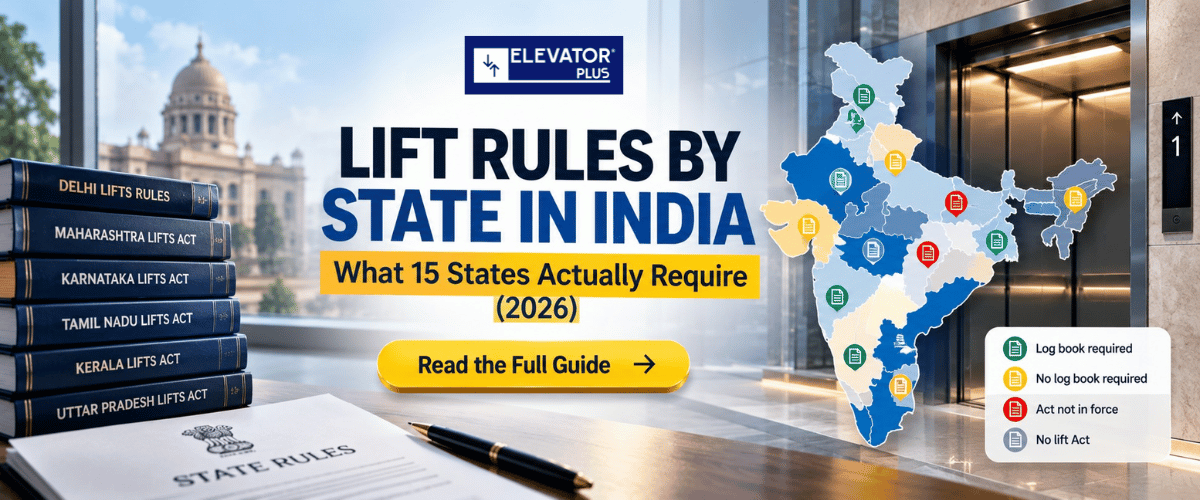
For the wider fifteen-state picture, see Lift Rules by State in India: What 15 States Actually Require (2026). This page goes deeper on the eight states where our customers are concentrated.
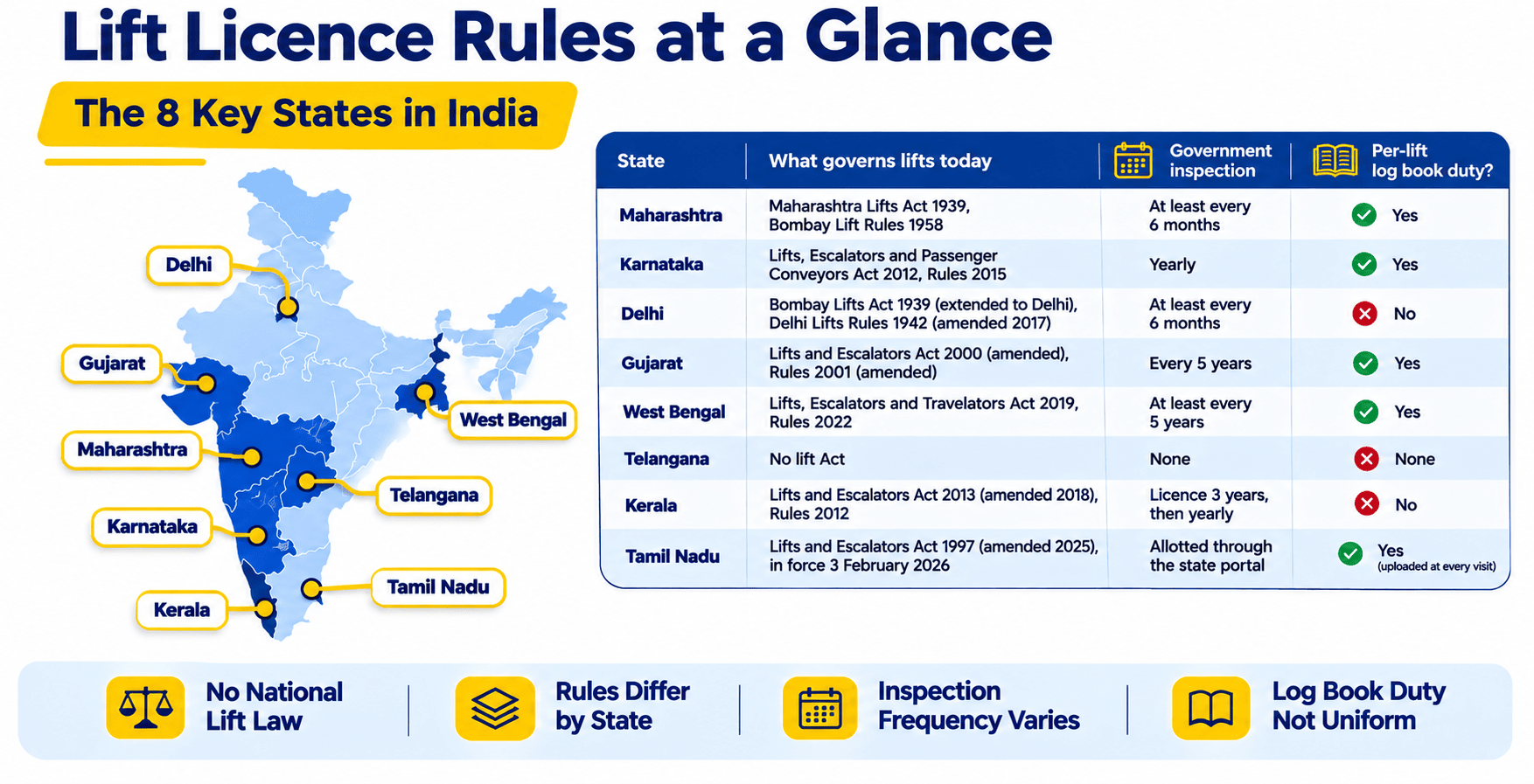
The eight states in one table
| State | What governs lifts today | Government inspection | Per-lift log book a legal duty? |
|---|---|---|---|
| Maharashtra | Maharashtra Lifts Act 1939, Bombay Lift Rules 1958 | At least every 6 months | Yes |
| Karnataka | Lifts, Escalators and Passenger Conveyors Act 2012, Rules 2015 | Yearly | Yes |
| Delhi | Bombay Lifts Act 1939 as extended to Delhi, Delhi Lifts Rules 1942, amended 2017 | At least every 6 months | No |
| Gujarat | Lifts and Escalators Act 2000 as amended, Rules 2001 as amended | Every 5 years | Yes |
| West Bengal | Lifts, Escalators and Travelators Act 2019, Rules 2022 | At least every 5 years | Yes |
| Telangana | No lift Act | None | None |
| Kerala | Lifts and Escalators Act 2013 as amended 2018, Rules 2012 | Licence 3 years, then yearly | No |
| Tamil Nadu | Lifts and Escalators Act 1997 as amended 2025, in force 3 February 2026 | Allotted through the state portal | Yes, uploaded at every visit |
Read from the Act and Rules text, September 2026. Fees, renewal deadlines, penalties and form numbers are deliberately not on this page; see the last section.
Maharashtra
The law in force is the Maharashtra Lifts Act 1939 with the Bombay Lift Rules 1958. The Maharashtra Lifts, Escalators and Moving Walks Act 2017 was passed but has never been brought into force, so its licence periods and penalties are not current law, however often they are quoted.
Government inspection is at least every six months. A per-lift log book is a duty. For a Pune or Mumbai lift company that means two inspection visits a year per lift, and a log that has to be producible at each one.
Karnataka
The Karnataka Lifts, Escalators and Passenger Conveyors Act 2012 with the Rules of 2015. Government inspection is yearly, and the per-lift log book is a duty. Bengaluru companies with several hundred lifts under maintenance are therefore running several hundred yearly inspection dates, each needing a log that is current on the day.
Delhi
Delhi is the one that surprises people. The governing law is the Bombay Lifts Act 1939 as extended to Delhi, with the Delhi Lifts Rules 1942, amended in 2017. Inspection is at least every six months. There is no per-lift log book duty in the Delhi Rules.
That does not mean a Delhi lift company should run without one. It means the record you keep is set by your maintenance contract and your own standard, not by the state, and a client auditor will ask for it regardless. The reason to keep it is in the audit section below.
Gujarat
The Gujarat Lifts and Escalators Act 2000 as amended, with the Rules of 2001 as amended. Government inspection is every five years, and the per-lift log book is a duty. A five-year inspection interval is the longest in this table; it shifts the weight of evidence onto the company's own records between inspections.
West Bengal
The West Bengal Lifts, Escalators and Travelators Act 2019, with Rules notified in 2022. Government inspection is at least every five years. The per-lift log book is a duty. The 2022 Rules are recent enough that many Kolkata companies are still bringing their records into line with them.
Telangana
Telangana has no lift Act in force. There is no state inspection and no statutory log book. In Telangana, as in Bihar and Jharkhand (where Acts were enacted but never commenced), the only record obligation a lift company carries is the one written into its own maintenance contract.
A Hyderabad lift company is therefore not exempt from keeping records. It is exempt from being told what to keep. What it keeps is decided by what its customers' contracts say, and by what it would need to show if a lift it maintains injured someone. The Supreme Court's 2026 lift judgment turned on exactly that: the contractor "produced no attendance register, duty chart, log book, or other contemporaneous record", its own contract had required all of them, and their absence "does not assist its case".
Kerala
The Kerala Lifts and Escalators Act 2013, as amended in 2018, with the Rules of 2012. The licence runs three years, then yearly. There is no per-lift log book duty in the Kerala Rules. As in Delhi, the record is set by contract and by the company's own standard.
Tamil Nadu
The Tamil Nadu Lifts and Escalators Act 1997 as amended in 2025, in force from 3 February 2026. Inspections are allotted through the state portal rather than on a fixed calendar interval. The per-lift log book is a duty, and the amended regime expects it uploaded at every visit. Chennai companies are the first in this table working to a portal-driven, visit-by-visit record rather than a book on site.
👉 Which of your lifts could pass a state inspection today, from the record alone? See how a per-lift record is kept in ElevatorPlus, set up aligned to your state's Act →
What does a licence holder have to be able to produce, whatever the state?
The eight states disagree on who inspects and how often. They agree, in effect, on the question that gets asked: show me this lift. An inspector in Mumbai, a client's auditor in Hyderabad and a court anywhere all ask for a per-lift record, not a monthly summary.
| What is asked for | Where it has to come from |
|---|---|
| Every planned maintenance visit on this lift, dated, with who attended | The lift's own record, not the technician's memory |
| Every breakdown on this lift, dated, with the fault and the part replaced | The same record, in date order |
| The current licence or permit, and the last inspection date | The lift's file |
| The contract that governs the lift, with its scope and dates | The contract book, linked to the lift |
| The checklist used at each visit, as the state's Act or your contract requires | Configured once per state, attached to every visit |
If any of those five lives in a different place (a register in the office, a WhatsApp group, a technician's phone), the record exists but cannot be produced on the day. That gap, not the absence of records, is what most companies discover at their first audit. We cover the audit itself in Elevator Audit Readiness: The Records an Inspector or Auditor Asks For (live 26 November).
How ElevatorPlus handles state-by-state requirements ?
Every service visit and breakdown is held against the lift, with the contract linked, so "show me this lift" is one screen. Checklists are fully configurable and are set up aligned to the state the lift is in: the Maharashtra checklist is not the Karnataka checklist, and a company with branches in both runs both. ElevatorPlus does not certify compliance and does not ship a "compliance module"; the state's Act is yours to meet, and the record is what lets you show that you met it.
What this page does not give you, and why
Inspection fees, licence renewal deadlines, penalties, accident-reporting windows, form numbers and who may legally maintain a lift vary by state and change by notification. We hold those in a state-by-state reference that we release on request rather than on a web page, because a wrong figure on a public page outlives its correction. Comment STATE on any of our posts, or ask on the Walk-Through, and we will send the current position for your state with the date it was read.
Frequently asked questions
1. Does India have a national lift law?
No. Lift law is set state by state. Some states have an Act in force, some have an Act that was enacted but never commenced, and some have no Act.
2. Is the Maharashtra Lifts, Escalators and Moving Walks Act 2017 in force?
No. It was passed but never brought into force. The live law in Maharashtra is the Maharashtra Lifts Act 1939 with the Bombay Lift Rules 1958.
3. Which of these eight states has no lift Act?
Telangana. The only record obligation there is the one in the company's own maintenance contract.
4. Which states in this table do not require a per-lift log book?
Delhi and Kerala. The other states with an Act in force treat the log book as a duty.
5. How often does the state inspect a lift?
At least every six months in Maharashtra and Delhi, yearly in Karnataka, every five years in Gujarat, at least every five years in West Bengal, allotted through the portal in Tamil Nadu, and not at all in Telangana.
6. Where are the fees and renewal deadlines?
Held in our state-by-state reference, released on request with the date it was read, because they change by notification.
📲 Join our WhatsApp channel for compliance tips, updates: ElevatorPlus - Business Automation Tool
Eight states, eight sets of rules, and one question underneath all of them: can you show this lift's history on the day it is asked for? Know which Act is actually in force where you work. Know whether the log book is a legal duty or a contractual one. Then keep the record per lift either way, because the state is not the only one who will ask.
👉 Book the 30-minute Revenue Leak Walk-Through and see your lifts set up to your state's checklist →
Related reading
- Lift Rules by State in India: What 15 States Actually Require (2026)
- Elevator Audit Readiness: The Records an Inspector or Auditor Asks For (live 26 November)
- The Year-End Audit for Lift Companies: AMC Book, Records, Stores and Cash
- Buying Another Elevator Company's Maintenance Book: A Due Diligence and Migration Checklist
- The Elevator Business Brief on LinkedIn: Before You Buy, Part 4, Does the vendor understand lifts? (25 November)
About the author. Mr. Sumeet Katariya is the Founder of Accucia Softwares Pvt Ltd and the Creator of ElevatorPlus, the Elevator Business Operating System used by 200+ elevator companies across 20+ countries.
Sources: Maharashtra Lifts Act 1939 and Bombay Lift Rules 1958 · Karnataka Lifts, Escalators and Passenger Conveyors Act 2012 and Rules 2015 · Bombay Lifts Act 1939 as extended to Delhi and Delhi Lifts Rules 1942 (amended 2017) · Gujarat Lifts and Escalators Act 2000 and Rules 2001, as amended · West Bengal Lifts, Escalators and Travelators Act 2019 and Rules 2022 · Kerala Lifts and Escalators Act 2013 (amended 2018) and Rules 2012 · Tamil Nadu Lifts and Escalators Act 1997 as amended 2025 · Maharashtra Lifts, Escalators and Moving Walks Act 2017 (not commenced). All read from Act and Rules text, September 2026. · Supreme Court of India, 2026 INSC 756, judgment dated 29 July 2026, for the quoted finding on records.
👉 Follow ElevatorPlus on,
Instagram LinkedIn Facebook YouTube Qoura Substack Twitter