
Delhi Lift Rules: No Log Book Duty. Keep One Anyway
Delhi Lifts Have No Log Book Duty. Keep One Anyway.
By Mr. Sumeet Katariya, ElevatorPlus ·
In short: Delhi lift rules do not require a per-lift log book. The law is the Bombay Lifts Act 1939 as extended to Delhi, with the Delhi Lifts Rules 1942 as amended in 2017. It sets a government inspection at least every six months and no log book duty. Your AMC is a different matter. In a 2026 Supreme Court case, the maintenance contractor could not produce records its own contract had required. Record every visit anyway, and write that duty into the contract.
Key takeaways
- Delhi has no statutory log book duty. The Act as extended to Delhi and the Delhi Lifts Rules set a government inspection at least every six months. Neither asks you to keep a per-lift book.
- Where the statute is silent, the AMC sets the standard. Your contract is the document that gets read when something goes wrong, and any records clause in it asks more than the Delhi rules do.
- The 2026 judgment shows what missing records look like in court. In 2026 the contractor "produced no attendance register, duty chart, log book, or other contemporaneous record", and its own contract had required all of them.
- Records outlive the people who wrote them. That case ran from a death in 2003 to a judgment in 2026. On our arithmetic, a record written today may be read 23 years from now.
- Fourteen fields per visit cover most questions. Lift, date, time on site, technician, work done, parts, defects, recommendations, status at departure and the customer's signature.
- The fix is a few lines in the AMC. Say what you record, who signs it, how fast you can produce it, and what happens to it when the contract ends.
What this guide covers: what Delhi lift rules require · who sets the standard when the statute is silent · what the court said about missing records · what to record at every visit · how to write it into the AMC · paper or software · how long to keep records · FAQs
What do Delhi lift rules actually require?
Less than most Delhi lift companies assume. Here is the full statutory position on the three questions that matter for records.
| Question | Delhi position |
|---|---|
| Law in force | Bombay Lifts Act 1939, as extended to Delhi, with the Delhi Lifts Rules 1942, as amended in 2017 |
| Government inspection | At least every six months |
| Per-lift log book | No duty |
Delhi is not unusual in having a lift law. It is unusual in what that law leaves out. Of the fifteen states we read, Delhi and Kerala are the two with a lift law in force and no log book duty. The full state-by-state picture is in Lift Rules by State in India: What 15 States Actually Require (2026).
So a Delhi lift company that keeps no per-lift book is not breaking the Delhi rules. That is the comfortable reading. The rest of this article is about why it is the wrong one to run a business on.
If the state is silent, who sets the standard?
Your AMC does.
A comprehensive AMC is a promise to keep a machine safe for people who have no control over it. The contract usually says how often you attend, how fast you respond to a breakdown, and what you hand over at the end of a visit. Those obligations bind you whether or not the Delhi rules mention them.
The government inspection twice a year is a snapshot. Between those two dates, the only continuous account of what happened to that lift is the one your technicians write. If they write nothing, there is no account.
That matters more since July 2026. The Supreme Court held that a lift is to be treated as a common carrier. The reason it gave: a passenger steps into a machine over which they have no control. It held that the manufacturer, the operator and the owner of the premises are duty bearers, jointly and severally liable to safeguard the user. And it held that a party that undertakes the comprehensive maintenance of a machine of that kind owes its users a heightened duty of care.
The court upheld compensation of Rs 3,01,48,195 to a family, with interest running from the date of death in 2003. That is compensation, not a fine. The court gave no direction to any government and ordered no new legislation.
What did the court say about missing records?
This is the part every Delhi AMC company should read twice.
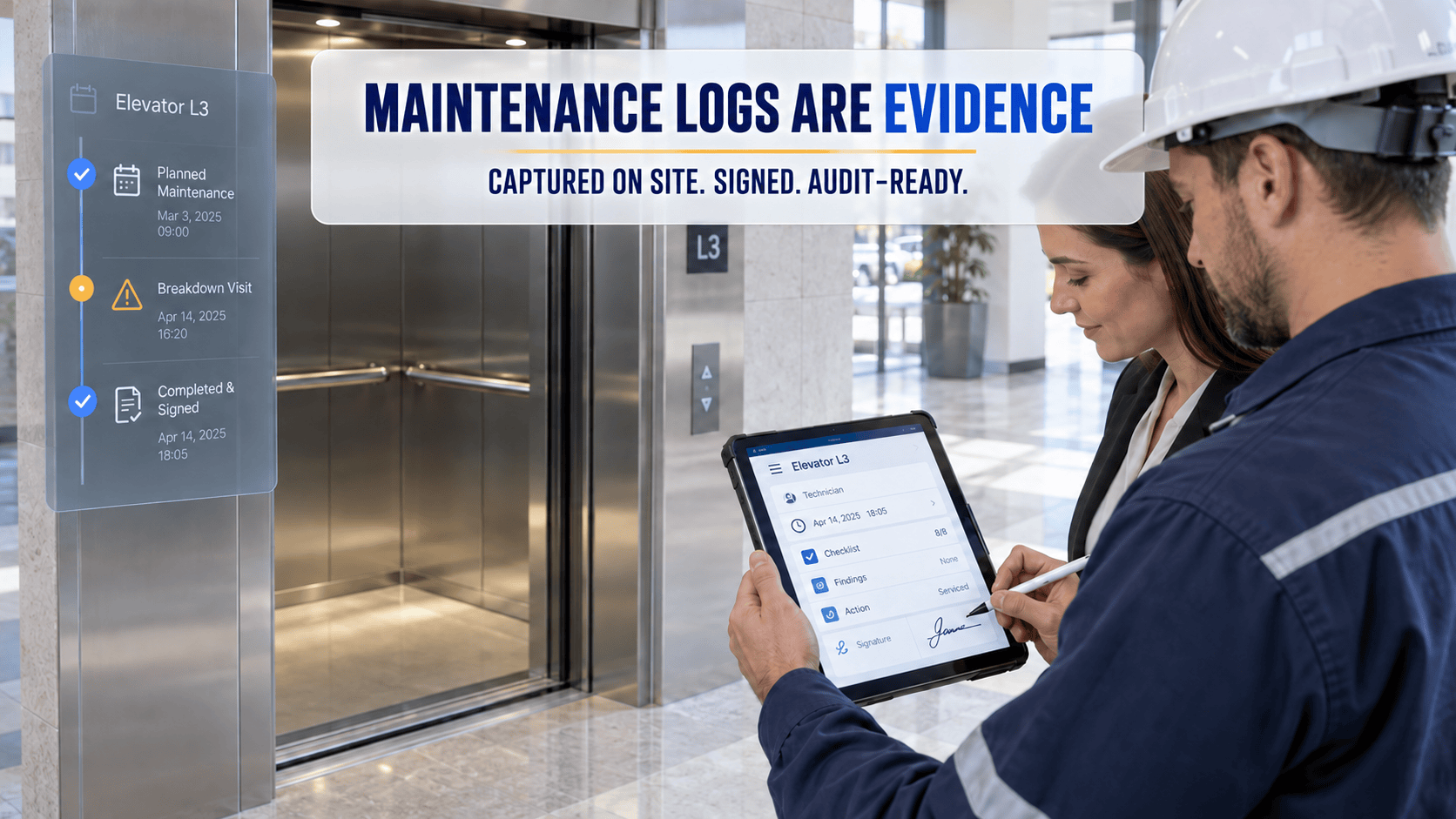
The judgment records that the contractor "produced no attendance register, duty chart, log book, or other contemporaneous record". Its own contract had required all of them. The court said their absence "does not assist its case".
Read that against the Delhi table above. The records the contractor could not produce were the ones it had agreed in writing to keep. A contract can ask for what a statute does not.
The practical lesson is narrow and uncomfortable. If your AMC says you keep a register, a duty chart or a log book, you are keeping it whether Delhi requires it or not. If it does not say so, you still need an answer, years later, to one question: "was your technician there, and what did they do?"
What should a Delhi lift company record at every visit?
Fourteen fields. They take a technician a few minutes at the end of a visit. They answer almost every question a customer, an inspector or a lawyer will ask later.
| # | Field | Why it matters later |
|---|---|---|
| 1 | Lift identifier and site address | Ties the record to one machine, not one building |
| 2 | Visit type: preventive, breakdown, complaint or inspection support | Shows the pattern of visits on that lift |
| 3 | Date, arrival time and departure time | Proves attendance, the first thing anyone asks |
| 4 | Technician name | Shows who was responsible on the day |
| 5 | Complaint reference and time the call was received | Shows response time on breakdowns |
| 6 | Checklist items worked, with the result of each | Shows what was checked, not just that someone came |
| 7 | Defects found | Puts the condition of the lift on record |
| 8 | Parts fitted or replaced | Links the machine's history to your stock and billing |
| 9 | Recommendations made in writing | Shows you told the customer what the lift needed |
| 10 | The customer's response to each recommendation | Shows who decided not to act |
| 11 | Whether the lift was left in service, and why | Records the call you made before you left |
| 12 | Photographs where a component was touched | Shows the condition before and after |
| 13 | Customer representative's name and signature | Turns your account into a shared one |
| 14 | Next visit due | Shows the schedule was being kept |
Two of these carry more weight than the rest. Field 10 records who decided not to spend the money. Field 11 records the judgement your technician made at the lift. Never sign a lift off as fit for use while your own written recommendation on it is still open.
Keep a short unit record alongside the visit log as well: the date of the last government inspection, the next one due, and any open defect from it. With an inspection at least every six months, that date is the one most likely to be missed when a technician leaves.
How do you make the AMC say it?
Add a records clause. Plain language is better than legal language here, because your technicians and your customer's facility manager both need to understand it.
Five lines cover most of it:
- "The Contractor will record every visit to each lift, including date, time on site, technician, work done, parts fitted and defects found."
- "Each visit record will be acknowledged at site by the Customer's representative."
- "Written recommendations will be recorded against the lift, together with the Customer's response."
- "The Contractor will provide the visit history for any lift within [number] working days of a written request."
- "Records will be kept for the life of the lift under this contract, and handed over in a readable format if the contract ends."
Clause 3 protects you most. When a customer declines a recommended repair, the record shows it was made and declined. Clause 4 forces you to be able to produce the records, which is a different discipline from writing them. We go through the other clauses that decide whether an AMC makes money in the clauses that decide whether a lift AMC makes money.
This is general guidance, not legal advice. Have your advocate review any wording before it goes into a contract.
👉 Could you produce twelve months of visits on one Delhi lift this afternoon, without calling three people? See per-lift inspection records and checklists →
Paper register or software?
A paper register filled in at the lift and stored properly will hold up. Nothing in the Delhi rules requires a digital record, because the Delhi rules require no record at all.
Paper does not usually fail because someone stops writing. It fails because the record scatters. The visit goes in a book at the site. The part goes in a message to the store. The signature is on a slip in a technician's bag. Each piece exists, and none of them can be produced together for one lift on one afternoon.
In ElevatorPlus, the technician opens the job at the lift and works through a checklist you configure to your own AMC. The technician attaches photographs, takes the customer's signature on the phone, and closes the visit. The record sits on that lift's history. The technician app works in Hindi and 17 other languages, so the person writing the record can write it properly. AMC renewal reminders go out 60 days, 30 days and 1 day before expiry. Digital signatures on the service report at site replace the slip in the bag.
How long should a Delhi lift company keep records?
Keep them for the life of the lift, not the life of the contract.
The case above began with a death in 2003 and ended with a judgment in 2026. That is 23 years. The arithmetic is ours, not a finding of the court, but it is the honest planning horizon. A visit your technician records this week may be read by someone who has never met them.
That is the strongest argument for writing the record where the work happens. People leave. Phones change. Branch offices move. A record attached to the lift survives all three.
Frequently asked questions
1. Do Delhi lift rules require a log book?
No. The Bombay Lifts Act 1939 as extended to Delhi, and the Delhi Lifts Rules 1942 as amended in 2017, impose no per-lift log book duty.
2. How often are lifts inspected in Delhi?
Under the Delhi lift law, a government inspection is due at least every six months.
3. Which law governs lifts in Delhi?
The Bombay Lifts Act 1939, as extended to Delhi, with the Delhi Lifts Rules 1942, as amended in 2017.
4. If there is no log book duty, why keep visit records?
Because your AMC usually requires them. In the 2026 Supreme Court case, the contractor could not produce records its own contract had required.
5. What did the Supreme Court say about missing maintenance records?
It recorded that the contractor "produced no attendance register, duty chart, log book, or other contemporaneous record". Its own contract had required all of them. The court said their absence "does not assist its case".
6. Was the Rs 3,01,48,195 a fine?
No. It was compensation to a family, upheld by the Supreme Court, with interest running from the date of death in 2003.
7. What should a Delhi AMC say about records?
What is recorded at each visit, and who signs it at site. How recommendations and the customer's response are recorded. How fast records can be produced, and what happens to them when the contract ends.
8. Is a paper register enough in Delhi?
Yes, if it is filled in at the lift, signed at site and stored so that one lift's history can be produced quickly. The usual failure is records scattered across books, messages and slips, not paper itself.
📲 Join our WhatsApp channel for compliance tips, updates: ElevatorPlus - Business Automation Tool
The Delhi rules let you keep no log book. That is a statement about the statute, not about your exposure.
A comprehensive AMC carries a heightened duty of care. In the 2026 Supreme Court case, the contractor's own contract had required the records it could not produce. In Delhi, where the statute asks for nothing, the contract is the standard you are held to.
Write the fourteen fields at every visit. Put the records clause in every AMC you sign from now on. The company that can produce one lift's history in an afternoon is not the one with the better memory. It is the one that wrote it down at the lift.
Related reading
- Lift Rules by State in India: What 15 States Actually Require (2026)
- Elevator Maintenance Records in India: What You Must Keep
- Maharashtra's Lift Act 2017 Has Never Come Into Force
- Kerala and Karnataka Lift Compliance: Two Different Clocks
- The Clauses That Decide Whether a Lift AMC Makes Money
About the author. Mr. Sumeet Katariya is the founder of ElevatorPlus, the Elevator Business Operating System used by 200+ elevator companies across 20+ countries.
Sources: Bombay Lifts Act, 1939, as extended to Delhi · Delhi Lifts Rules, 1942, as amended in 2017 · Supreme Court of India, 2026 INSC 756, 29 July 2026.
👉 Follow ElevatorPlus on,
Instagram LinkedIn Facebook YouTube Qoura Substack Twitter