
The Lift Register: What to Record for Every Lift
The Lift Register: What to Record for Every Lift You Maintain
By Mr. Sumeet Katariya, ElevatorPlus ·
In short: A lift register is one record per lift you maintain, holding the facts that rarely change. Record six groups: identity, specification, statutory position, contract, service set-up and documents. It is not the log book. The log book records each visit; the register says which lift the visit was on. Give every lift an ID you never reuse, name an owner for every field, and test the register by filling ten lifts in one hour.
Key takeaways
- The register and the log book are different records. The register holds one row per lift. The log book holds one entry per visit, breakdown or repair.
- Every lift needs an ID you never reuse. "Tower B, Lift 2" is the customer's name for it. Your ID survives a change of building name, owner or AMC.
- Statutory dates belong in the register, not in a diary. Licence validity differs by state: ten years in Karnataka, three years in Kerala.
- Each field needs an owner. The installation team fills the specification, the office fills the contract, and the technician confirms access details on the first visit.
- A register you cannot fill in an hour for ten lifts is not a register. It is a set of files in different places.
What this guide covers: Register vs log book · The six field groups · Statutory fields by state · Who owns which field · Outside India · The one-hour test · FAQs
What is a lift register, and how is it different from a log book?
A lift register is your master list of every lift you maintain, with the facts about each one. A log book is the running record of what happened to that lift on each visit. Most lift companies keep the second and assume they have the first.
| Lift register | Log book | |
|---|---|---|
| One record per | Lift | Visit, breakdown or repair |
| How often it changes | Rarely: at handover, AMC renewal, licence renewal, major repair | Every visit |
| Who fills it | Office and installation team | Technician on site |
| Question it answers | What is this lift, whose is it, and what are we bound to do? | What did we do, when, and who did it? |
| What breaks without it | You cannot say how many lifts you maintain, by type, by branch or by expiry month | You cannot prove a visit happened |
The log book matters for the law and for disputes. We covered it in Elevator Maintenance Records in India: What You Must Keep. The register matters for running the business. It is where pricing, planning, renewals and staffing start.
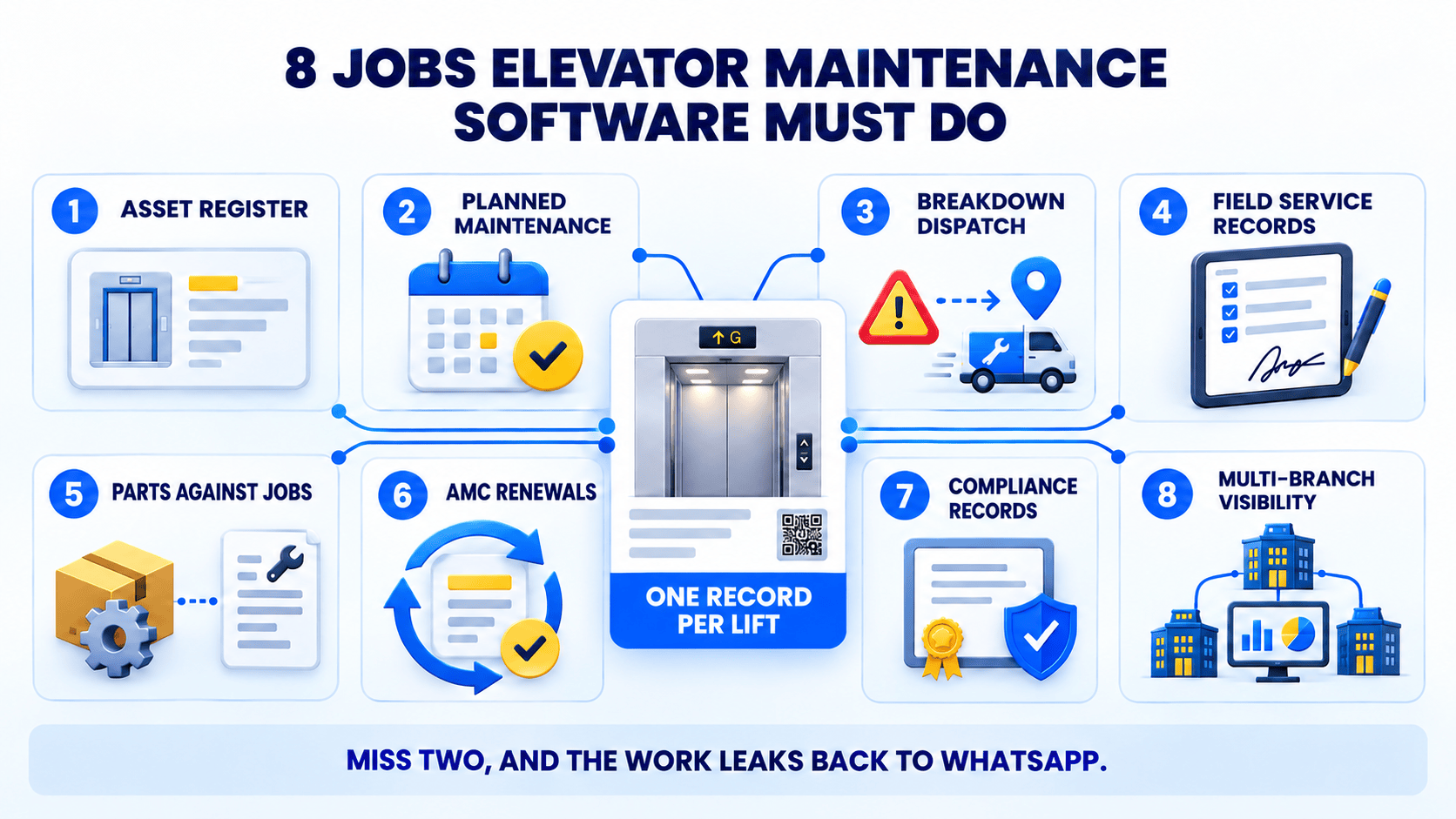
For the wider list of what your systems need to hold across AMC, service and stores, see Elevator Maintenance Software: What It Has to Do (2026).
What should a lift register record for every lift?
Six groups of fields. Around 30 fields in total. Not every lift will have every field on day one, but every field should have a place to go.
1. Identity
| Field | Why it matters |
|---|---|
| Your lift ID | Unique, permanent, never reused. Every visit, complaint and part links to it |
| Customer's name for the lift | "Tower B, Lift 2" or "Service lift, rear". What the caller will say on the phone |
| Building and full address | Where the technician goes |
| Site contact and phone | Who opens the machine room |
| Customer (owner, society or builder) | Who you bill and who signs |
| Branch and service area | Which team owns the lift |
2. Specification
| Field | Why it matters |
|---|---|
| Lift type | Passenger, goods, hospital, home, dumbwaiter. Decides checklist and visit time |
| Original manufacturer | Decides spares and who can supply them |
| Capacity | In kg and persons, as on the car plate |
| Stops and floors served | Affects visit time and door count |
| Machine room or machine room-less | Changes access and rescue procedure |
| Controller, machine and door operator details | Model and serial number of each, for spares |
| Year of installation | Drives your modernisation list |
3. Statutory position
| Field | Why it matters |
|---|---|
| State and the lift Act that applies | The rules differ by state |
| Licence number, where the state issues one | Proof the lift may be worked |
| Licence validity date | Ten years in Karnataka, three in Kerala, set by each state's Act |
| Last government inspection date | Where your state inspects on a cycle |
| Next inspection due | The date your customer will ask you about |
4. Contract
| Field | Why it matters |
|---|---|
| Contract type | Comprehensive or non-comprehensive AMC, warranty, or chargeable only |
| Start and end date | Drives the renewal list |
| Warranty end date, for lifts you installed | The day the AMC should start |
| Visits per year agreed | What you are bound to deliver |
| Parts position | What is included and what is chargeable |
| Billing cycle | Monthly, quarterly, yearly |
5. Service set-up
| Field | Why it matters |
|---|---|
| Assigned technician or route | Who goes |
| Visit day or week | When they go |
| Access rules | Key holder, permitted hours, society permissions |
| Known issues | Repeat faults or pending repairs a new technician should know |
6. Documents
| Field | Why it matters |
|---|---|
| Handover letter and test report | Proof of condition when you took it on |
| Licence copy | Proof for the customer and the inspector |
| AMC contract copy | What was actually signed |
| Drawings and wiring diagram | Needed on a breakdown at night |
For lifts you installed yourself, groups 2 and 6 come straight from the installation file. The sequence and the signatures are in
Lift Installation Stages in India: From Site Survey to Handover, and Who Signs Off Each One.
Which statutory fields depend on your state?
All of them. India has no national lift law, so the statutory group changes with the lift's address. Three examples from the Act text:
| State | What the register has to hold | Source |
|---|---|---|
| Karnataka | Licence validity: ten years, renewable every five. Government inspection once a year | Karnataka Lifts, Escalators and Passenger Conveyors Act 2012, section 5; Rules 2015, rule 17(1) |
| Kerala | Licence validity: three years, then renewed annually after an inspection | Kerala Lifts and Escalators Act 2013 as amended 2018, section 4(5) |
| Maharashtra | Inspection at least once in six months under the 1939 Act. No licence validity term stated in the Act or the 1958 Rules | Maharashtra Lifts Act 1939, section 11; Bombay Lift Rules 1958 |
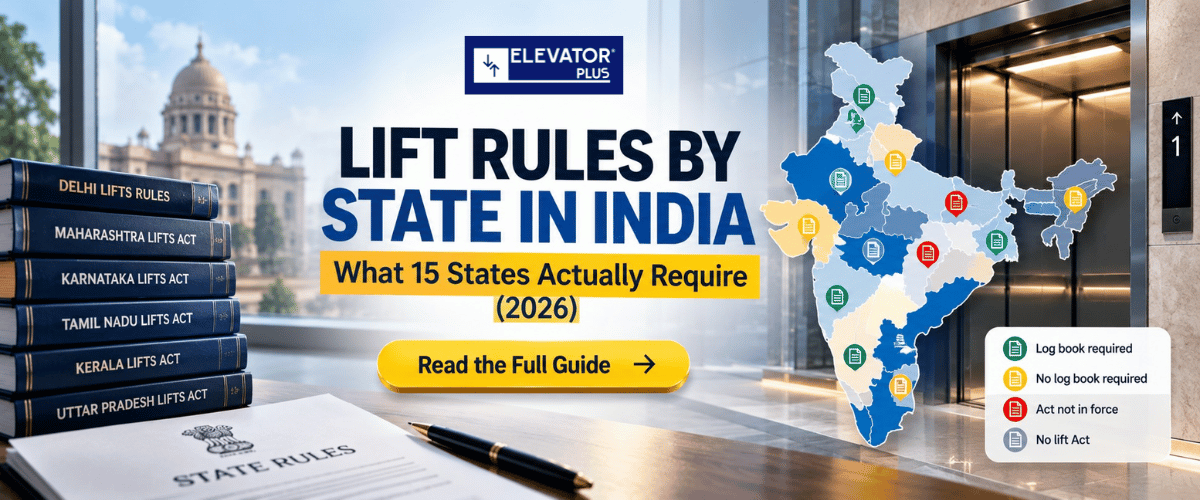
Telangana has no lift Act in force, so the statutory group stays empty there. The only record duty is the one in your own contract. For every other state, check your state's lift Act and Rules, or start with Lift Rules by State in India: What 15 States Actually Require (2026).
Who should own each part of the register?
A register decays when nobody owns it. Fields get filled once at handover and never touched again. Assign each group to a role, with the event that triggers an update.
| Group | Owner | Update when |
|---|---|---|
| Identity | Office | New lift taken on, site contact changes |
| Specification | Installation team, or the technician on the first visit for a lift you took over | Handover, major repair, part replaced with a different model |
| Statutory position | Office | Licence issued or renewed, government inspection done |
| Contract | Office or sales | AMC signed, renewed, lapsed or converted |
| Service set-up | Service manager | Route change, new technician, new access rule |
| Documents | Office | Any new document arrives |
The weakest field in most registers is the specification of lifts taken over from another company. Nobody installed them, so nobody filled it. Make it part of the first visit: the technician photographs the car plate, the controller and the machine nameplate, and the office types it in.
Is the register only for lifts? What about your own tools?
No. You need a second register for the things you own. The lift belongs to the customer. The ladders, chain blocks, testing instruments and harnesses your team takes to site belong to you. They go missing in the same quiet way spares do.
Asset management in ElevatorPlus registers each company asset with its type, serial number, purchase date, value and current status. It records which technician or installation site has it, with the history of who had what and when. Keep the two registers separate. One tells you what you maintain. The other tells you what you own.
What changes outside India?
The six groups stay the same. The statutory group and the vocabulary change.
| Market | What the statutory group holds | Words to use |
|---|---|---|
| US | Written maintenance records for each unit under ASME A17.1 Section 8.6, kept for five years. Electronic records are explicitly permitted | Elevator, maintenance agreement, callback |
| UK | Date of the last LOLER thorough examination and the next one due. Lifts carrying people are examined at least every six months. File each Report of Thorough Examination against the lift | Lift, maintenance contract, service visit |
The register itself is the same idea everywhere: one record per unit, with a permanent ID. Only the statutory fields and the words change with the market.
👉 Can your office list every lift you maintain, by type and AMC expiry month, without opening a spreadsheet? See how every lift's AMC, visits and renewals are held in ElevatorPlus →
How do you test whether your lift register works?
Run the one-hour test. Pick ten lifts at random: some new, some taken over, some from each branch. Give one person in the office one hour to fill all six groups for all ten.
Score each lift on how many of the six groups were complete without a phone call to site.
| Score | What it means | What to do |
|---|---|---|
| 6 of 6 | The register works for that lift | Nothing |
| 4 to 5 | Usable, with gaps | Fill the gaps on the next visit |
| 3 or fewer | The lift is known to one person, not to the company | Make it a first-visit task this month |
The pattern matters more than the score. If specification is missing on every taken-over lift, fix the first-visit routine. If statutory dates are missing everywhere, nobody owns them. Give them an owner this week.
In ElevatorPlus, every preventive visit, breakdown, part changed and complaint is logged against the lift it happened on. Parts are issued to a technician against a specific job or lift. AMC reminders go out 60 days, 30 days and 1 day before expiry. Each lift's record also holds its specifications, its warranty position, its installation documents and any other important documents. That includes lifts installed years ago, before your company used the app, and the documents stay on record. A register built on the same lift ID makes the one-hour test a search rather than a hunt.
Frequently asked questions
1. What is a lift register?
A master record of every lift you maintain, one record per lift, holding identity, specification, statutory position, contract, service set-up and documents.
2. Is a lift register the same as a log book?
No. The register holds facts about each lift that rarely change. The log book records each visit, breakdown and repair on that lift.
3. What should a lift register include?
Six groups: identity, specification, statutory position, contract, service set-up and documents. Around 30 fields in total, each with a named owner.
4. Do Indian states require a lift register?
Each state sets its own rules, and India has no national lift law. Check your state's lift Act and Rules. The register is worth keeping either way, because renewals, pricing and planning run on it.
5. What lift ID should we use?
Your own permanent ID, never reused, alongside the customer's name for the lift. The ID should survive a change of building name, owner or contract.
6. How do we fill the register for lifts taken over from another company?
Make it a first-visit task. The technician photographs the car plate, controller and machine nameplate, and the office enters the details.
7. What is the one-hour test?
Pick ten lifts at random and give one person an hour to fill all six groups for each. Any lift scoring three or fewer is known to one person, not to the company.
Most lift companies can tell you how many AMCs they hold. Far fewer can tell you how many lifts sit behind those AMCs, by type, by age and by licence expiry. That second number is the one that prices contracts and plans technicians.
The register is not paperwork for an inspector. It is the list your business runs on. If it lives in one person's memory, so does the business.
Start with the one-hour test. Ten lifts, six groups, one person. The gaps you find will tell you exactly where to begin.
👉 Find out what your lift records are costing you. Book the Revenue Leak Walk-Through →
Related reading
- Elevator Maintenance Records in India: What You Must Keep
- The Handover: Twenty Years of Paper Into a System
- Lift Rules by State in India: What 15 States Actually Require (2026)
- The AMC Contract Audit: What Are You Servicing?
- What Happens to Your Lift Data If You Leave a Vendor?
About the author. Mr. Sumeet Katariya is the founder of ElevatorPlus, the Elevator Business Operating System used by 200+ elevator companies across 20+ countries.
Sources: Karnataka Lifts, Escalators and Passenger Conveyors Act 2012, section 5, and Rules 2015, rule 17(1). · Kerala Lifts and Escalators Act 2013 as amended 2018, section 4(5). · Maharashtra Lifts Act 1939, section 11, and Bombay Lift Rules 1958. · ASME A17.1, Section 8.6. · Lifting Operations and Lifting Equipment Regulations 1998 (SI 1998/2307). · Drawn from ElevatorPlus onboarding work with 200+ elevator companies across 20+ countries.
👉 Follow ElevatorPlus on,
Instagram LinkedIn Facebook YouTube Qoura Substack Twitter