What Happens to Your Lift Data If You Leave a Vendor?
By Sumeet Katariya, ElevatorPlus · Published 15 September 2026 · Last updated 15 September 2026 · ~9 min read · Reviewed by Mr. Sumeet Katariya
In short: Ask every software vendor what happens to your data if you leave, and get the answer in writing before you sign. A complete export means all of your records, contracts, service history, complaints, quotations, parts consumption, technician records, photographs and signatures, in a format another system can read, delivered on request inside a stated number of working days. A PDF report is a printout, not an export. Whether a fee applies is a contractual matter, which is exactly why it belongs in the agreement rather than in the conversation you have while trying to leave.
Key takeaways
- Your data outlives your software. A lift installed today may still be under your maintenance for decades, while a software relationship typically runs a few years. At some point the records have to move, so the exit route matters at the point of purchase.
- A report is not an export. A PDF or a printed summary shows you the data. An export hands you the records in a structured file another system can load. Re-keying years of service history from printouts is a project that never finishes.
- A complete export includes attachments. Photographs, signed job cards, scanned handovers and documents are the part most often left out. Ask about them by name, because a contract list exports easily and twelve thousand attached images often do not.
- The delivery promise needs a number in it. "We would work with you on that" is not a commitment. A stated number of working days, written into the agreement, is.
- What happens to their copy matters as much as what happens to yours. Ask how long records are retained after termination, what the deletion process is, and what confirmation you receive. That clause is the one buyers forget.
What this guide covers: why portability matters more in this industry · what you are actually entitled to · what belongs in a complete export · what file format an export should be in · the difference between a report and an export · what a weak answer sounds like · migrating in as well as out · what to write into the contract before you sign · FAQs.
Why does this matter more for elevator companies than for most buyers?
Because of how long your records need to live.
A lift you install this year may still be on your maintenance book in twenty five years. The service history attached to it is not administrative overhead. It is the evidence behind every renewal conversation, every compliance request, every warranty argument and every dispute about who did what and when. In a business where the asset outlives the software that recorded it, portability is not a technical detail. It is continuity.
Most software relationships last a handful of years. Most lifts last considerably longer. So the question is not whether the records will need to move. It is whether moving them will be a scheduled task or an emergency.
There is a second reason. Elevator records are unusually attachment heavy. A service visit generates a job card, a signature, sometimes photographs of a component before and after. A breakdown generates a call log, a cause code and a note about what was fitted. None of that lives comfortably in a spreadsheet, and none of it is optional when a client asks you to prove a visit happened.
What are you actually entitled to?
Whatever the contract says, and nothing more.
That sentence is uncomfortable, and it is the reason this article exists. Ownership of the data is usually not in dispute. Almost every vendor will tell you the records are yours, and almost every vendor means it. The dispute, when there is one, is never about ownership. It is about the mechanics: what format, on what timescale, at what cost, including which parts, and with what obligation on the vendor to actually do the work.
Those mechanics are only ever as good as the wording you agreed to. A verbal assurance from a salesperson does not survive a change of account manager, let alone a change of ownership at the vendor. If it matters, it goes in the agreement.
So treat this as a buying question rather than a technical one. You are not auditing their database. You are deciding what you want the contract to oblige them to do, and then asking for that.
What should a complete data export include?
Be specific, and ask for the list rather than the concept.
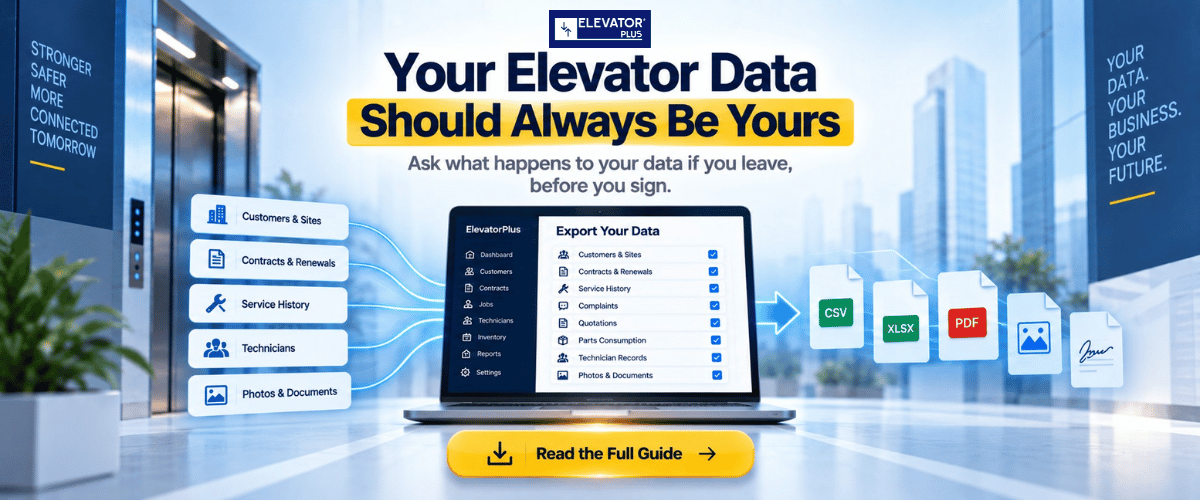
A full export should carry your customer and site records, your contracts and their renewal history, the full service and breakdown history per installation, complaints and their resolution, quotations and their outcomes, parts consumption, technician assignment and time records, and every attachment linked to any of the above.
The attachment line is where exports quietly fail. Systems will often produce a clean set of tables and treat the linked files as a separate conversation. An export that gives you a service record with a reference to a photograph you cannot retrieve is not a complete export. Ask specifically whether attachments come out, in what structure, and how each file is linked back to the record it belongs to.
Ask about deleted and archived records too. If you archived a site three years ago, decide now whether you expect it in the export, because the answer varies and it is easier to settle in advance.
| What you ask for | A weak answer | A workable answer |
|---|---|---|
| Scope | "Your main data, obviously" | A named list of record types, attachments included |
| Format | "You can print or download a report" | CSV or a documented structured format, with a field description |
| Timescale | "We would work with you on that" | A stated number of working days from written request |
| Cost | Not discussed | Stated in the agreement, including what is chargeable and what is not |
| Their copy | "It stays on our servers" | A retention period, a deletion process and written confirmation |
What file format should a software export be in?
Something another system can read without a human retyping it.
In practice that means CSV for tabular records, or a documented structured format such as JSON or XML where the data has nesting that a flat table would destroy. Attachments should arrive as the original files, in a folder structure or with an index file that maps each one to its parent record.
Two things make a format usable rather than merely present. The first is a field description, so the receiving system knows what each column means and which column joins to which. The second is referential integrity, so a service record still points at the right site and the right contract once it lands somewhere else. An export that loses its keys is a pile of rows, not a history.
Ask for a sample. A vendor confident about portability can show you an anonymised example of what an export looks like without much difficulty, and the sample answers more questions in five minutes than the clause does in five pages.
What is the difference between a report and an export?
A report is for reading. An export is for loading.
A report answers a question you already have: how many jobs last month, which contracts renew in the next quarter, what a given technician did on a given day. It is formatted for a person, it usually filters and summarises, and it drops the fields that were not relevant to the question being asked.
An export answers no question at all. It is deliberately unformatted, it summarises nothing, and it keeps the identifiers that let another system rebuild the relationships between records. That is why "you can download a PDF at any time" is not an answer to this question. The PDF is the output of a reporting engine, and the information it discarded on the way out is the information a migration needs.
If you take one test into your next vendor conversation, take this one: can the file you are being offered be loaded into another system without a person reading it and typing it in again? If not, it is a report.
👉 Wondering how your existing systems would connect to a new one?
See how ElevatorPlus works with the tools you already run →
What does a weak answer sound like?
You will hear these, and it helps to recognise them while you are still in the room.
"That has never come up." It has. This is a choice not to answer.
"We would obviously help you out." The awkward part is that the person saying this usually means it. They would help. But they will not be the account manager in four years, the company may not have the same owner by then, and goodwill is not a term of the agreement. A sincere promise from someone who cannot bind their employer is worth the same as an insincere one on the day you try to collect on it.
"You can export to PDF at any time." That is a report.
"It is all in the cloud, so it is always available." Available to view inside a product is not the same as portable out of it.
"Nobody has ever left." Even if it is true, the process has never been tested, so nobody knows what it does. Set it against what a good answer to that same question sounds like: yes, a few customers have left, here is what we sent them, here is roughly how long it took, and here is an anonymised sample of the file. That takes a minute to say and settles the subject.
None of these mean a vendor is acting in bad faith. Most of the time nobody has thought about it, which is itself useful information about how the product is built and how the company is run.
Does the same rigour apply to getting data in?
Yes, and buyers are much more relaxed about this than they should be.
Ask who performs the migration from your current system, what it costs, what the vendor needs from you, and how long you are expected to run both systems in parallel. Ask what happens to records the new system cannot represent, because there will be some. Every migration loses something. A vendor who promises a lossless migration has either not done many or is not being straight with you.
The honest version is that some historical detail gets flattened. A free text note that meant something specific in the old system becomes a general note in the new one. A status that existed in one workflow has no equivalent in another. The useful conversation is not about avoiding that. It is about deciding which detail matters enough to preserve deliberately, and agreeing before the cutover which fields are being mapped, which are being merged and which are being dropped.
Get that mapping in writing too. It is the document you will want on the day somebody asks why a 2019 record reads differently now.
What should an exit clause actually say?
Short, plain and specific. Five things.
That the data is yours. That on written request the vendor will provide a complete structured export, with the record types and attachments named rather than implied. That the export will be delivered within a stated number of working days. What, if anything, is chargeable, and what is not. And what happens to the vendor's copies after termination, with a retention period, a deletion process and written confirmation that deletion has happened.
Add one more line if you can get it: that the export remains available for a defined window after the contract ends. Buyers often discover a missing record two months after cutover, when access has already gone.
None of this is adversarial. A vendor with a clean answer will not object to writing it down, because writing it down costs them nothing. The reaction to the request tells you as much as the wording you end up with.
Frequently asked questions
Who owns the data in elevator maintenance software?
In almost every commercial arrangement the customer owns the operational data they put into the system, and the vendor owns the software. That said, ownership is settled by the contract you sign, not by convention, so read the clause and make sure it says so in plain words rather than assuming it.
What should a full data export include?
Customer and site records, contracts and renewal history, complete service and breakdown history per installation, complaints, quotations, parts consumption, technician and time records, and every attachment linked to those records, including photographs and signed job cards. Ask for the list by name, because scope disputes are almost always about attachments.
What file format should a software export be in?
CSV for tabular data, or a documented structured format such as JSON or XML where the records are nested. Attachments should come as original files with an index that maps each one to its parent record. A field description should come with it so the receiving system knows what each column means.
Is a PDF report the same as a data export?
No. A PDF is formatted for a person to read and usually filters and summarises. An export keeps every field and every identifier so another system can load it. If a file has to be read and retyped by a human, it is a report.
Can a vendor charge you to export your own data?
That depends entirely on what your contract says, which is why it should be written down before you sign. As a commercial matter, a fee for genuinely bespoke extraction work is defensible, while a charge for releasing records in the vendor's own standard export format is worth challenging at the negotiating table rather than at the exit. Agree the position in the agreement so it is not a conversation you are having under time pressure.
What should an exit clause say?
That the data is yours, that a complete structured export including attachments is available on written request, that it will be delivered within a stated number of working days, what is and is not chargeable, and what happens to the vendor's copies after termination, including retention period, deletion process and written confirmation.
How long should we keep elevator service records after switching systems?
Longer than the software relationship, because the asset outlives it. Keep the exported archive intact and readable independently of any vendor, and decide your retention period against your own contractual and client obligations rather than against your software renewal cycle.
📲 Join our WhatsApp channel for compliance tips, updates: ElevatorPlus - Business Automation Tool
Nobody asks this during a demo. It feels pessimistic, like raising divorce while planning a wedding, and a sales conversation is not built to accommodate it.
Ask it anyway. Ask us, and ask everyone else on your shortlist.
The answer costs a vendor nothing if they have thought about it and costs them a great deal of comfort if they have not, which is what makes it such an efficient question. You learn about the export in one minute and about the company in the next.
And the version worth having is not a reassurance. It is a clause: your data, complete and structured, on request, in a stated number of working days, with the terms of any charge agreed in advance and the fate of their copy spelled out. Sign that and the switching decision stays yours for the whole life of the relationship, which is the only condition under which staying means anything.
This is general commercial guidance and not legal advice. Have your own advisor review any contract wording before you adopt it.
👉 See what a complete, exportable service record looks like across your whole portfolio. Book a demo →
Related reading
- Integrations: how ElevatorPlus connects to the tools you already run
- Document Automation: generate records and documents from your own templates
- Asset Management: keep the full history attached to each installation
- Inspection Management: keep signed job cards and attachments on the record
About the author. Sumeet Katariya is the founder of ElevatorPlus, the Elevator Business Operating System used by 200+ elevator companies across 20+ countries. Reviewed by Mr. Sumeet Katariya.
Sources: Operational patterns described here are drawn from ElevatorPlus onboarding across 200+ elevator companies in more than 20 countries. No third party study is cited because none was used.
👉 Follow ElevatorPlus on,
Instagram LinkedIn Facebook YouTube Qoura Substack Twitter