
Elevator Maintenance Software: What It Has to Do (2026)
By Sumeet Katariya, ElevatorPlus ·
In short: Elevator maintenance software is the system an elevator company runs its service business on. It holds the asset register, plans the routine visits, takes breakdown calls and dispatches them, captures what the technician did in the field, ties spare parts to the job, tracks AMC renewals and the money behind them, and keeps the compliance record per lift. Not a diagnostics box. A business record.
Key takeaways
- The record is the product. A service visit that produced no signed, retrievable entry against a specific lift on a specific date did not happen, as far as an inspector or a client committee is concerned.
- Scheduling is the easy half. Most systems can print a plan. Far fewer can prove the plan was carried out, by whom, with which parts, and get the AMC invoice raised off the back of it.
- Scale changes the questions, not the features. At forty lifts you are fixing memory. At four hundred you are fixing coordination. At two thousand across branches you are fixing visibility.
- ElevatorPlus does not do prediction. No condition monitoring, no sensors, no forecast of the next failure. It plans, records, dispatches and proves. We say so plainly because half the category will not.
- Ninety days is the honest implementation window. Two weeks of asset data, two weeks of schedules, six weeks of technicians actually using it on real jobs, and a month of tightening what broke.
What this guide covers: what elevator maintenance software is · what it is not · the eight jobs it has to do · how it differs from generic maintenance software · the prediction question, answered honestly · how needs change with fleet size · what to check before buying · the first ninety days · what goes wrong · FAQs
What is elevator maintenance software?
Elevator maintenance software is a system that plans, records and proves the maintenance of lifts across their working life. It holds the asset register, schedules preventive visits, takes breakdown calls, dispatches technicians, captures signed field reports, links spare parts to jobs, and tracks contract renewals so the service record stands up to an inspection.
That is the whole of it, and the order matters. Planning first, because a lift that nobody scheduled is a lift nobody visited. Recording second, because the visit that left no trace is worth nothing when a building committee asks what you have been billing them for. Proving third, because the record is eventually read by someone who was not there and does not trust you yet.
Everything else a vendor shows you sits on top of those three.
What is elevator maintenance software not?
It is not a diagnostics system. It does not sit on the controller, does not read fault codes off the drive, and does not know the brake is wearing.
It is not a CRM. A CRM tracks a sales pipeline. This tracks an installed base you are contractually responsible for, a different problem with a different clock on it.
It is not a spreadsheet with a login. Spreadsheets are good at columns and bad at custody. Who edited the June entry for car three, and were they authorised, is a question a sheet cannot answer.
We put ElevatorPlus in a category we had to name ourselves, an Elevator Business Operating System, because the software has to carry the operating side of the company as well as the technical side. Jobs, people, parts, money, records. Take any one of those out and the rest stops being useful.
What jobs does elevator maintenance software actually have to do?
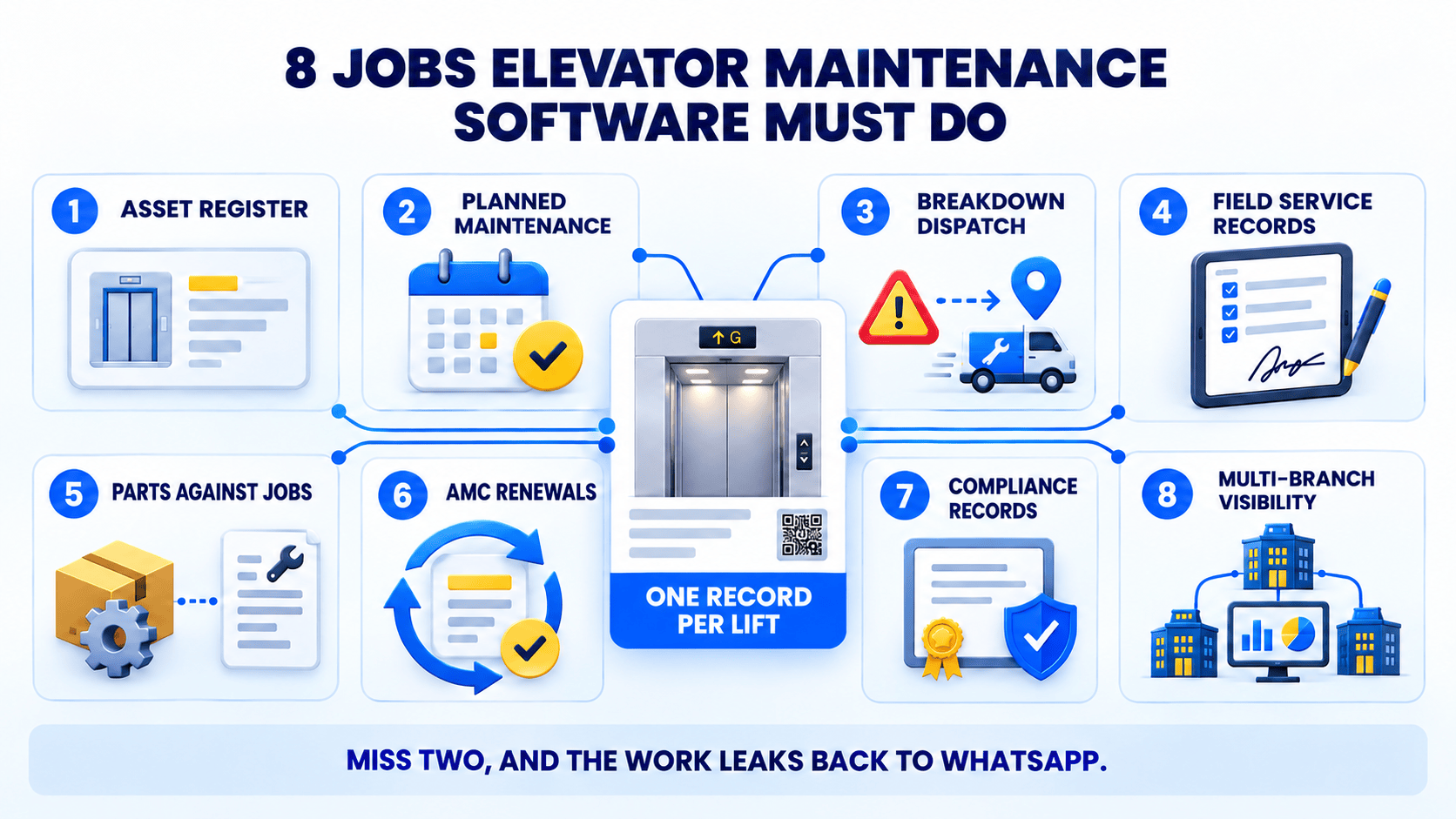
There are eight. A system that does six of them well will still leak, because the two it misses become the two your office runs on WhatsApp.
Asset register. One record per lift, not per client and not per building. Make, capacity, floors served, controller type, date commissioned, warranty position, contract status, licence and certificate expiry, and the full visit history. This is the spine. Everything else hangs off the asset ID. See asset management.
Planned maintenance schedules. Generate the visit calendar from the contract and the asset, not from someone's memory. Your local rule sets the interval, and your contract may set a tighter one, and the tighter of the two is the one you have to plan to. The system should be able to hold a different frequency per lift in the same building, because in practice the goods lift and the passenger lift are not on the same regime. See PM and AMC reminders.
Breakdown intake and dispatch. Calls arrive by phone, by WhatsApp, from a guard, from a resident, sometimes all four about the same stuck car. Intake has to deduplicate, attach the complaint to the right asset, assign a technician, and start a clock. Response time is what clients actually judge you on. See breakdown management.
Technician records in the field. The visit report has to be completed at the lift, on a phone, with the client signing it there. Not typed up in the office on Saturday from a pocket full of paper. Offline capture matters because basements are where signal goes to die. See field tracking and digital signatures.
Spare parts against the job. A part that leaves the store has to land on a job, and that job has to land on an asset. Otherwise your stock report and your service history disagree and you will believe the wrong one. See inventory management.
AMC renewals and collections. Contracts expire quietly. Nobody notices a renewal that did not happen until the lift breaks and the client asks why you are invoicing for a call-out. Renewal dates, invoice and the payment chase belong in the same system as the service record. See payment management.
Compliance records. Licence numbers, certificate validity, inspection outcomes, third party reports, held per lift with expiry dates that surface before the deadline rather than after. See inspection management and document automation.
Multi-branch visibility. The moment you have two service centres, you have two versions of the truth. One asset register, branch-level operational control, and consolidated reporting upward. See multi-branch.
How is this different from generic maintenance software?
Generic maintenance software was built for factories. A machine on a shop floor is owned by the company that maintains it and is serviced by staff who work there.
None of that is true for a lift.
| The difference | Factory maintenance | Elevator maintenance |
|---|---|---|
| Who owns the asset | You do | Your client does, and you are contracted to it |
| Where the work happens | One site | Hundreds of buildings across a city or a country |
| Who sets the frequency | Engineering judgement | Contract and statute together, whichever is tighter |
| Who reads the record | Your plant manager | An inspector, a building committee, sometimes a court |
| Sign-off | Internal | On site, by the client, at the lift |
| Parts | One store | A store, a van, and a technician's bag |
| Access | Walk over | Keys, guards, permission, and a resident who wants the lift back now |
The last row is the one nobody puts on a slide and everybody loses money on. A visit that could not happen because the caretaker was unreachable is still a visit you owe.
Does elevator maintenance software predict failures?
Ours does not, and I would rather say that here than let you find out in month two.
ElevatorPlus has no condition monitoring, no sensors on the machine, no remote diagnostics, no energy tracking, no forecast of which component fails next. It does not integrate with a building management system.
What it does instead is less exciting and more reliable. It makes sure the scheduled visit happens and is recorded. It surfaces the lift that has had four breakdowns in three months, which is a pattern any supervisor can act on without a model. It makes the parts history per lift readable, so a repeat replacement is visible. It puts the certificate expiry in front of someone while there is still time.
That is not prediction. It is attention, applied consistently, to the things a service business already knows.
I have watched companies buy a forecasting promise and still miss half their scheduled visits, because the underlying record was never solid. Fix the record first.
How do requirements change between forty lifts and four hundred?
The features barely change. The failure mode changes completely.
| Fleet size | What actually breaks | What the software has to fix first |
|---|---|---|
| Under 50 lifts | Memory. One or two people hold the whole schedule in their heads | Asset register and a schedule that generates itself |
| 50 to 200 lifts | Handover. Work gets assigned verbally and lost between shifts | Dispatch with an audit trail, and field reports completed on site |
| 200 to 600 lifts | Coordination. Parts, people and jobs stop lining up | Inventory tied to work orders, and approval routing that does not need the owner |
| 600 to 2,000 lifts | Visibility. Branches diverge and reporting becomes negotiation | One asset register, branch-level roles, consolidated dashboards |
| Above 2,000 lifts | Governance. Nobody can personally check anything | Access control, automation rules, and exception reporting rather than activity reporting |
The smaller company usually over-buys. The larger one usually under-configures. Both end up in the same place, which is a system half the staff avoid.
👉 Wondering whether your renewals are actually being tracked or just remembered?
See how PM and AMC reminders work →
What should you check before you buy?
Six checks. Run them in a demo, with your own data, not with the vendor's sample fleet.
| Check | The question to ask | What a weak answer sounds like |
|---|---|---|
| Asset granularity | Can I open one lift and see every visit, part, complaint and certificate since commissioning? | "You can filter the reports by building" |
| Offline field capture | What happens when my technician has no signal in a basement? | "Coverage is quite good these days" |
| Signature and proof | Can the client sign on the phone at the lift, and is that signature attached to that visit? | "They can confirm by email afterwards" |
| Parts to job | If a contactor leaves the store, which job and which lift does it appear against? | "Inventory is a separate module" |
| Renewal to money | Does an expiring AMC create a task, an invoice and a follow-up, or just an alert? | "You will get a reminder" |
| Getting out | Can I export my full asset and service history in a readable format, on demand? | "You can request an export from support" |
Two more checks that are not features. Ask who configures it, and ask what happens in week five when a technician refuses to use it. A vendor with no answer to the second question has never done a real rollout.
On mobile specifics, be precise with the vendor. In ElevatorPlus, GPS and live technician location are Android only. Our HRMS covers attendance, leave, overtime and approved expenses, not payroll. Ask every vendor for that level of specificity.
What do the first ninety days actually look like?
Not a switch. A migration of habits.
Weeks one and two, the asset register. This is the part everyone underestimates. You are collecting one clean record per lift, and your existing data is in three spreadsheets, a WhatsApp group and one supervisor's head. Expect to find lifts you are servicing with no contract, and contracts for lifts that were replaced.
Weeks three and four, schedules and contracts. Load the AMCs, set the frequency per lift, set the renewal dates, and let the system generate next quarter's plan. Compare it against what your team thought the plan was. The gap is the number you needed.
Weeks five to ten, the field. Technicians start closing jobs on the phone. This is where rollouts fail. Not because the app is hard, but because the paper habit is thirty years old and the phone feels like surveillance. Two things help. Give them fewer fields than you want, and pay them faster because their reports now clear approval faster. Adoption follows self-interest, not training.
Weeks eleven to thirteen, tighten. Now add approval routing, breakdown escalation, and the reports the owner reads on Monday morning. Not before. A rule added in week two gets worked around by week four.
One practical note. Do not migrate ten years of history. Migrate the asset register, open contracts, and the last twelve months of service. Archive the rest.
What goes wrong?
Five things, in order of how often I see them.
The register is built per building instead of per lift. It works for six months and then a client asks for the history of one specific car and you cannot produce it cleanly.
Field reports get filled in later. Once "later" is acceptable, the record stops being evidence and becomes recollection.
Parts stay in a separate world. The store issues, the technician fits, nobody links the two, and the lift with the recurring failure looks fine on paper.
Renewals sit with one person. That person goes on leave in March and you lose contracts you had already earned.
And the fifth, which is the quiet one. The company buys the software and keeps the old process running alongside it, because switching off the old way feels risky. Six months later staff are doing both, badly, and the conclusion drawn is that the software did not work. It was never given the job.
Frequently asked questions
1. What is elevator maintenance software?
It is a system that plans, records and proves lift maintenance across the asset life. It holds the asset register, schedules preventive visits, handles breakdown intake and dispatch, captures signed technician reports in the field, links spare parts to jobs, and tracks AMC renewals and compliance records per lift.
2. Is elevator maintenance software the same as a CRM?
No. A CRM manages a sales pipeline of people who might buy. Elevator maintenance software manages an installed base you are already contractually responsible for. ElevatorPlus is an Elevator Business Operating System, which covers service operations, field work, parts, contracts and records together.
3. Does elevator maintenance software predict breakdowns?
Some vendors claim so. ElevatorPlus does not. It has no sensors, no condition monitoring and no remote diagnostics. It reduces breakdowns by making sure planned visits actually happen and are recorded, and by making repeat failures on a specific lift visible to a supervisor.
4. How often should lifts be serviced?
Your local rule sets the interval, and your service contract may set a tighter one. The stricter of the two is the one to plan against. Good software lets you hold a different frequency per lift, because two lifts in the same building often sit under different regimes.
5. Can technicians use it without an internet connection?
Yes. Field capture is designed for machine rooms and basements where signal fails, with reports syncing when the device reconnects. One specific to note: GPS and live technician location are Android only.
6. What is the difference between elevator maintenance software and generic maintenance software?
Generic systems assume you own the asset and it sits on one site. Lifts are owned by your client, spread across many buildings, governed by contract and statute together, and the record is read by inspectors and building committees rather than by your own plant manager.
7. How long does implementation take?
Around ninety days to be genuinely in use. Two weeks on the asset register, two on schedules and contracts, six on getting technicians closing jobs in the field, then a few weeks of tightening rules and reports. Rollouts that promise a week are usually counting the login, not the adoption.
📲 Join our WhatsApp channel for compliance tips, updates: ElevatorPlus - Business Automation Tool
Most elevator companies do not have a maintenance problem. They have a proof problem. The work is largely being done, by people who know what they are doing, and almost none of it is recoverable in a form anyone else can read.
That gap costs money quietly. Contracts renew at a discount because you cannot show the year of service you delivered, breakdowns repeat because the pattern was never visible, and staff time goes into reconstructing what happened instead of doing the next job.
Software fixes that only if you let it be the single place the work is recorded. Half-adoption produces the worst of both, and it is the most common outcome in this industry.
Be sceptical of prediction promises. Ask instead whether you can open one lift, on one date, and see who attended, what they found, what they fitted, who signed, and when the certificate expires. If a system answers that reliably for every lift you look after, everything else is negotiable. If it cannot, nothing else it does matters much.
Start with the asset register. Everything else is downstream of it.
👉 See what a per-lift service record looks like across your whole fleet. Book a demo →
Related reading
- Preventive maintenance and AMC renewal reminders, per lift
- Breakdown intake, dispatch and escalation for service teams
- Field tracking and technician job closure on site
- Asset management: one record per lift, for its whole life
- Running service across multiple branches from one register
About the author. Sujit Katariya is the Team of ElevatorPlus, the Elevator Business Operating System used by 200+ elevator companies across 20+ countries.
👉 Follow ElevatorPlus on,
Instagram LinkedIn Facebook YouTube Qoura Substack Twitter