Elevator Service Software USA 2026: Compete & Grow
By Mr. Sumeet Katariya, Founder & CEO, ElevatorPlus · Published 7 July 2026 · Last updated 7 July 2026 · ~8 min read
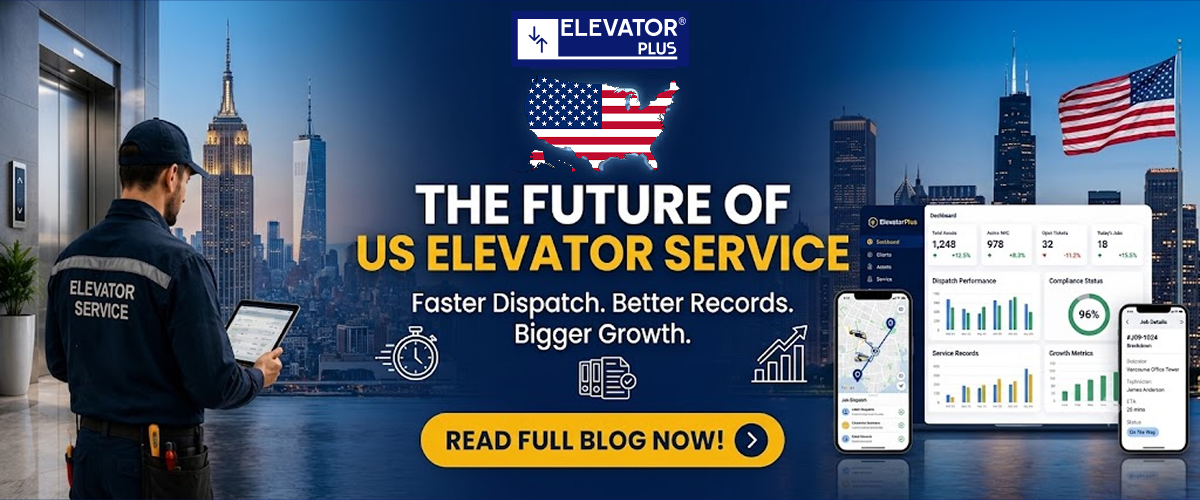
In short: The United States has one of the largest installed bases of elevators in the world much of it ageing and thousands of independent service contractors competing against a handful of global majors. The independents that win aren't bigger; they're better organised. This guide shows how purpose-built software helps US lift contractors meet ASME A17.1, dispatch technicians faster, and protect maintenance revenue.
Key takeaways
- The US has an estimated 1 million+ elevators in service, a large share of it ageing equipment needing ongoing maintenance and modernisation.
- Four global majors Otis, KONE, Schindler and TK Elevator dominate new installs, but independent contractors service a significant portion of the existing base.
- A shortage of licensed elevator mechanics means technician efficiency, not headcount, decides who can take on more buildings.
- ASME A17.1 / CSA B44 and local Authority Having Jurisdiction (AHJ) inspections demand complete, retrievable maintenance records including a documented Maintenance Control Program.
- ElevatorPlus runs AMC and service operations for 200+ elevator companies across 20+ countries.
What this guide covers: the size of the US service market · why independents can out-service the majors · what ASME A17.1 means for your records. dispatching faster despite the mechanic shortage. reactive vs systemised operations · FAQs.
How big is the US elevator service market?
There are well over a million elevators operating across the United States, and a large share of them are decades old. New installations grab headlines, but the real, recurring money in this industry is in service: inspections, maintenance, callbacks, repairs and modernisation on equipment that has to keep running safely for forty years or more. For an independent contractor, every building under contract is an annuity. if you can keep the service organised.
That 'if' is the whole game. The market is enormous and durable, but it's also fragmented and competitive, and the contractors who grow are the ones who can take on more buildings without dropping the ones they already have.
Why can independent contractors out-service the majors?
The global majors win on scale and new-construction relationships. But on service especially for mid-size commercial and residential portfolios independents have a structural advantage: they're local, they're faster to respond, and they're not routing every decision through a national call centre. A building manager who can reach a real person and get a mechanic on site the same day will stay loyal for years.
The catch is that this advantage only holds if the independent is organised. The moment service runs on a whiteboard, a group text and one dispatcher's memory, the responsiveness that made you competitive starts to slip. Systemising your operations is how you keep the personal touch while handling ten times the volume.
What does ASME A17.1 mean for your maintenance records?
Definition : Maintenance Control Program (MCP): under ASME A17.1/CSA B44, every elevator must have a documented program describing the maintenance tasks, intervals and procedures for that specific unit and you must be able to show the records on demand.
In practice, AHJ inspectors and building owners increasingly expect to see a complete, retrievable history: what was done, when, by whom, and which parts were replaced. If those records live in paper logbooks in a truck or a filing cabinet, an inspection becomes a scramble and a gap in documentation can mean a violation. When every visit, task and part is logged against the specific unit in one system, compliance stops being a fire drill and becomes a search.
How do you dispatch faster when mechanics are scarce?
The US faces a real shortage of licensed elevator mechanics, and that shortage isn't ending soon. You can't simply hire your way out of growth. The only lever left is making each mechanic more productive less time driving and calling, more time on equipment.
That means dispatching the nearest qualified mechanic automatically, putting the unit's full history on their phone before they arrive, and capturing the visit on site instead of back at the office. Cut an hour of coordination and travel out of every call, and the same crew covers noticeably more buildings without anyone working longer.
Reactive vs systemised service operations
| Reactive (whiteboard + texts) | Systemised (one platform) | |
|---|---|---|
| Dispatch | Whoever answers the phone | Nearest qualified mechanic, auto-assigned |
| A17.1 records | Paper logs, scattered | Complete history per unit, instant |
| Callback context | Starts from scratch | Full unit history on the phone |
| Inspection readiness | Last-minute scramble | Records pulled in seconds |
| Taking on more buildings | Adds chaos | Adds revenue, not headaches |
The same discipline scales across borders see how independent contractors approach it in our Canada operations guide and the wider shift in the global state of the elevator service industry.
👉 See what one connected system looks like for a US contractor. Book an ElevatorPlus demo →
Frequently asked questions
1. What is the best software for a US elevator service company?
Look for a platform built specifically for the elevator industry one that tracks each unit's ASME A17.1 maintenance program and history, auto-dispatches the nearest mechanic, and links parts and billing to each job. Generic field-service or accounting tools miss the unit-by-unit detail elevator work requires. ElevatorPlus is purpose-built for it.
2. How does software help with ASME A17.1 compliance?
It keeps a complete, time-stamped record of every maintenance task, inspection and part for each specific unit, so your Maintenance Control Program is documented and retrievable the moment an AHJ inspector or owner asks.
3. How can an independent contractor compete with Otis or KONE?
By being faster and more personal on service and staying that way as you grow. Systemising dispatch, history and records lets a local contractor respond quicker than a national call centre while handling far more buildings.
4. Does this work for a small shop with a few mechanics?
Yes, smaller shops often benefit most, because the owner is usually the dispatcher, the records keeper and the salesperson at once. A system removes that bottleneck and frees them to take on more work.
The US service market is huge, durable and wide open to independents who run a tight operation. You don't beat the majors by getting bigger you beat them by being faster, more reliable and audit-ready, building after building. That's an operations problem, and it's a solvable one.
👉 See your service operation the way it should run — book a demo →
📲 Join our WhatsApp channel for compliance tips, updates: ElevatorPlus - Business Automation Tool
Related reading
- Elevator Service Software in Canada 2026
- The Global State of the Elevator Service Industry 2026
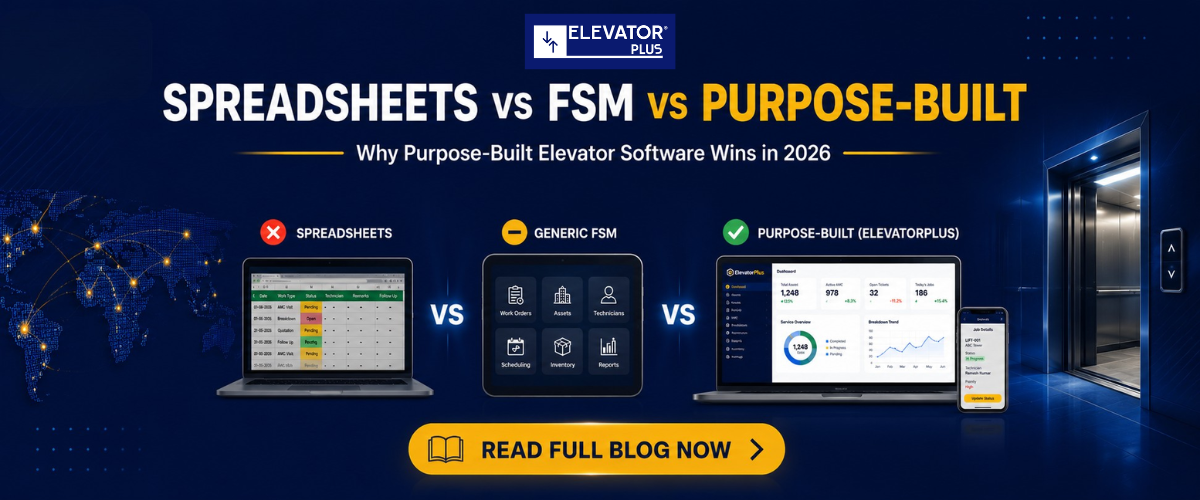
- ElevatorPlus vs Spreadsheets & Generic FSM Tools
About the author : Mr. Sumeet Katariya is the Founder & CEO of ElevatorPlus, the Elevator Business Operating System used by 200+ elevator companies across 20+ countries. He is the author of "ElevatorPlus How to run your operation stress-free and 3x your business."
Sources: US installed elevator base (1 million+) and ageing-stock context industry market reports / ElevatorPlus Global Market Intelligence 2026; major-OEM market position company filings and industry estimates; licensed mechanic shortage. US elevator-industry workforce reporting; ASME A17.1/CSA B44 Maintenance Control Program ASME A17.1 Safety Code for Elevators and Escalators.
👉 Follow ElevatorPlus on,