Reduce Elevator Breakdown Response Time: 2026 Guide
By Mr. Sumeet Katariya, Founder & CEO, ElevatorPlus · Published 9 July 2026 · Last updated 9 July 2026 · ~6 min read
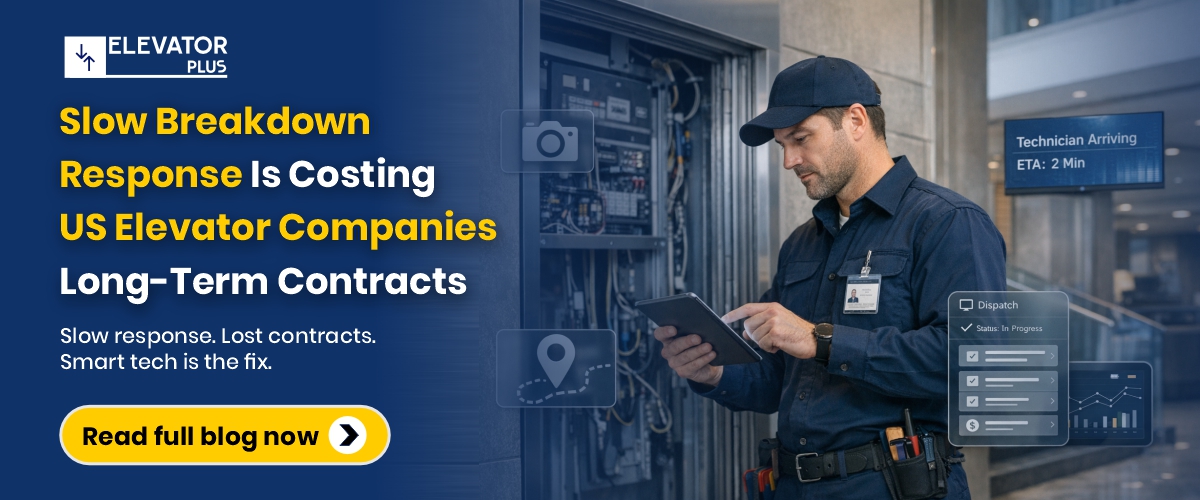
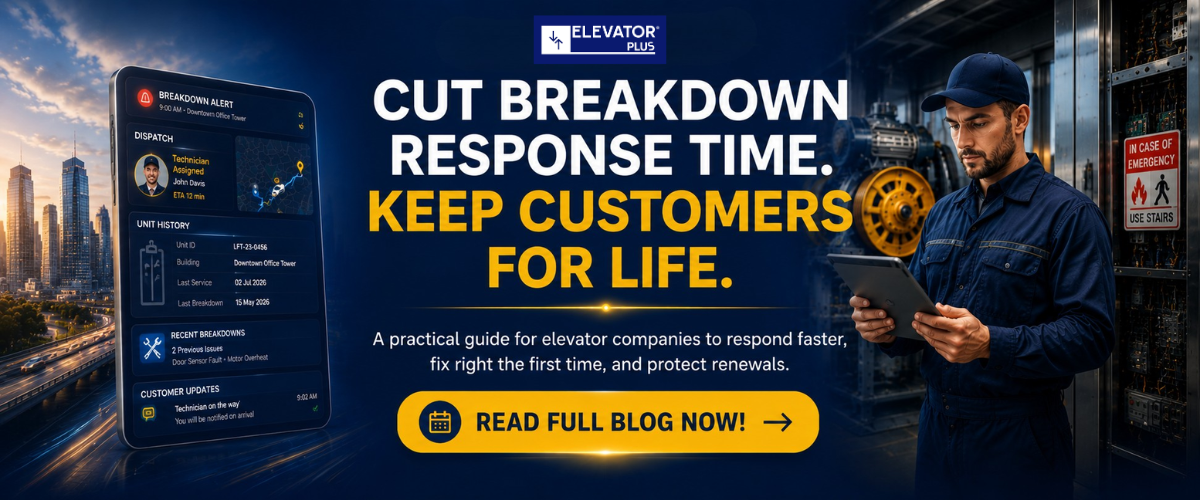
In short: When a lift goes down, every minute costs you trust. Yet most elevator companies lose the first hour to coordination figuring out who's free, who's nearest, and what the building's history is. This guide covers the practical levers that cut breakdown response time and turn service into a reason customers stay.
Key takeaways
- Slow breakdown response is usually a coordination problem, not a technician problem.
- The first hour is lost to phone calls: who's available, who's closest, what's the history.
- Instant, location-based dispatch plus the unit's history on the technician's phone removes most of that lost time.
- Faster response lifts first-time fix rates, cuts repeat callbacks, and protects AMC renewals.
- ElevatorPlus runs AMC and service operations for 200+ elevator companies across 20+ countries.
What this guide covers: where response time is lost · the levers that cut it · reactive vs systemised dispatch · FAQs.
Where does breakdown response time actually go?
Picture a typical callout. A lift stops at 9 am. The customer calls the office. The office doesn't immediately know which technician is closest or free, so it makes three calls to find out. By the time someone's assigned, the customer has already rung twice asking where the technician is. If it's a repeat fault, the technician arrives with no history and starts from scratch.
Notice that almost none of that delay is the technician's fault. It's coordination the time between the complaint coming in and the right person arriving prepared. That's the time you can cut.
The levers that cut response time
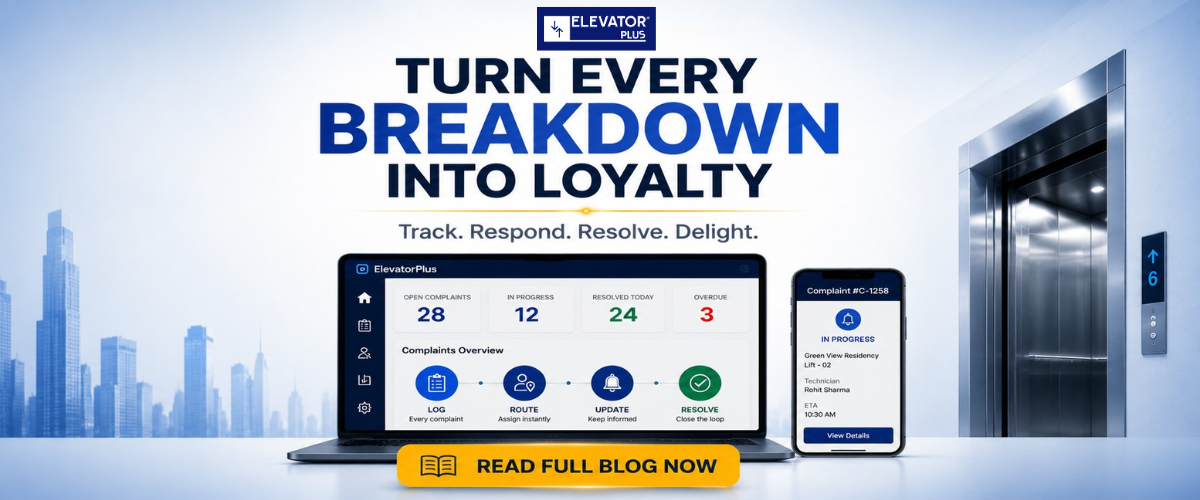
- Log every complaint in one place. Phone, WhatsApp, email all into a single queue, so nothing sits unseen.
- Auto-assign by location and availability. The system routes the job to the nearest free, qualified technician in seconds.
- Arm the technician with history. Past breakdowns, parts replaced, last service on their phone before they leave, so they arrive ready to fix, not diagnose from zero.
- Keep the customer informed automatically. Status updates without the customer calling the office.
- Watch the queue. A live board, colour-coded by urgency and age, so nothing is forgotten.
Reactive vs systemised dispatch
| Reactive (phone + memory) | Systemised (one platform) | |
|---|---|---|
| Assignment | Three calls to find someone | Nearest tech, auto-assigned in seconds |
| History at the site | None start from scratch | Full unit history on the phone |
| Customer updates | Customer chases the office | Automatic status updates |
| Open complaints | Easy to lose track | Live board by urgency |
This is the operational backbone behind reliable service see the wider picture in the global state of the elevator service industry.
👉 Turn breakdowns into a reason customers stay. Book an ElevatorPlus demo →
Frequently asked questions
1. How can I reduce elevator breakdown response time?
Log every complaint in one queue, auto-assign to the nearest available technician, and give that technician the lift's full history before they arrive. Most delay comes from coordination, which a system removes.
2. What is a good elevator breakdown response time?
It varies by contract and building criticality, but the goal is consistent, fast assignment and a high first-time fix rate. The biggest gains come from removing the coordination delay, not from rushing technicians.
3. How does technician tracking help?
Knowing where technicians are and what they're working on lets you assign the nearest free person instantly and give customers accurate updates instead of guessing.
4. Why do repeat breakdowns take so long to fix?
Usually because the technician arrives without history and re-diagnoses a known fault. Putting the unit's record on their phone prevents that.
Faster breakdown response isn't about pushing technicians harder. it's about deleting the lost hour of coordination before they even arrive. Fix that, and reliability becomes your competitive edge.
👉 See instant dispatch in action — book a demo →
📲 Join our WhatsApp channel for compliance tips, updates: ElevatorPlus - Business Automation Tool
Related reading
- The Global State of the Elevator Service Industry 2026
- ElevatorPlus vs Spreadsheets & Generic FSM Tools
About the author : Mr. Sumeet Katariya is the Founder & CEO of ElevatorPlus, the Elevator Business Operating System used by 200+ elevator companies across 20+ countries.
Sources: Breakdown-response coordination patterns and first-time-fix impact ElevatorPlus Global Market Intelligence 2026 and field-service management best practice.
👉 Follow ElevatorPlus on,