Elevator Service Software Middle East 2026 | UAE & Saudi
By Mr. Sumeet Katariya, Founder & CEO, ElevatorPlus · Published 18 June 2026 · Last updated 18 June 2026 · ~8 min read · Reviewed for GCC operations
In short: Elevator companies across the UAE and Saudi Arabia are scaling faster than their back offices can handle. The fix is not more technicians it is a single Elevator Business Operating System that runs multi-tower AMC contracts, service dispatch, spare-parts inventory, payments and compliance records in one place. This guide shows what to look for and how leading non-OEM lift firms in the Gulf are making the shift in 2026.
Key takeaways
- The Middle East elevator market is projected to roughly double from USD 1.25 billion (2023) to USD 2.38 billion by 2030, driven by Saudi Vision 2030 and UAE smart-city projects.
- By industry estimates, the majority of elevator service worldwide often cited as around three-quarters is handled by non-OEM independents, exactly the firms still running on spreadsheets and WhatsApp.
- The real margin leak in Gulf lift businesses is between jobs: lapsed AMC renewals, untracked callbacks, and service history no one can produce at audit time.
- A purpose-built platform beats generic field-service software because it models AMC contracts, lift-level service history and inspection compliance natively.
- ElevatorPlus runs operations for 200+ elevator companies across 20+ countries — including a fast-growing Gulf base — on one multi-currency, multi-location platform.
What this guide covers: why Gulf operations are hard right now · what to look for in elevator software · how multi-tower AMC works on one platform · staying compliant in the UAE and Saudi Arabia · the results to expect · how to start.
Why is elevator operations management so hard in the Middle East right now?
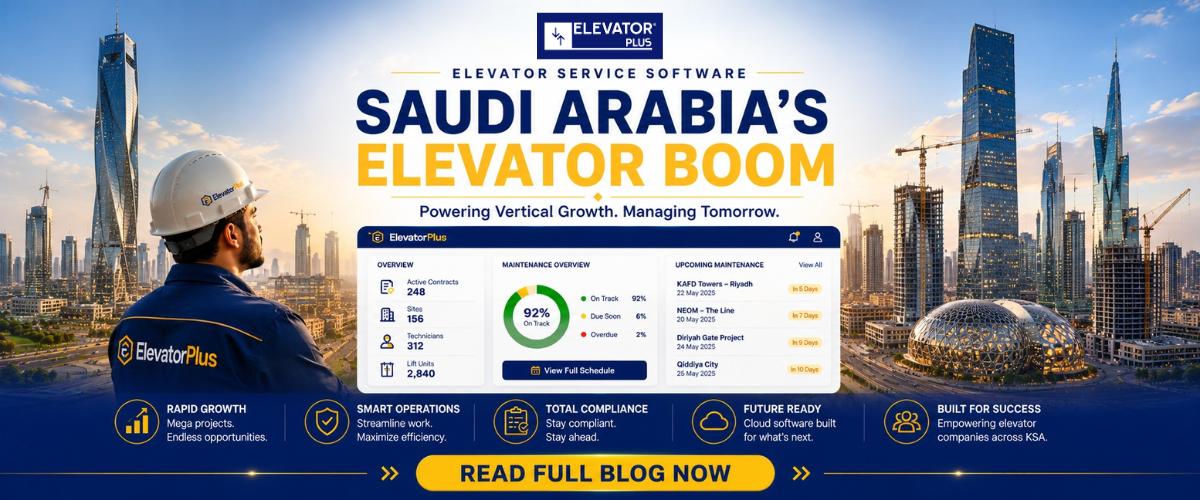
The Gulf is one of the most demanding elevator markets on earth. Towers are taller, tenants expect near-zero downtime, and building owners increasingly write service-level agreements with penalties for slow response. At the same time, the market is expanding quickly: the Saudi elevator and escalator market alone was valued at roughly USD 1.23 billion in 2025 and is forecast to keep growing at a mid-single-digit annual rate through the end of the decade, while the UAE is adding from 16,150 new units in 2024 toward an estimated 19,130 by 2030.
Growth is good. But growth on the wrong systems is how profitable lift companies quietly become busy, stressed and thin-margined. Most independent firms in Dubai, Abu Dhabi, Riyadh and Jeddah still coordinate operations across three or four disconnected tools: spreadsheets for AMC lists, WhatsApp for dispatch, a notebook or PDF for service records, and an accountant's software for invoicing. None of them talk to each other.
Reality check: When a building manager calls about a stuck lift in a 40-floor tower, the question that decides your reputation is simple who is the nearest technician, what is this lift's service history, and is this building's AMC active? If answering takes three phone calls, you are losing the contract slowly.
What should elevator companies in the UAE and Saudi Arabia look for in service software?
The market is full of generic field-service management (FSM) tools built for plumbers, HVAC and general contractors (we go deeper on why generic FSM tools fall short for lift companies). They handle a work order, but they don't understand an elevator business — recurring AMC contracts, lift-by-lift service history, spare-part consumption per car, and inspection compliance. Here is how the options compare for a Gulf lift firm:
| Capability | Spreadsheets + WhatsApp | Generic FSM software | ElevatorPlus (purpose-built) |
|---|---|---|---|
| AMC contract & renewal tracking | Manual, easily missed | Basic recurring jobs | Native AMC lifecycle + auto-renewal alerts |
| Lift-level service history | Scattered / lost | Per-customer only | Per-lift, per-building, instant at audit |
| Multi-tower / multi-location | Breaks down fast | Limited | Built for multi-location operations |
| Spare-parts inventory per job | None | Add-on | Linked to every job, cost-per-job accuracy |
| Compliance & inspection records | Paper / PDF | Generic attachments | Structured, regulator-ready records |
| Multi-currency (AED, SAR, USD) | Manual | Rare | Native multi-currency billing |
| Payment & collections follow-up | Manual chasing | Basic | Automated reminders at 30/60/90 days |
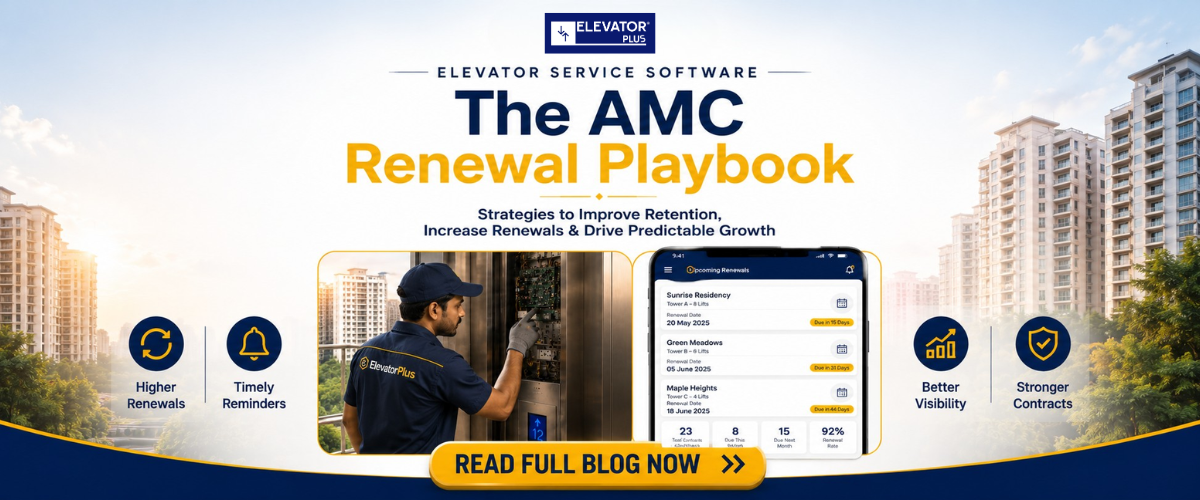
Definition: AMC (Annual Maintenance Contract): the recurring service agreement under which a lift company maintains a building's elevators for a fixed period. AMC renewals are the single largest source of predictable revenue for a service firm — and the most commonly lost to poor tracking.
How does multi-tower AMC management actually work on one platform?
A Gulf service contractor often maintains dozens of buildings, each with several lifts, each lift on its own service schedule and warranty status. On one platform, that complexity becomes a single operating picture:
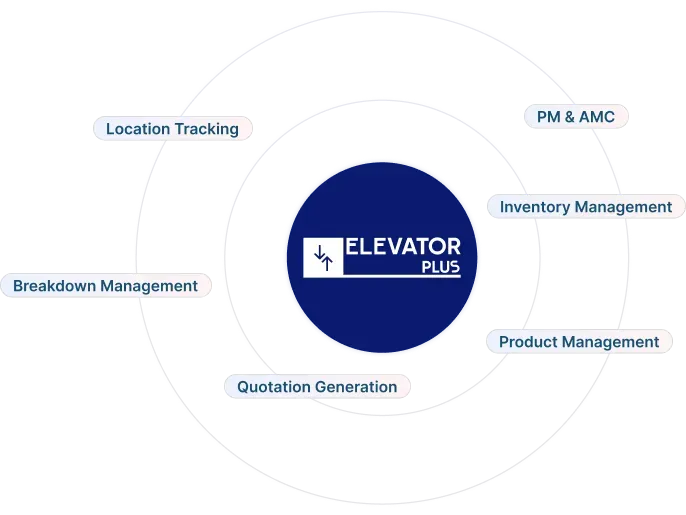
- Every building and every lift is a record with its own service history, AMC status, and assigned technician.
- Preventive maintenance is scheduled automatically by lift, so no tower is skipped and no technician is double-booked.
- Breakdown calls are dispatched by location to the nearest available technician, with the lift's full history on their phone before they arrive.
- Spare parts are logged against the specific lift and job, giving real cost-per-job and stopping inventory leakage.
- AMC renewals trigger alerts weeks before expiry, so contracts are renewed proactively instead of lapsing silently.
Imagine this: It is the last week of the quarter. Instead of a manager manually combing a spreadsheet for which of 120 AMCs expire next month, the system has already flagged them, drafted the renewals, and shown which buildings had the most callbacks the ones to renegotiate upward.
How do you stay compliant with UAE and Saudi lift regulations?
Elevator safety in the Gulf is tightening, not loosening. Installations and maintenance are widely held to international standards such as EN 81-20 and EN 81-50, enforced locally through authorities and codes including Dubai Municipality and Dubai Civil Defence requirements in the UAE, and the Saudi Building Code (SBC) and SASO standards in the Kingdom. (More on the Kingdom's construction wave in our look at Saudi Arabia's elevator boom and Vision 2030.) Building owners and facility managers now routinely demand digital proof of maintenance before renewing a contract.
The operational risk is not only a failed inspection it is being unable to produce the records on demand. When maintenance history lives in paper logbooks and WhatsApp threads, an audit becomes a fire drill. When it lives in a structured system, compliance is a search box: every service visit, checklist, and signature for any lift, instantly.
What results can Middle East elevator companies expect?
The firms that move off fragmented tools typically see the same pattern: fewer missed AMC renewals, faster breakdown response, cleaner audits, and most importantly owners who get their evenings back because the business no longer lives in their head. The pattern is consistent enough that ElevatorPlus now supports 200+ elevator companies across 20+ countries, with multi-currency billing in AED, SAR and USD and multi-language operations suited to the region's mixed workforce.
What typically happens: within the first 90 days, the owner stops being the dispatcher. Technicians self-serve job history, the office sees every open contract and overdue payment, and the leadership team finally plans growth from data instead of memory.
👉 Want to see this on your own operations? Book a personalised ElevatorPlus demo →
How to get started
You do not need to digitise everything at once. Start with your AMC list and your most active towers, get service history flowing into one place, then layer in inventory, payments and compliance. The goal of the first month is simple: one source of truth for who maintains what, when it was last serviced, and which contracts are at risk.
Frequently asked questions
What is the best elevator service software for companies in the UAE and Saudi Arabia?
The best fit for a non-OEM lift company in the Gulf is a purpose-built Elevator Business Operating System that handles AMC contracts, multi-tower service dispatch, spare-parts inventory, multi-currency billing and compliance records in one place — rather than a generic field-service tool. ElevatorPlus is built specifically for the elevator industry and operates in 20+ countries.
Can elevator software handle multiple buildings and multiple lifts per building?
Yes. A purpose-built platform models every building and every individual lift as its own record with its own service history, AMC status and schedule, which is essential for contractors maintaining many multi-tower sites across cities like Dubai, Abu Dhabi, Riyadh and Jeddah.
Does it support AED, SAR and other currencies?
Yes. ElevatorPlus offers native multi-currency billing, so firms operating across the UAE, Saudi Arabia and other markets can invoice in the right currency without manual conversion.
How does elevator software help with UAE and Saudi compliance?
It stores structured, regulator-ready service and inspection records for every lift, so maintenance history aligned with standards such as EN 81-20/50 and local codes can be produced instantly during an audit instead of being reconstructed from paper.
Is this only for large companies?
No. The biggest gains often go to small and mid-size independents (the firms still on spreadsheets and WhatsApp), because a system removes the founder-as-dispatcher bottleneck that caps their growth.
How long does it take to get started?
Most firms begin with their AMC list and busiest towers and have a single source of truth within the first month, then expand into inventory, payments and compliance over the following weeks.
The Middle East elevator market is growing too fast to run on memory and message threads. The firms that will own the next decade of Gulf contracts are the ones turning operations into a system today — visible, compliant, and built to scale across every tower they take on.
👉 Run your elevator business on one platform — book a demo →
Related reading
- Saudi Arabia's Elevator Boom: Scaling Lift Service with Vision 2030
- Elevator Maintenance Software in Africa: A 2026 Guide for Kenya, Nigeria & South Africa
- The Global State of the Elevator Service Industry 2026
About the author : Mr. Sumeet Katariya is the Founder & CEO of ElevatorPlus, the Elevator Business Operating System used by 200+ elevator companies across 20+ countries. He is the author of "ElevatorPlus How to run your operation stress-free and 3x your business," the world's first book on optimising elevator-industry operations.
Sources: Middle East elevator market size. NextMSC; Saudi Arabia elevator & escalator market MarkNtel Advisors / Grand View Research; UAE installations Arizton; non-OEM service share FieldBoss elevator industry survey (industry estimate); ElevatorPlus Global Market Intelligence 2026.