Elevator Software Cost in Year One: A Buyer's Framework
What Does Elevator Software Cost in Year One? A Buyer's Framework
By Miss Nutan Mandal, ElevatorPlus ·
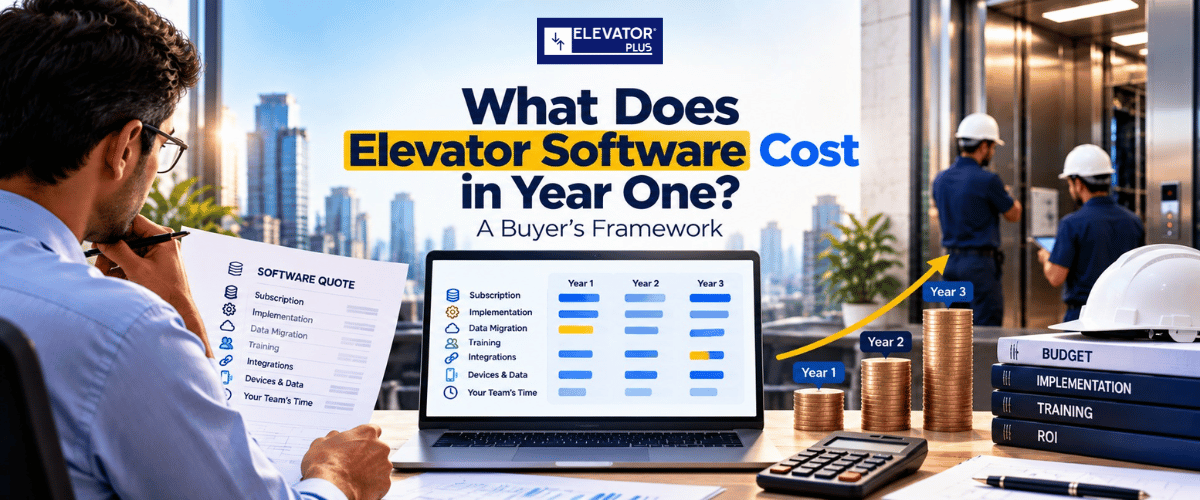
In short: Elevator software cost in year one is seven lines, not one: subscription, implementation, data migration, training, integrations, devices and data, and your own team's time. Most proposals show the first line clearly and the other six loosely. Per-user pricing grows with every technician you add, so price year three as well as year one. Send every vendor the same seven-row table and ask for each cell in writing. The cheapest subscription is often not the cheapest year.
Key takeaways
- The subscription is one line of seven. Implementation, data migration, training, integrations, devices and your team's hours sit outside it, and those six lines are where quotes differ most.
- Implementation can be the biggest single line. Some vendors include it in setup. Others sell it as a separate project with its own price list, paid before the first technician logs in.
- Per-user pricing grows with the thing you bought the software for. Every technician you put on the app adds to the bill every month. In the illustrative example below, the licence line more than doubles by year three.
- Some costs sit underneath the platform. Licences for software the product runs on, charges for new releases, and the cost of getting your data out when you leave.
- Your team's time is a cost nobody invoices. Data cleaning, training sessions and running two systems in parallel all come out of the same office hours that run your service book.
- Compare year one and year three, side by side. A quote that only shows year one is a quote built to look small.
What this guide covers: the seven cost lines · how per-user pricing scales · costs underneath the platform · what should be included · a one-page comparison table · FAQs
What does elevator software cost in year one?
The honest answer depends on your headcount, your number of units under contract, and what the vendor counts as included. The useful answer is a list.
Year one has seven cost lines. Only the first one is usually printed in bold on page one of the proposal. If you are still deciding what this category of software should do for you, start with What Is Elevator Service Software? A Straight Answer for Lift Companies, then come back to the cost.
| # | Cost line | What it covers | How it is usually charged | The question to ask |
|---|---|---|---|---|
| 1 | Subscription | The right to use the platform | Per user, per unit or per company, monthly or annually | What is the total at our year-three headcount? |
| 2 | Implementation | Setting the system up around your contracts, checklists and workflows | Included, a fixed fee, or a separate project with its own scope | Is configuration included, and who on your side does it? |
| 3 | Data migration | Moving customers, sites, units, contracts and service history in | Included, priced per record, or "to be scoped" | Who cleans the data, and is that in the price? |
| 4 | Training | Office team and technicians | Included sessions, or a daily trainer rate | How many sessions, for whom, and in which languages? |
| 5 | Integrations | Accounting, payments, messaging | Native, a paid connector, or a custom build | Who builds it, who maintains it, and at what cost? |
| 6 | Devices and data | Phones or tablets for technicians, mobile data plans | Your own purchase | Which devices and operating system versions are supported? |
| 7 | Your team's time | Hours spent cleaning data, attending training, running in parallel | Never invoiced | How many hours will you need from us, and in which weeks? |
Lines 1 to 5 come from the vendor. Line 6 comes from your own budget. Line 7 comes out of the office, which is why it is the one that overruns.
Why implementation is the line to read first ?
Implementation is where the spread between vendors is widest. At one end, configuration is part of setup. At the other, it is a consulting project with its own statement of work.
Ask for the implementation price in writing, as its own line, with a list of what it includes. If it is sold as a separate project, ask for the scope, the fixed fee or the cap, and what happens if the project runs over. Implementation is paid once; the subscription recurs. Keep them on separate lines so neither hides the other.
Neither model is wrong. A large multi-branch contractor may need a scoped project. A 20-person company usually does not. The point is to see the number before you compare anything else.
Why data migration gets quoted last ?
Migration is the line most often written as "to be scoped after kick-off". That phrase means the cost is not known yet, and you will find out after you have signed.
Ask what format your data needs to be in, who does the cleaning, and what happens to records that do not fit the new structure. Old service history in free text, duplicate customer names and units with no unique ID are the usual problems.
How does per-user pricing scale when you add technicians?
Per-user pricing looks small at the start and grows with your field team. That is the opposite of what you want, because the software only pays back when every technician uses it.
The figures below are illustrative round numbers, not any vendor's price. Assume a licence of 100 per user per month, in whatever currency you pay, and a company that grows its field team over three years.
| Illustrative | Office users | Technicians | Total users | Annual licence at 100 per user per month |
|---|---|---|---|---|
| Year one | 4 | 8 | 12 | 14,400 |
| Year two | 4 | 14 | 18 | 21,600 |
| Year three | 5 | 20 | 25 | 30,000 |
| Three-year total | 66,000 |
The rate never changed. The bill more than doubled, because the business grew.
The predictable response is rationing. The office gets licences, the technicians stay on paper or phone in their visits, and the system never records what happens at the unit. That is the failure the software was bought to fix.
Per-unit pricing behaves the same way in a different direction. It grows every time you win a maintenance contract. Model both at the headcount and unit count you expect in year three, not today's.
What costs sit underneath the platform?
Three costs rarely appear in a proposal because they belong to something other than the subscription.
Licences for the software underneath. Some products in this category are built on top of a general ERP, CRM or field service platform. You may need a licence for that platform too, often per user. Ask one plain question: do we need a licence from anyone other than you to run this?
Release charges. Some vendors include every new release. Others charge for version upgrades, or treat moving to a new version as a paid project. Ask how many releases ship a year and whether each one is included.
Data exit cost. At some point your records will move again. A complete export with attachments, in a format another system can load, delivered in a stated number of days, is a contract term. We set out what a complete data export should include when you leave a vendor. Agree the cost of exit before you sign, not when you are leaving.
What should be included in the price?
A fair year-one proposal names, in writing, which of the seven lines are inside the price and which are not. "Included" counts only if it is written.
Here is what ElevatorPlus includes, so you have one filled-in answer to compare against:
| Cost line | ElevatorPlus position |
|---|---|
| Implementation | Configuration is included in setup. Most customers are fully live within 2 to 7 days. |
| Data migration | Included in setup. |
| Training | Team training is included in setup. The technician app runs in 18 languages on Android and iOS. |
| Releases | 12+ releases a year, included. |
| Software underneath | No third-party licence is required to run ElevatorPlus. |
| Integrations | Tally is live. QuickBooks and Xero connect through our open API. The integration is built by your accounting vendor, by your own team, or by us at a mutually agreed cost. |
| Subscription | For international customers there is no per-user fee and every module is included, so adding technicians does not add to the licence line. The number itself is not published. It is set per company after the Revenue Leak Walk-Through, because it depends on what that walk-through finds. |
The integration line is the one buyers misread most often. ElevatorPlus is not an accounting platform. Your books stay where they are, and the integration carries records between the two. You can see how ElevatorPlus connects to your accounting and payment tools before you ask anyone for a number.
👉 Want to know which of the seven lines would apply to your company?
See how ElevatorPlus connects to the tools you already run →
A one-page comparison table you can copy
Send this table to every vendor on your shortlist. Give each of them the same headcount and unit count for year one and year three. Ask for every cell to be filled, in writing, in the currency you pay in.
| Cost line | Vendor A year one | Vendor A year three | Vendor B year one | Vendor B year three | Vendor C year one | Vendor C year three |
|---|---|---|---|---|---|---|
| 1. Subscription | ||||||
| 2. Implementation | ||||||
| 3. Data migration | ||||||
| 4. Training | ||||||
| 5. Integrations | ||||||
| 6. Devices and data | ||||||
| 7. Your team's time (hours) | ||||||
| Total |
Line 6 is yours to fill. Line 7 is best filled in hours, then multiplied by what an office hour costs you.
How to read the completed table
Four patterns tell you more than the totals do.
- A blank cell. If a vendor will not put a number against a line, that line is not included.
- "To be scoped". This is a number you will learn after signing. Ask for a range or a cap.
- Year three missing. A vendor that prices only year one has not modelled your growth, or has and would rather you did not.
- No renewal terms. Ask what happens to the rate at renewal, and whether any increase is capped.
A video walk-through of this framework publishes on Saturday 10 October.

Frequently asked questions
1. How much does elevator software cost?
It depends on your headcount, your unit count and what the vendor includes. Compare the total of all seven cost lines, in year one and in year three, rather than the subscription rate alone.
2. What is included in elevator software implementation?
Usually configuration of your contracts, checklists, users and workflows. Data migration and training may be inside implementation or priced separately, so ask for each one by name.
3. Why does per-user pricing get expensive for elevator companies?
Because the bill grows with every technician you put on the app, and the software only pays back when every technician uses it. Model the price at your year-three headcount.
4. What hidden costs should I ask about?
Licences for any software the platform runs on, charges for new releases, and the cost of exporting your data when you leave. Add the hours your own team will spend on migration and training.
5. Does elevator software integrate with QuickBooks or Xero?
It depends on the vendor. ElevatorPlus has Tally live and connects to QuickBooks and Xero through its open API. The integration is built by your accounting vendor, by your own team, or by ElevatorPlus at a mutually agreed cost.
6. How long does elevator software take to set up?
It varies widely by vendor. Most ElevatorPlus customers are fully live within 2 to 7 days, with data migration, configuration and team training included.
7. Should I compare vendors on year one or year three?
Both. Year one shows the setup cost. Year three shows how the pricing model behaves as you add technicians and units.
8. Does ElevatorPlus publish its price?
No. Pricing is set per company after the Revenue Leak Walk-Through, because the number depends on what that walk-through finds.
📲 Join our WhatsApp channel for compliance tips, updates: ElevatorPlus - Business Automation Tool
Most elevator software decisions are made on the subscription line. That is the line least likely to decide what the software actually costs you.
The expensive surprises sit in implementation, migration and the hours your office loses in the first three months. They are not hidden on purpose. They are simply not on page one.
Fill the seven-row table for every vendor, for year one and year three. If a vendor will not fill it, you have your answer about that vendor. If they all fill it, the decision usually makes itself.
👉 Get your own seven-line number for year one. Book the Revenue Leak Walk-Through →
Related reading
- Elevator Software Buyer's Guide: 12 Questions to Ask Before You Choose
- Lift Maintenance Software Cost in the UK (2026 Guide)
- Build vs Buy: Should an Elevator Company Build Its Own Software?
- What Happens to Your Lift Data If You Leave a Vendor?
- Why Elevator Software Implementations Fail in Month Four
About the author. Miss Nutan Mandal is the Team of ElevatorPlus, the Elevator Business Operating System used by 200+ elevator companies across 20+ countries.
Sources: Drawn from ElevatorPlus onboarding work with 200+ elevator companies across 20+ countries.