
The AMC Contract Audit: What Are You Servicing?
By Sujit Katariya, ElevatorPlus · Published 31 August 2026 · Last updated 31 August 2026 · ~7 min read
In short: This is not the article about winning lapsed contracts back. This is the one that comes before it. Most lift company owners have never had every AMC on a single sheet, which means they cannot say what they are servicing, what they are billing, or which of those two lists is longer. The audit closes that gap first.
Key takeaways
- The audit is an inventory, not a campaign. Every contract, live and dead, on one sheet with an expiry date and a named owner.
- The gap between what you service and what you bill is the finding. Two lists, compared once.
- Expired but still attended is the row that cannot wait. You are doing unbilled work and carrying the full liability that attending a lift creates.
- Every contract has three honest outcomes and only one is a clean win. Reporting a count instead teaches your office to chase volume.
- The audit is worth nothing if you run it twice. What holds the gain is a dated renewal task with one person's name on it, firing before expiry.
What this guide covers: which article this is · what you are actually servicing · what goes in the audit · unknown as a finding · the expired but still attended row · the three outcome discipline · what changes permanently · FAQs
Which of these two articles do you need?
Quick answer, because there are two.
If contracts have already lapsed and you want them back, you need the renewal recovery playbook. It builds the lapsed list from your invoicing, splits it by why each one lapsed, and runs a ninety day outreach sequence.
This article is the audit underneath it. No outreach, no scripts, no sequence. One question: what are you contractually obliged to service, and does that match what your technicians actually attend? Until you can answer that, any recovery campaign is guesswork with a phone in its hand.
Read this one if the honest answer to "how many live AMCs do you have" is a range rather than a number.
What are you actually servicing right now?
Fewer owners can answer that than you would think, and the reason is structural.
A service business with a few hundred units runs on rhythm. Technicians go where the complaint is. The office invoices the buildings it remembers invoicing. For years that works, because the rhythm carries the knowledge. Then the rhythm and the paperwork drift apart, because nothing forces them back together. A contract ends and the visits continue. A rate set in 2019 renews itself by habit for six years. Neither produces a complaint, so neither surfaces.
The audit is not an accusation. It is the first time anyone has compared two halves of the business that were never designed to be compared.
What goes in the audit, and what stays out?
Six fields. Resist adding a seventh.
Client, building, number of units, expiry date, current annual value, and the name of the person responsible for renewing it. That is the whole first pass. Not the scope, not the payment terms, not the equipment history. Those matter later, and now they will slow you down enough to kill the exercise.
Most operators assemble this in a fortnight from contract files, invoice history and the service manager's memory. Then list every address your technicians attended in the last twelve months. Two lists, side by side. The audit is the comparison.
| Field | What it tells you when it is present | What it tells you when it is blank |
|---|---|---|
| Expiry date | Whether renewal can be scheduled at all | Renewed verbally, or never filed. Treat it as expired. |
| Current annual value | Whether the site still earns what it costs to attend | You are invoicing from habit rather than from an agreement |
| Named renewal owner | Somebody will be asked about it in November | Renewal is everybody's job, which makes it nobody's. Usually the most common blank. |
| On the attended list too | Contract and service agree, which is the normal case | Either you are servicing without a contract or billing without attending |
Write unknown where you do not know. Unknown is a finding, and the one people are most tempted to tidy away with a guess. Forty honest unknowns are useful. Forty invented dates are worse than no sheet, because now the guesses have authority.
Why is expired but still attended the row that cannot wait?
Because it is the only row costing you money every week you leave it.
Here is how it happens. A contract ends in June, and a contract ending produces no event. Breakdowns at that address are still attended in July and August, because technicians go where they have always gone. The office does not invoice it, because the invoice was tied to the contract that ended. Six months later somebody opens the file and the expiry date is last year. That is not negligence. It is what happens when renewal lives in memory instead of in a system.
While it runs you hold the worst version of both positions. No revenue, and every duty that attending a lift attracts. You attended, so you had management or control of that work, and your technician's report exists. If the lift injures somebody, the missing contract removes none of that and removes your ability to point at an agreed scope.
Resolve those rows in the first three weeks, before anything else gets discussed. Two options, both written down. Reinstate on paper at a current rate, or withdraw service formally in writing. There is no third option where you keep attending and hope.
👉 Two lists, compared once. Most owners find the gap in an afternoon. Book an ElevatorPlus demo →
What are the only three honest outcomes for a contract?
Three, and only one is a clean win. Deciding this before you make a single call separates an audit from a scramble.
| Outcome | When it applies | What has to be written down |
|---|---|---|
| Reinstate at a corrected rate | The site earns its keep at today's numbers | The old rate, the new rate, and the reason for the difference |
| Reinstate at the old rate, deliberately | The relationship justifies carrying it, and you know the cost | The margin you are choosing to give up, and a review date |
| Release it | The site never paid, never earned, or cannot be kept running | The reason, and the date you closed the row |
The second row is the one people avoid writing down, and it costs most. A contract reinstated below cost survives for years, because revisiting it means admitting the decision.
Report the split, not the count. If your office reports "eleven contracts recovered", you have taught everybody that volume is the measure, and you will get volume, including the sites that were losing money. Report four corrected, three carried deliberately, four released, with the margin beside each group.
To size it, use your own numbers. Multiply the corrected group by your current average annual value, not the value on the old paper. For the carried group, take the difference between old and corrected rate. For the released group, add up the travel hours those sites consumed. That is what the audit was worth.
What has to change permanently?
The audit is a one time event. Needing it twice means you learned nothing the first time.
What holds the gain is duller than the audit. Four things become true at all times. Every contract has an expiry date in one place everybody uses. Every contract has one named person responsible for renewing it, a person and not a department. Renewal starts a fixed number of days before expiry, ninety for larger portfolios and sixty for smaller ones, fired automatically rather than remembered. And no contract passes its expiry date without appearing on somebody's screen.
Add one more that most operators miss. The attended list and the contract list get compared quarterly, so the gap you just closed cannot reopen silently. That comparison is the control.
None of that is clever, and plenty of well run companies still lack it, because each renewal feels manageable on its own. Only in aggregate does memory fail, and by then the failure is a year old.
Frequently asked questions
How long should the audit take?
A fortnight to assemble, a week to read. Longer than a month and it has become a project, which breakdowns overtake.
Who should do it, sales or service?
Service, because they know which buildings exist. One person assembling, one director reading. Not a committee.
What if half the fields come back unknown?
That is a legitimate result. Count them and treat the count as your baseline. Unknowns falling is the measure of progress.
Should we chase lapsed contracts while the audit is running?
No. Finish the inventory, resolve the expired but still attended rows, then run recovery separately.
What about a contract we cannot find at all?
It does not exist. Treat the site as uncontracted, re-paper it, and stop searching. Filing archaeology is worse value than one honest phone call.
Do we need software to do this?
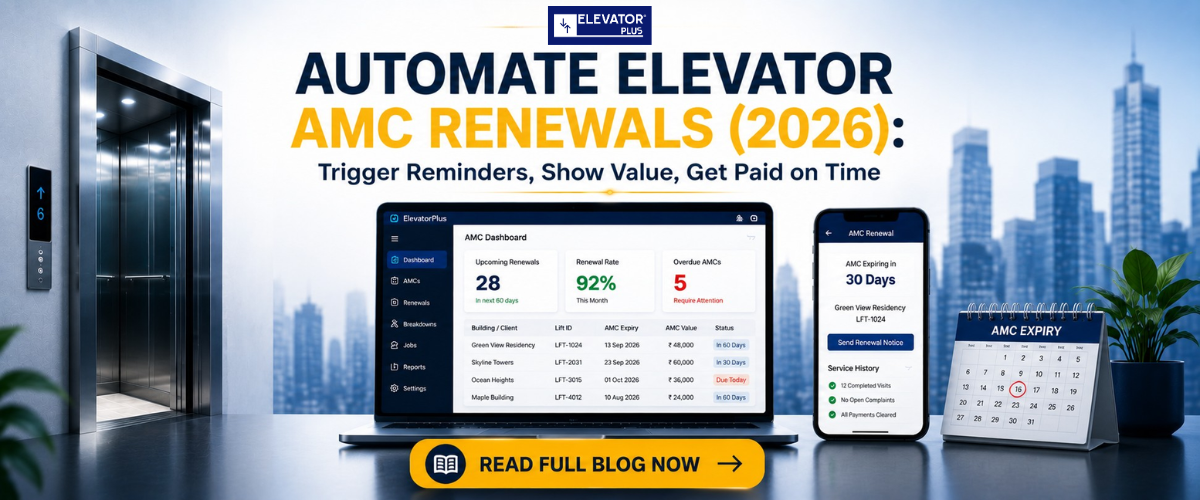
No. You need a reliable list, a schedule and an owner. Software matters once keeping that list by hand becomes its own failure point, which for most operators arrives past two hundred contracts.
How do we know it worked?
Ask the question again in twelve months. If the answer to "how many live AMCs do you have" is still a range, it did not.
📲 Join our WhatsApp channel for compliance tips, updates: ElevatorPlus - Business Automation Tool
The audit is unglamorous and it cannot be skipped. Six fields, two lists, one comparison. Resolve the sites you attend without a contract inside the first month. Then decide each remaining contract into one of three outcomes and write down which one and why.
Then make renewal a dated task with a name on it, and compare the two lists quarterly.
Do the list first. The recovery work is easier when you know what you have.
See how ElevatorPlus keeps contracts, expiry dates and renewal owners in one place →
Related reading
- Winning back lapsed AMCs: the renewal recovery playbook
- The clauses that decide whether a lift AMC makes money
- How to automate AMC renewals
- Independence from spreadsheets
About the author · Sujit Katariya is part of the ElevatorPlus team, which builds the Elevator Business Operating System used by 200+ elevator companies across 20+ countries.
Sources: No external statistics are cited here. The audit field list, the observation that a named renewal owner is the most commonly blank field, and the frequency of the expired but still attended finding are ElevatorPlus client onboarding and implementation observations, 2026, not published research. The ninety and sixty day renewal lead times are recommended practice, not a measured result. Liability duties differ by jurisdiction, so confirm your position with your insurer and your regulator.
👉 Follow ElevatorPlus on,
Instagram LinkedIn Facebook YouTube Qoura Substack Twitter