Lift Repair Quote Approval After a Breakdown: A Checklist
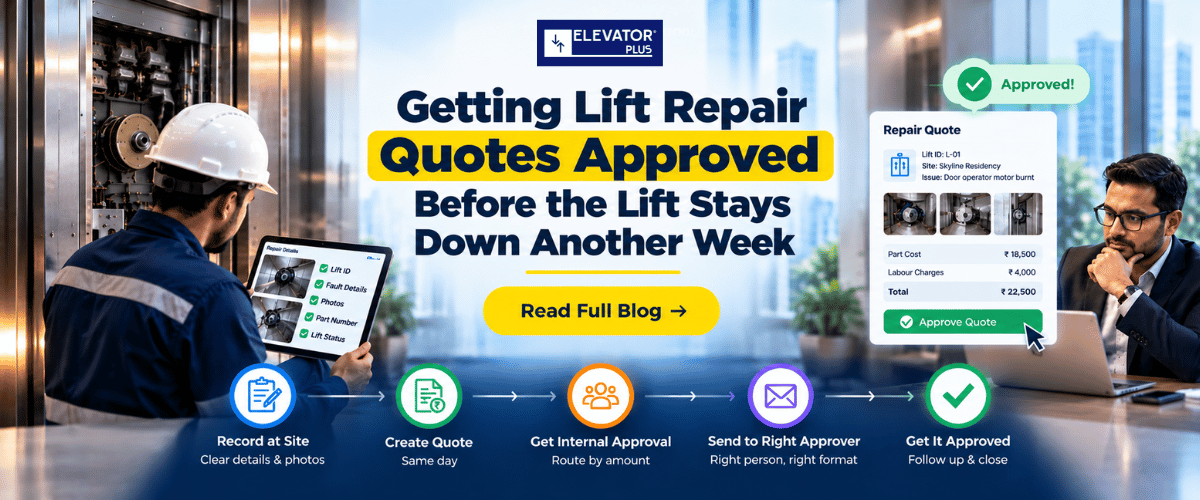
Getting Lift Repair Quotes Approved Before the Lift Stays Down Another Week
By Miss. Nutan Mandal, ElevatorPlus ·
In short: Lift repair quote approval stalls in four places: the technician's notes, your own internal sign-off, the wrong person at the customer, and silence after sending. Fix each one. Record the fault with photos before leaving site. Send the quote the same day in the format the customer already knows. Route it internally by amount. Send it to whoever can actually approve, ask how many signatures they need, and follow up on a fixed schedule until it is signed.
Key takeaways
- The lift is usually down for paperwork, not parts. Most of the waiting sits between "technician found the fault" and "customer said yes".
- Approval starts at the lift, not in the office. A quote built from a vague WhatsApp message gets questioned. A quote with photos and the lift ID gets approved.
- Check the AMC before you quote. On a comprehensive AMC, many parts are already covered. Quoting for them damages trust you will need at renewal.
- Find the real approver on day one. In a housing society that is often two office-bearers, not the person who called in the complaint.
- Silence is a status, so track it. A quote that has been opened and not signed needs a different call from one that was never opened.
- Get the yes in writing. A verbal approval on the phone becomes a payment dispute three months later.
What this guide covers: where the days go · what the technician records on site · AMC or chargeable · what the quote must say · internal approval · who signs at the customer · a seven-day follow-up plan · three numbers to track · FAQs
Where do the days go after a lift breaks down?
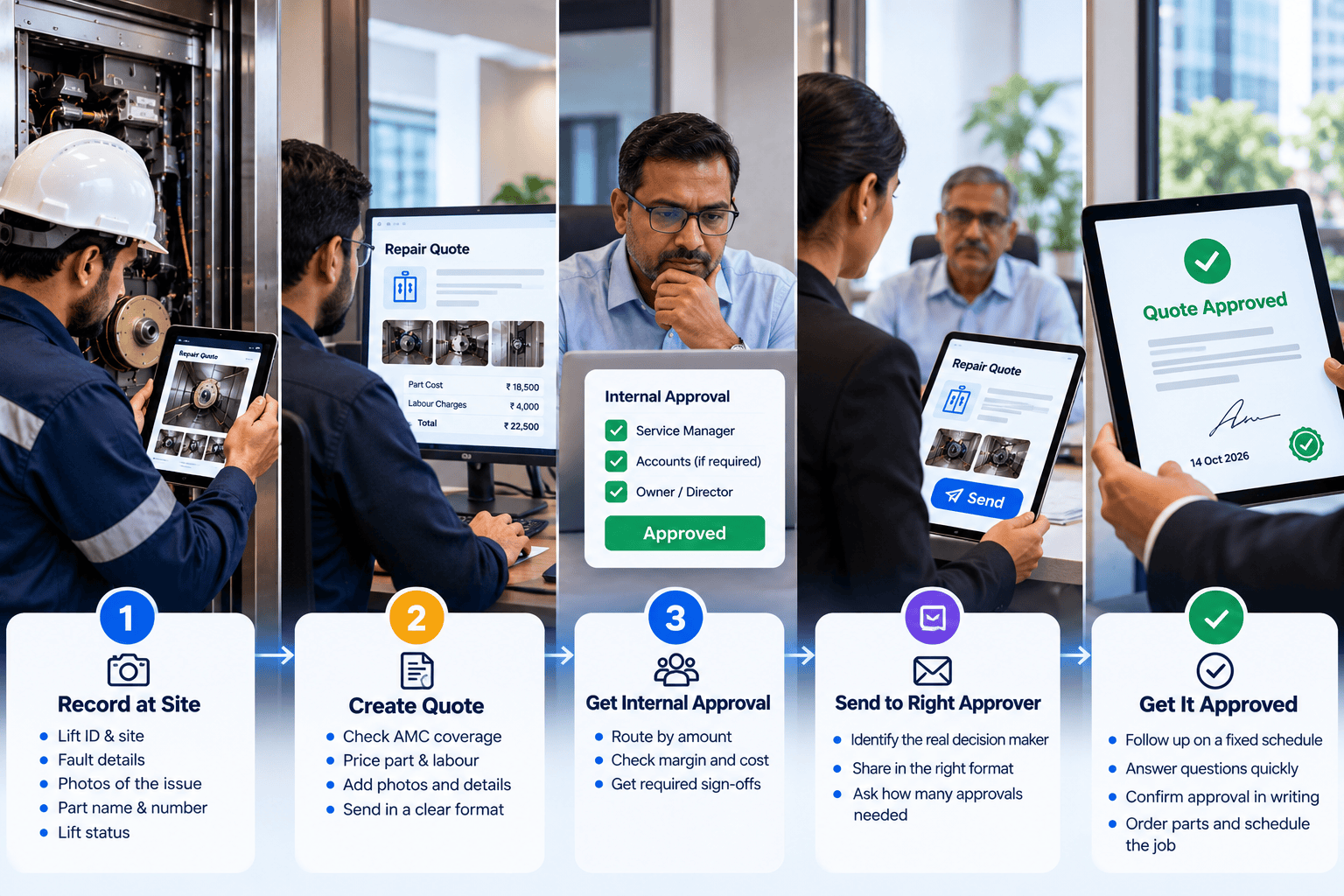
A breakdown call comes in. Your technician attends, finds that the door operator, a controller card or the ropes need replacing, and switches the lift off or leaves it running with a warning. Then the clock starts on a different problem: getting someone to approve the money.
Here is where the days go, in our onboarding experience. The right-hand column is the part nobody planned for.
| Stage | What should happen | What usually stalls it |
|---|---|---|
| On site | Technician records the fault, the part needed and photos | A two-line WhatsApp message with no lift ID and no photo |
| Back at office | Someone prices the part and labour and drafts a quote | The person who prices repairs is out, so it waits |
| Internal approval | A manager checks margin and signs off before it goes out | The owner is travelling and approves by phone, two days later |
| Sent to customer | The quote reaches whoever can approve the spend | It goes to the security supervisor or the resident who complained |
| Customer decision | The approver asks questions, then signs | Questions arrive by phone, nobody writes them down, the quote is revised twice |
| Parts and scheduling | Part is reserved or ordered, job is booked | Part ordered only after approval, so the lead time starts late |
Each stall is small. Together they keep a lift out of service while residents climb stairs and call your office.
For the wider view of what your systems need to do across breakdowns, AMC and stores, see Elevator Maintenance Software: What It Has to Do (2026).
What should the technician record before leaving site?
The quote is only as good as the information behind it. If the office has to call the technician back to ask which lift, which part and how bad, you have lost a day before pricing starts.
| Record on site | Why the approver needs it |
|---|---|
| Lift ID and site | So the quote matches the lift in the AMC and nobody argues about which car |
| The fault in plain words | "Door operator motor burnt" is understood. A fault code alone is not |
| Two or three photos of the worn or failed part | Committees approve what they can see |
| Part name and number | Lets the office price it and check stock without a callback |
| Lift status when you left | Running normally, running with a restriction, or switched off and why |
| Whether the fault can get worse | Separates "fix this week" from "fix at the next visit" |
| Customer contact present on site | Who saw the fault and who was told |
The lift status line matters more than it looks. If you left the lift switched off for safety, write that down with the time and the name of the person you informed. If the repair is delayed by approval, that record shows the delay was the customer's decision, not your neglect.
Is the repair covered by the AMC or chargeable?
Check this before you price anything. Quoting a society for a part their comprehensive AMC already covers is the fastest way to lose the renewal.
| AMC type | Typical position on parts | What to quote |
|---|---|---|
| Comprehensive | Most parts included, with listed exclusions | Only the excluded items, with the clause reference |
| Non-comprehensive | Labour included, parts charged | Parts, plus any labour outside the contract scope |
| No AMC or lapsed | Everything chargeable | Parts and labour, and offer a fresh AMC alongside |
The exclusions list in your contract decides most arguments. Common ones are ropes, major controller replacement and damage from misuse or water. If yours are vague, fix them at renewal. We go through how to write them in The Clauses That Decide Whether a Lift AMC Makes Money.
A lapsed AMC is a special case. If your team is still attending breakdowns at a site with no contract, the repair quote is also your renewal conversation. Send both together.
What should a repair quote for a stalled lift say?
A repair quote after a breakdown is a different document from a new-installation quote. The reader is not comparing vendors. They want to know what broke, what it costs, and how fast the lift will run again.
| Section | What to include |
|---|---|
| Header | Your format, your logo, quote number, date, validity |
| Site and lift | Society or building name, lift ID, location of the lift |
| What we found | The fault in two or three plain sentences, with the photos |
| What we recommend | The part and labour, line by line |
| Lead time | Days to get the part after approval, from your stock or the supplier |
| If not approved | The lift stays out of service, or runs with the stated restriction |
| AMC position | Covered, partly covered, or chargeable, with the clause |
| Payment terms | As your contract sets them |
| Who must sign | Space for the approver's name, designation and date |
Keep it to one page, with the photos next to the price. An approver who sees a burnt motor beside the number asks fewer questions. Use the format the customer already knows from you; a new-looking document invites a new round of questions.
Who in your company should approve before it goes out?
Most lift companies either approve nothing internally, or route everything to the owner. The first loses margin. The second loses days.
Set amount bands and stick to them.
| Repair value | Who approves internally | Target turnaround |
|---|---|---|
| Below your first threshold | Branch or service manager | Same day |
| Between thresholds | Operations head | Same day |
| Above your top threshold | Owner or director | Within one working day |
Set the thresholds from your own repair history. Most quotes should never need the owner, and the ones that do should reach the owner's phone, not a pile on the desk.
👉 How long do your repair quotes wait for internal sign-off today? See how approval workflows route quotes by amount →
Who actually signs at the customer?
The person who called in the breakdown is rarely the person who can approve the spend. Ask on the first call: who approves repairs, and how many signatures do you need?
| Customer type | Who usually reports the fault | Who usually approves the spend |
|---|---|---|
| Housing society | Security supervisor, a resident, the facility manager | Office-bearers such as the secretary and treasurer; larger amounts may wait for a committee meeting |
| Builder-maintained building | Site engineer or facility staff | The builder's head office or purchase team |
| Commercial building | Facility manager | Facility manager within a limit, purchase team above it |
Write the approver's name and number against the site once, so the next breakdown does not start from scratch. If a society needs two office-bearers, send the quote to both at the same time, not one after the other.
If a large repair must wait for a committee meeting, ask the date, and send a summary the secretary can read out: what broke, the photos, the price, and what waiting means.
A seven-day follow-up plan
Most quotes are not rejected. They are forgotten. A fixed follow-up schedule stops that.
| Day | Action | Purpose |
|---|---|---|
| Day 0 | Send the quote with photos the same day the fault is found | Momentum while the lift is fresh in everyone's mind |
| Day 1 | Check whether it was opened. If not, call the approver | Find out if it reached the right person |
| Day 2 | Answer questions in writing and revise once if needed | Avoid a second revision later |
| Day 3 | Call the second signatory if two are needed | Stop one signature waiting on another |
| Day 5 | Send a short written note: lift status, part lead time, validity date | Puts the cost of waiting on record |
| Day 7 | Owner-to-secretary call | Escalate before the quote goes stale |
Record every call and every answer against the quote. When the society later asks why the lift was down for nine days, you can show exactly where the days went.
How ElevatorPlus handles repair quotes ?
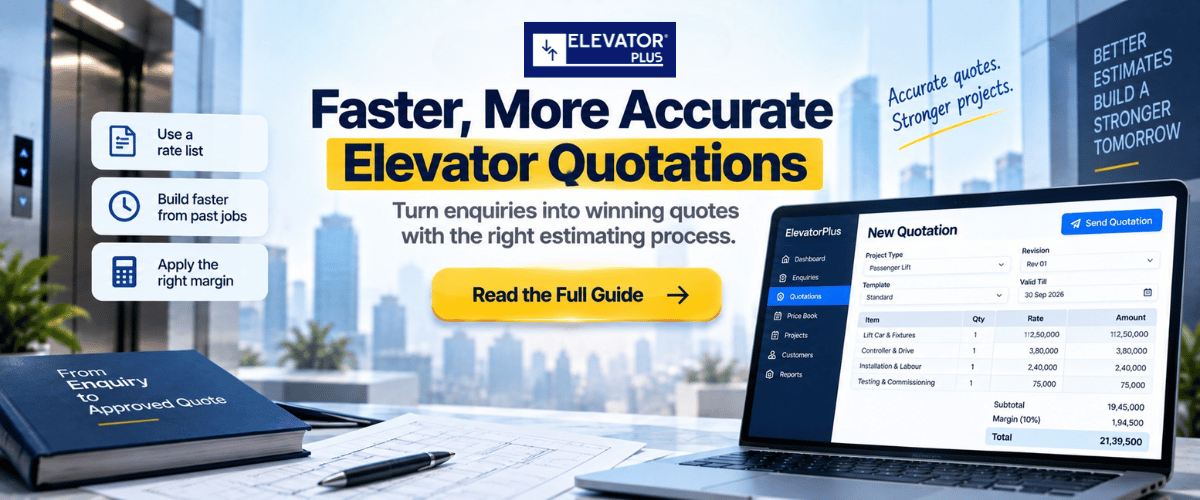
Quick quotation in ElevatorPlus does not ask you to change your quote. You send us the format you use today and our team rebuilds it during onboarding. If you use a different format by lift type or by branch, we set up more than one. Quotes go out as PDFs you can share on WhatsApp.
Approval workflows route each quotation by amount, so smaller ones go to the branch manager and larger ones to the operations head or owner. Approvals are actioned from the mobile app, and every approval and rejection is logged with who, when and why.
Digital signatures cover the customer's side. Repair quotations can be signed digitally, the same way as contracts. The quotation is sent over WhatsApp or email, the approver opens the link, reviews the PDF and signs, so the written yes arrives in the same step as the quote. You see which documents are sent, opened, signed or pending, and the signed document is stored in the client record. When the repair is done, the customer can sign the service report at site.
What three numbers tell you it is working?
Pull these from your own records for the last 20 chargeable repairs.
| Number | How to measure it | What it tells you |
|---|---|---|
| Fault found to quote sent | Days between the technician's visit and the quote leaving your office | How fast your office and internal approval move |
| Quote sent to approval | Days between sending and a written yes | How well you reach the real approver and follow up |
| Lift out of service waiting for approval | Days the lift was off while the quote was pending | The number the society actually feels |
Measure them now and again after three months. A long first number is an internal problem. A long second number is about who you send to and how you follow up.
Frequently asked questions
1. Why do lift repair quotes take so long to approve?
Usually because the quote lacks photos or a lift ID, waits for internal sign-off, goes to someone who cannot approve the spend, or is never followed up.
2. What should a lift repair quotation include?
The site and lift ID, the fault in plain words, photos of the failed part, the part and labour cost, the lead time after approval, the AMC position, what happens if it is not approved, and space for the approver's signature.
3. Who approves lift repairs in a housing society?
It varies by society. Often two office-bearers such as the secretary and treasurer, and larger amounts may wait for a committee meeting. Ask on the first call and record the answer against the site.
4. Should a repair be quoted if the lift is under a comprehensive AMC?
Only for items the contract excludes. Check the exclusions list and quote the clause, so the society can see why the item is chargeable.
5. How often should we follow up on a pending repair quote?
On a fixed schedule: same-day send, a call on day 1, written answers on day 2, the second signatory on day 3, a written status note on day 5, and an owner call on day 7.
6. Is a verbal approval enough to start a lift repair?
It is risky. A written or signed approval protects both sides when the invoice arrives.
7. Can ElevatorPlus use our existing quotation format?
Yes. Our team rebuilds your existing format during onboarding, and can set up more than one format by lift type or branch.
📲 Join our WhatsApp channel for compliance tips, updates: ElevatorPlus - Business Automation Tool
When a lift waits a week for a repair, the part is rarely the reason. The quote is.
Most of the fix costs nothing. Ask the technician for photos and a lift ID. Set internal approval limits so the owner sees only the big ones. Find the real approver on day one and follow up on a schedule.
Do that, and the society stops seeing a repair quote as a sales document. They see it as the fastest way to get their lift back, which is what it should be.
Related reading
- Elevator Estimating and Quotation Software (2026 Guide)
- The Clauses That Decide Whether a Lift AMC Makes Money
- Reduce Elevator Breakdown Response Time: 2026 Guide
- The Real Cost of Lift Downtime, Argued Properly
About the author. Miss. Nutan Mandal is the Team of ElevatorPlus, the Elevator Business Operating System used by 200+ elevator companies across 20+ countries.
Sources: Drawn from ElevatorPlus onboarding work with 200+ elevator companies across 20+ countries.
👉 Follow ElevatorPlus on,
Instagram LinkedIn Facebook YouTube Qoura Substack Twitter