Lift Installation Stages in India and Who Signs Each One
By Mr. Sujit Katariya, ElevatorPlus ·
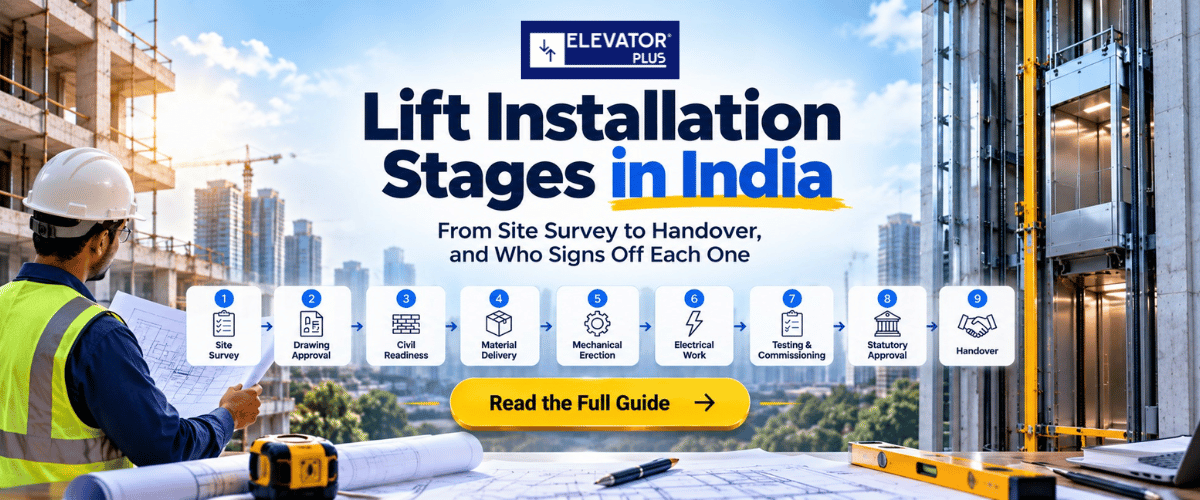
In short: A typical lift installation in India runs through nine stages. They are site survey, drawing approval, civil readiness, material delivery, erection, electrical work, testing, the state's statutory step, and handover. Each stage should end with a signature from the customer side and one document you keep. Without those signatures, every delay caused by the site looks like your delay. The statutory step depends on your state's lift Act, so check it before you promise a handover date.
Key takeaways
- Lift installation stages are a chain of signatures, not a list of tasks. Each stage ends when someone on the builder's side signs, not when your team finishes.
- Civil readiness is the stage that decides your timeline. Most installation delays start in a shaft that was handed over before it was ready.
- Material at site needs a named custodian. A delivery challan signed by the builder's storekeeper puts the stored material in a named person's hands.
- The statutory step is set by your state, not by the contract. Licence terms differ: ten years in Karnataka, three years in Kerala, and no lift Act at all in Telangana.
- Handover starts two clocks. The warranty period and the AMC renewal conversation both begin on the date the handover letter is signed.
What this guide covers: The nine stages · Who signs each one · Civil readiness · Material at site · The statutory step by state · Handover, warranty and AMC · Delay records · FAQs
What are the stages of a lift installation in India?
The nine stages below are an example sequence, the one we see most often on new installations in India, whether the customer is a builder, a housing society or a commercial owner. Your company may split, merge or add stages to match its own standards and SOPs. The time each stage takes varies, because half of the stages depend on the site.
Your team controls erection, wiring and testing. The builder controls the shaft, the power supply and access. The state controls the statutory step. Carry the sheet below on every site: one row per stage, one signature, one document.
| # | Stage | What has to be true before it closes | Who signs on the customer side | Document you keep |
|---|---|---|---|---|
| 1 | Site survey | Shaft size, pit depth, overhead and machine room or top floor measured | Builder's site engineer | Survey sheet with measurements and photos |
| 2 | Drawing approval | Layout drawing matches the survey and the order | Builder or architect | Signed drawing, with revision number |
| 3 | Civil readiness | Shaft finished, pit dry, openings correct, power and storage available | Builder's site engineer | Shaft handover checklist with pending items listed |
| 4 | Material delivery | Every item on the challan received and stored | Builder's storekeeper | Delivery challan signed with date and storage location |
| 5 | Mechanical erection | Rails, car, counterweight and doors fitted and aligned | Your supervisor (internal) | Erection check sheet and dated site photos |
| 6 | Electrical work | Wiring complete, permanent power supply connected | Builder's electrical contractor for the supply | Wiring check sheet, note of the supply connection date |
| 7 | Testing and commissioning | The lift runs through your full test routine | Your commissioning engineer (internal) | Test report, signed |
| 8 | Statutory step | Whatever your state's lift Act requires before use | Set by the state | Copies of whatever the state issues |
| 9 | Handover | Lift handed to the owner in working order | Builder or owner | Handover letter with date, warranty terms and support contact |
Two rows are internal signatures and one belongs to the state. The other six need someone from the customer side. That is the point of the table. You cannot argue about a delay later if the site never signed that the shaft was ready.
For the state-by-state position on which law applies, see Lift Rules by State in India: What 15 States Actually Require (2026).
Who should sign off each stage, and why does it matter?
A signature does two jobs. It proves the stage happened on a date, and it shows who accepted it. Both matter when the project slips and the builder asks why the lift is late.
Name one person on the customer side for each signature, in the order itself. Builders change site engineers, and "the builder's representative" signs nothing.
Keep the rule simple. No stage moves forward on a phone call. A WhatsApp message saying "shaft is ready, start" is not a signature. Ask for the checklist to be signed, or at least photographed with the signer's name and date on it.
What does the survey sign-off protect?
The survey is where most rework starts. A shaft measured 50 mm narrower than the drawing becomes a fabrication change, a delay and a cost argument. Measure at three heights, photograph the tape, and get the builder's engineer to sign the sheet on site. If the shaft is not built yet, survey the drawing and survey again before erection.
Why does civil readiness decide your timeline?
Because once your team is on site, every day the shaft is not ready costs you labour and blocks another project. Civil readiness is the stage most often handed over early under pressure.
A shaft handover checklist should cover, at the least:
| Item | Ready means |
|---|---|
| Shaft walls | Plastered and plumb, openings at every floor as drawn |
| Pit | Dry, at the drawn depth, with no water seepage |
| Top of shaft | Machine room or headroom complete as drawn, hook fixed if your design needs one |
| Power | Construction power available for your tools, and a date for permanent supply |
| Storage | A lockable room for material, with a named key holder |
| Access | Scaffolding and safe access agreed, and who provides it |
Sign the checklist with every pending item written on it. "Pit seepage to be fixed by builder" with a date is worth more than a clean signature on a shaft that is not ready. When that date slips, you have it in writing.
Who is responsible for material once it reaches site?
Agree that in writing before you dispatch. The person who signs the challan and holds the storage key should be the builder's storekeeper, not your technician.
Lift material sits on site for weeks before erection. Door panels become walkways, small parts go missing, rails get bent by other trades. If nobody on the builder's side signed for it, the loss lands on you.
Ask for three things on every challan: the signer's name, the date, and where the material is stored. Photograph the material in storage the same day. If the builder will not provide lockable storage, write that on the civil readiness checklist before you dispatch.
What is the statutory step, and does every state have one?
No. The statutory step depends on the state, and India has no national lift law. Some states issue a licence to work the lift. Some inspect on a fixed cycle. Telangana has no lift Act in force at all.
Licence terms show how far apart the states are. These are the three we have read in the Act text:
| State | What the Act says about the licence | Source |
|---|---|---|
| Karnataka | Licence valid for ten years, renewable every five years | Karnataka Lifts, Escalators and Passenger Conveyors Act 2012, section 5 |
| Kerala | Licence valid for three years, then renewed annually after an inspection | Kerala Lifts and Escalators Act 2013 as amended 2018, section 4(5) |
| Maharashtra | The live law is the Maharashtra Lifts Act 1939 and the Bombay Lift Rules 1958. Neither states a licence validity term | Maharashtra Lifts Act 1939; Bombay Lift Rules 1958 |
Two warnings. In Maharashtra, the 2017 Act that many people quote has never been brought into force. And who files, which forms, and how long the government takes are set by each state's Act and Rules. Check your state's lift Act and Rules before you write a handover date into a contract.
The full picture for 15 states is in Lift Rules by State in India: What 15 States Actually Require (2026). For the two southern states side by side, read Kerala and Karnataka Lift Compliance: Two States, Two Completely Different Clocks.
What should the handover letter contain?
The handover letter is the last signature and the most important one. It starts the warranty and it ends your custody of the lift.
| Field | Why it is on the letter |
|---|---|
| Lift ID and location | So the letter cannot be applied to the wrong lift in a multi-tower project |
| Handover date | Starts the warranty period |
| Warranty period and what it covers | Ends the argument about what is free later |
| Test report reference | Shows the lift was tested before handover |
| Statutory documents attached, if any | Shows which state step was completed |
| Support contact for breakdowns | Tells the owner who to call from day one |
| Signature, name and designation | The person who accepted the lift |
Watch the handover to a builder whose flats are not yet occupied. The lift may stand idle for months, but the warranty clock is already running.
How do installation stages connect to warranty and AMC?
The warranty end date is your AMC start date. If nobody writes it down at handover, the lift drifts out of warranty with no contract behind it. Your team keeps answering breakdown calls for free.
Put the warranty end date into your AMC renewal list on the day of handover. In ElevatorPlus, AMC management sends reminders 60 days, 30 days and 1 day before expiry. The AMC conversation starts two months before the warranty ends, not after the first unpaid breakdown.
How should you record delays during installation?
Record every delay with three facts: the stage, the cause, and who owns the cause. "Erection stopped 12 days, pit water, builder" is a usable record. "Delayed due to site issues" is not.
| Delay owner | Typical causes | What to record |
|---|---|---|
| Builder | Shaft not ready, no power, no storage, access blocked by other trades | Date raised, date resolved, photo, name of person informed |
| Lift company | Material shortage, team not available, rework | Date, cause, revised date |
| Neither | Statutory step pending, weather, festival shutdown | Date, cause, document reference |
When the builder asks why the lift is late, this table answers in one page. It also tells you how much buffer to add on that builder's next project.
Project management in ElevatorPlus does not impose a stage list. Stages are fully configurable: your company sets as many stages as it wants, named and ordered to its own standards and SOPs. The nine in this guide are one example; set it up your way. ElevatorPlus then tracks plan dates against actual progress for each stage. The team on site adds photos and remarks, and a delay alert goes out when a stage overruns. Handover letters are generated from the same project record.
👉 Can you see today which of your installations is waiting on the builder, and since when? See how installation stages and site photos are tracked in ElevatorPlus →
Frequently asked questions
1. What are the stages of a lift installation?
A typical sequence is site survey, drawing approval, civil readiness, material delivery, mechanical erection, electrical work, testing and commissioning, the state's statutory step, and handover. Many companies add or split stages to match their own SOPs. Each stage should close with a signature and a document.
2. Who signs off civil readiness for a lift shaft?
The builder's site engineer, on a shaft handover checklist that lists any pending civil items with a date. Do not start erection on a verbal go-ahead.
3. Is a lift licence required in every Indian state?
No. It depends on the state's lift Act. Karnataka and Kerala issue licences with different validity periods. Telangana has no lift Act in force. Check your state's lift Act and Rules.
4. How long is a lift licence valid in Karnataka?
Ten years, renewable every five years, under section 5 of the Karnataka Lifts, Escalators and Passenger Conveyors Act 2012.
5. When does the lift warranty start?
Usually on the handover date written in the handover letter, unless your contract says otherwise. Write the date and the warranty period on the letter itself.
6. Who is responsible for lift material stored on site?
Agree it in the contract before dispatch. Then ask the builder's storekeeper to sign the challan with the date and storage location, so there is a named custodian.
7. How do I avoid being blamed for installation delays caused by the site?
Record every delay with the stage, the cause, the owner of the cause and a date. Get pending civil items written on the signed shaft handover checklist.
📲 Join our WhatsApp channel for compliance tips, updates: ElevatorPlus - Business Automation Tool
Installation projects in India rarely go wrong in the shaft. They go wrong in the paperwork around the shaft. The lift is fine. The argument is about who was late, who lost the door panel, and when the warranty started.
Nine stages, nine signatures, nine documents. It sounds like admin. It is the only thing that protects your timeline and your margin when a builder is behind on his own project.
Start with civil readiness and the handover letter. Those two signatures settle most of the disputes we see.
👉 See where your installations lose days and money. Book the Revenue Leak Walk-Through →
Related reading
- Lift Rules by State in India: What 15 States Actually Require (2026)
- The Maharashtra Lift Act Everyone Quotes Has Never Come Into Force
- Kerala and Karnataka Lift Compliance: Two States, Two Completely Different Clocks
- Gulf Lift Installation: Contract Award to Handover
- Elevator Maintenance Records in India: What You Must Keep
About the author. Mr. sujit Katariya is the Team of ElevatorPlus, the Elevator Business Operating System used by 200+ elevator companies across 20+ countries.
Sources: Karnataka Lifts, Escalators and Passenger Conveyors Act 2012, section 5. · Kerala Lifts and Escalators Act 2013 as amended 2018, section 4(5). · Maharashtra Lifts Act 1939 and Bombay Lift Rules 1958. · State lift Acts and Rules as read by ElevatorPlus, September 2026. · Drawn from ElevatorPlus onboarding work with 200+ elevator companies across 20+ countries.
👉 Follow ElevatorPlus on,
Instagram LinkedIn Facebook YouTube Qoura Substack Twitter