
Elevator Maintenance Records in India: What You Must Keep
By Mr. Sumeet Katariya, ElevatorPlus · Statutory positions read from the Acts and Rules, September 2026
In short: An Indian lift company keeps two sets of records, not one. The first is whatever its state Lift Act requires, and the states disagree sharply: most require a log book for every lift, while Delhi and Kerala require none at all. The second is whatever the maintenance contract requires, and that is usually the stricter of the two. In July 2026 the Supreme Court decided a fatal lift case largely on records a maintenance contractor could not produce, and the contract it examined had required every one of them.
Key takeaways
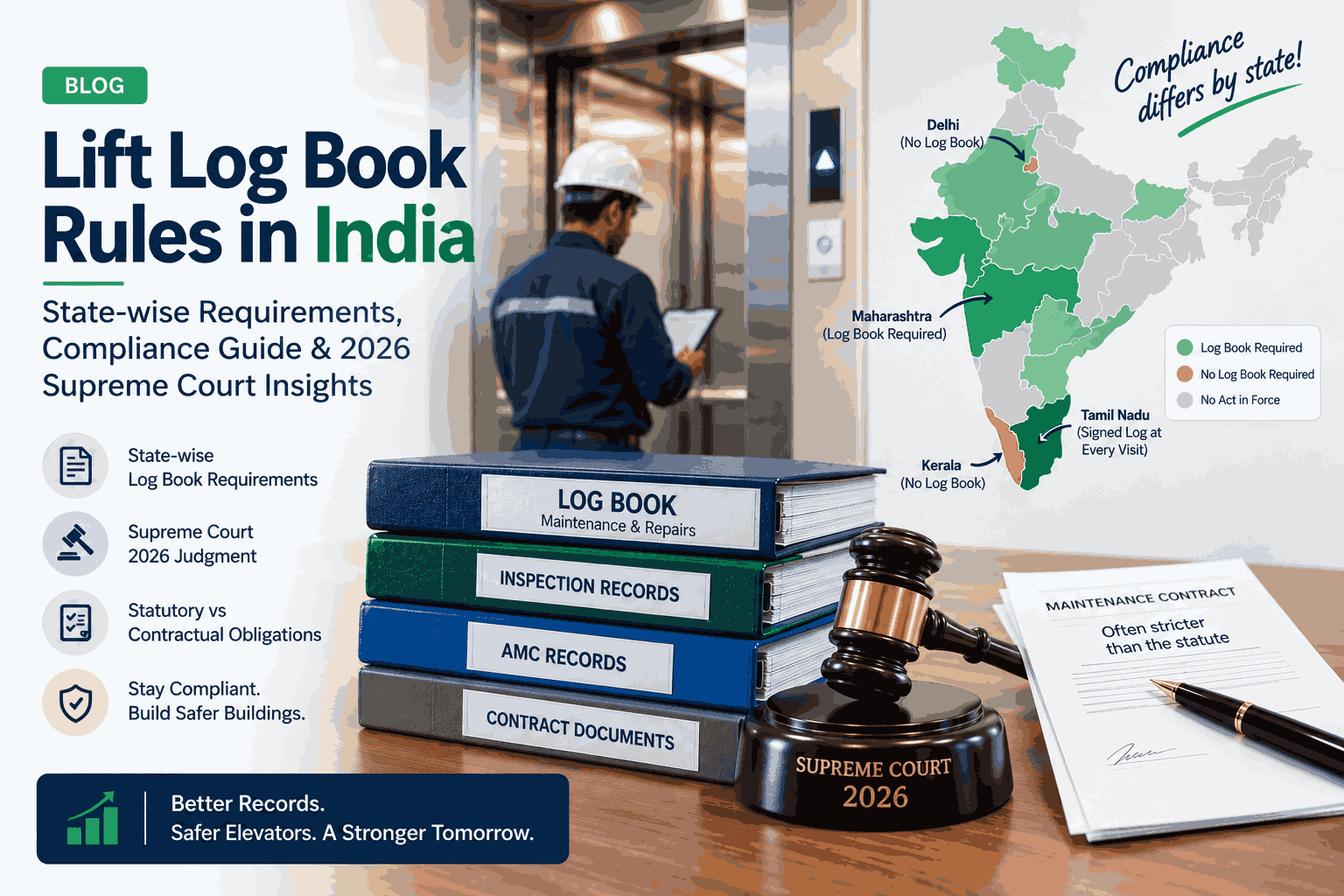
- Most states with a Lift Act require a per-lift log book. Maharashtra, Karnataka, Gujarat, Uttar Pradesh, West Bengal, Haryana, Himachal Pradesh, Assam and Andhra Pradesh all require a record kept against each unit.
- Delhi and Kerala require none. Neither the Bombay Lifts Act 1939 as extended to Delhi with the Delhi Lifts Rules 1942, nor the Kerala Lifts and Escalators Act 2013 with its Rules, imposes a log book duty.
- Tamil Nadu now requires a signed log at every visit. Since the third of February 2026 the maintenance log is uploaded at every preventive maintenance visit or repair and closes with two signatures.
- Karnataka requires testing once in every three months. Section 14(3) of the Karnataka Lifts, Escalators and Passenger Conveyors Act 2012 requires testing and maintenance by a registered person, a register, and an annual report.
- Maharashtra runs on a law from 1939. The Maharashtra Lifts, Escalators and Moving Walks Act 2017 is widely quoted and has never been brought into force.
- The contract is usually stricter than the statute. In the 2026 judgment the court read the maintenance contract, not the state Act, and the contract required attendance registers, daily certification and a signed per-lift book.
What this guide covers: the two sources of obligation · which states require a log book · what the Supreme Court decided in July 2026 · the records that decided that case · who signs and when · how long to keep them · why records fail in practice · FAQs
What records must an Indian lift company keep?
There are two sources of obligation and they are frequently confused.
The first is the state Lift Act. Around a dozen Indian states have one. They disagree with each other on almost everything that matters operationally: whether a log book exists, how often an inspector attends, and who is even permitted to maintain a lift.
The second is the maintenance contract you signed. This is the one most owners underestimate, because it is the one that gets read out when something goes wrong. A comprehensive maintenance contract typically specifies attendance at site, servicing frequency, response times, and what has to be signed and by whom. Those obligations bind you whether or not your state requires anything at all.
An operator in Delhi has no statutory log book duty and may still owe a daily signed certification under contract. An operator in Karnataka owes both.
Which states require a log book, and which do not?
| State | What the state requires you to keep | The official inspection clock |
|---|---|---|
| Maharashtra | Log book at each lift recording every repair and alteration, with the contractor entering the result of monthly checks | At least once in six months |
| Karnataka | A register, plus an annual testing and maintenance report filed with the authorised officer | Once in a year, with testing by a registered person once in every three months |
| Tamil Nadu | Maintenance log uploaded at every visit, signed by the technician and the owner or authorised signatory | No fixed cycle; inspections allotted through the portal |
| Kerala | Nothing. No log book, register or maintenance report in the Act or the Rules | Licence renewed annually after inspection, after an initial three years |
| Delhi | Nothing. No log book duty in the Act or the Rules | At least once in six months |
| Gujarat | Owner's log book of every repair, with monthly maintenance recorded in it by the authorised person | Once in five years, with a yearly test by an authorised person |
| Uttar Pradesh | A maintenance logbook and a separate accident logbook, displayed at the lift in public premises | No periodic inspection; entry on complaint only |
| West Bengal | Per-lift log book of every repair and routine visit, with the six-monthly inspection entered and filed | At least once in five years |
| Telangana | Nothing. There is no lift Act in force | None |
Read the Delhi and Kerala rows against the Maharashtra row. The two jurisdictions with no log book duty are not the two where records matter least. They are the two where the only thing standing between you and an unanswerable question is your own contract, which is precisely the situation the Supreme Court examined in 2026.
What did the Supreme Court decide in July 2026?
The judgment, reported as 2026 INSC 756 and delivered on the twenty-ninth of July 2026, decided an appeal arising out of a death in a lift at a government building in New Delhi in March 2003.
It held three things. That a lift is to be treated as a common carrier, because a passenger steps into a machine over which they have no control. That the manufacturer, the operator and the owner of the premises are duty bearers who are jointly and severally liable to safeguard the user. And that a party who undertakes the comprehensive maintenance of a machine of that kind owes its users a heightened duty of care.
It upheld compensation of Rs 3,01,48,195 with interest running from the date of death in 2003.
Two things it did not do are worth stating plainly, because both are circulating as fact. It gave no direction to any government and ordered no lift legislation. And it did not rule that every maintenance company now carries seventy percent of every accident: that apportionment turned on one company being both the manufacturer of the lift and the holder of its maintenance contract, which the court described as a position of unique knowledge and control.
Which records did the court actually examine?
The court set out the maintenance contract clause by clause, and then recorded what the contractor produced against it.
The contract required an attendance register for each shift, checked every day by the customer's engineer. It required the mechanic to certify every morning, in a complaint register kept for each lift, that the lift had been checked and found fully functional in every respect. It required a maintenance schedule book to be kept for each lift and produced to the customer's engineer daily and signed. It required fortnightly servicing of each lift with a record maintained for it. And it required a twenty-four hour call book, with no complaint kept pending for more than four hours.
Against all of that, the judgment records that the contractor "produced no attendance register, duty chart, log book, or other contemporaneous record" to establish whether its mechanic was present on the day of the accident, and that the absence of those records, which lay peculiarly within its own knowledge and custody, "does not assist its case".
Two further findings were about records that were never created rather than never produced. The court held that the contractor should have followed up its own written recommendation for a voltage stabiliser, or declined to certify the lift as fit for continued use, or at the very least escalated the matter. And it held that warning stickers inside the lift could not substitute for training the building's personnel in the correct rescue procedure, of which there was no evidence.
Who signs the record, and when?
A record signed only by your own technician is your account of events. A record signed by the customer is a shared one, and that difference is the whole value of the signature.
Tamil Nadu now makes this explicit. Since the third of February 2026 the maintenance log there closes with the signature of the technician and the signature of the owner or authorised signatory, and the log is uploaded whenever preventive maintenance or a repair is carried out.
Elsewhere it is contractual rather than statutory, and the contract in the 2026 case shows the older pattern: a register produced to the customer's engineer daily and signed. The practical rule that follows is simple. Sign at the site, at the end of the visit, on the lift's own record, and never sign a certification of full functionality on a lift that has an open defect. The court treated the option of declining to certify as a real one that should have been exercised.
How long should maintenance records be kept?
No Indian state Act sets a general retention period for lift maintenance records, which leaves the question to your contract and to the limitation period for a claim.
The useful benchmark is the case itself. The accident occurred in March 2003. The complaint was filed in 2005. The award came in 2014. The Supreme Court decided the appeal in July 2026. The records being asked about were more than twenty years old by the time the question was finally settled.
A lift installed today carries a twenty to forty year service life. Treat the record as having the same life as the asset rather than the same life as the contract, and keep it in a form that survives a change of technician, a change of contractor and a change of phone.
Why do records fail in practice?
Not because anyone decides to stop keeping them. They fail because they scatter.
The visit gets written in a book at the site. The parts used go into a message thread. The customer's signature ends up on a slip in a technician's bag. The renewal date lives in one person's memory. Every individual record exists somewhere, and the set of them cannot be produced as a set for one lift on one afternoon.
A paper register, filled in properly and stored properly, will hold up perfectly well. The failure mode is not paper. It is fragmentation, and it becomes visible only when somebody asks for twelve months of history on one unit and the answer requires three phone calls.
How this connects to the rest of your operation
Once the record is created where the work happens, most of this stops being an administrative burden.
On a system, the technician opens the job at the lift, works the checklist for that unit, attaches photographs, takes the customer's signature on the phone, and closes the visit. The report reaches the customer the same day and the entry sits on that lift's history rather than in a book at a branch office. Licence dates, inspection dates and insurance expiry sit on the same unit record, which matters when your book spans states with different clocks.
The obligation has not changed. What changes is whether you can meet it at short notice, years later, with the person who did the work no longer at the company.
👉 Could you produce twelve months of visits on one lift today, without calling three people?
See how inspection records and certificates sit per unit →
Frequently asked questions
1. Is a paper log book still valid in India?
Yes. No state Act requires a digital record. What matters is that the record exists, that it was made at the time of the work rather than reconstructed afterwards, and that it can be produced when it is asked for.
2. Which Indian states require a lift log book?
Maharashtra, Karnataka, Gujarat, Uttar Pradesh, West Bengal, Haryana, Himachal Pradesh, Assam and Andhra Pradesh all require a record kept against each unit. Delhi and Kerala do not. Telangana has no lift Act at all.
3. How often must a lift be tested in Karnataka?
Once in every three months. Section 14(3) of the Karnataka Lifts, Escalators and Passenger Conveyors Act 2012 requires the owner to get the unit tested and maintained by a registered person once in every three months, to keep a register, and to submit an annual testing and maintenance report.
4. Which Act applies to lifts in Maharashtra?
The Maharashtra Lifts Act 1939, with the Bombay Lift Rules 1958. The Maharashtra Lifts, Escalators and Moving Walks Act 2017 is frequently quoted as current law and has never been brought into force, so its licence periods and penalties do not describe Maharashtra today.
5. Does the customer have to sign the service report?
In Tamil Nadu, yes, since February 2026. Everywhere else it depends on your maintenance contract, and most comprehensive contracts require some form of customer acknowledgement at the site.
6. How long should lift maintenance records be kept?
No state Act prescribes a period. Keep them for the working life of the unit rather than the life of the contract. In the 2026 judgment the records in question were more than twenty years old.
7. Does the 2026 Supreme Court judgment apply to small maintenance companies?
The seventy percent apportionment in that case turned on one company being both the manufacturer and the comprehensive maintenance contractor. The heightened duty of care the court described applies to anyone who undertakes comprehensive maintenance.
8. What happens if we cannot produce the records?
Missing records do not decide liability on their own. What they do is remove your ability to answer. In the 2026 case the court said the absence of the registers and log book "does not assist its case".
📲 Join our WhatsApp channel for compliance tips, updates: ElevatorPlus - Business Automation Tool
India has no single answer to what a lift company must record, and the state you operate in changes the answer more than most owners expect.
The states that ask for nothing are the ones worth thinking about hardest. Where the statute is silent, the maintenance contract becomes the only standard you are held to, and contracts in this industry routinely require more than the law does: attendance at site, daily certification, a signed per-lift book, a four hour response.
Records are not administration. They are the only part of a twenty year maintenance obligation that survives the people who did the work. The company that can produce them is not the one with the better memory. It is the one that wrote things down where the work happened.
This article summarises statutory provisions and a reported judgment for operational planning. It is general guidance and not legal advice.
👉 See per unit records, certificates and signatures across Indian states. Book a demo →
Related reading
- Inspection management: due dates, certificates and checklists per unit
- Digital signatures, from the AMC contract to the service report at site
- Breakdown management, from the first call to the closed ticket
- Kerala and Karnataka lift compliance: two states, two different clocks
About the author. Mr. Sumeet Katariya is the founder of ElevatorPlus, the Elevator Business Operating System used by 200+ elevator companies across 20+ countries.
Sources: Supreme Court of India, 2026 INSC 756, judgment dated 29 July 2026 · Maharashtra Lifts Act, 1939, Section 11, and the Bombay Lift Rules, 1958, Rule 6 · Karnataka Lifts, Escalators and Passenger Conveyors Act, 2012, Section 14(3), and the Karnataka Lifts, Escalators and Passenger Conveyors Rules, 2015, Rule 17 · Tamil Nadu Lifts and Escalators Act, 1997, as amended by Act 35 of 2025, with the Rules as amended on 3 February 2026 · Kerala Lifts and Escalators Act, 2013 (Act 18 of 2013), Section 4(5) as amended by Act 14 of 2018 · Bombay Lifts Act, 1939, as extended to Delhi, with the Delhi Lifts Rules, 1942 · Gujarat Lifts and Escalators Act, 2000, Section 16 · Uttar Pradesh Lifts and Escalators Act, 2024 · West Bengal Lifts, Escalators and Travelators Act, 2019, Section 10(1). Primary statutory text and the reported judgment only. The judgment is cited by neutral citation and the parties are not named, because the point is the record rather than the company. No commercial statistics are used and no jurisdictions outside India are cited. This article is not legal advice.
👉 Follow ElevatorPlus on,
Instagram LinkedIn Facebook YouTube Qoura Substack Twitter