Elevator Inspector Certification US 2026: QEI, States, Costs
By Nutan Mandal, ElevatorPlus · Published 25 August 2026 · Last updated 25 August 2026 · ~8 min read · Reviewed by Mr. Sumeet Katariya
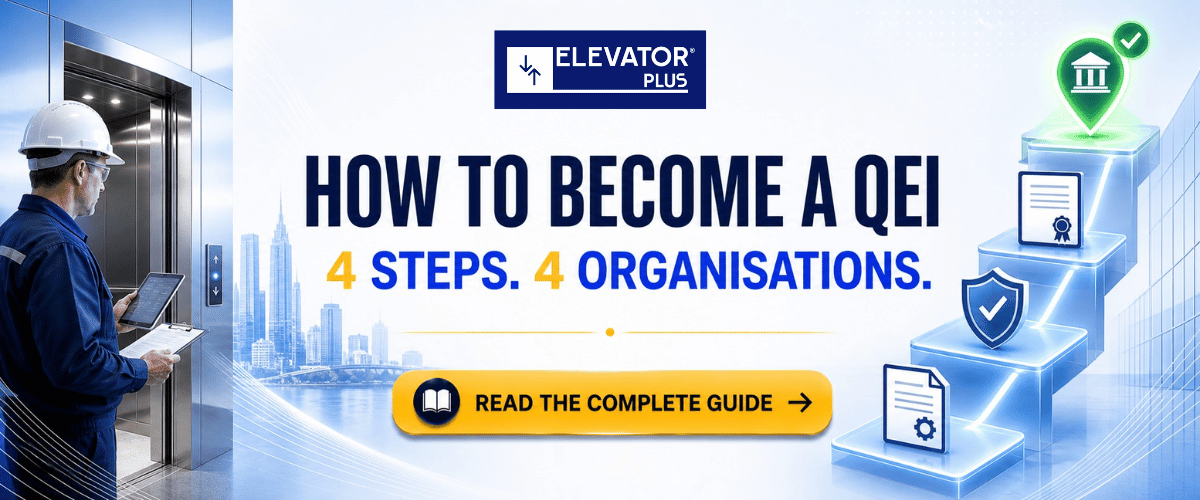
In short: ASME writes the standard, ANAB accredits the certifying bodies, the certifying body certifies you, and your state licenses you to work. Four steps, four different organisations, and almost every article on this subject collapses them into one. Here is the accurate route in 2026, with the fees, the recertification rule and the states that do something different.
Key takeaways
- The current standard is ASME QEI-1-2024, published 30 December 2024. The current code you inspect against is ASME A17.1-2025/CSA B44:25.
- ASME does not certify inspectors and has not accredited certifying organisations since 31 December 2013. If a training provider offers to make you "ASME certified", that is a red flag.
- ANAB accredits the certifying bodies to ISO/IEC 17024. NAESA International holds ANAB accreditation for QEI and Inspector Supervisor (QEI-S). CET and CAT are NAEC credentials, not NAESA ones.
- Recertification is annual and requires 1.0 CEU, which is ten contact hours.
- California does not use QEI at all. It runs its own Certified Competent Conveyance Inspector credential, and a QEI will not let you inspect there.
What this guide covers: who does what · the codes you need · the QEI route and its cost · recertification · six states compared · what the workforce data actually says.
Who does what, and why it keeps getting confused
This is the part worth reading twice, because the terminology is genuinely misleading and even some state regulations have not caught up.
- ASME writes QEI-1, the Standard for the Qualification of Elevator Inspectors. It sets the criteria. It certifies nobody.
- ANAB, the ANSI National Accreditation Board, accredits the certifying organisations against ISO/IEC 17024. ASME announced it would stop accrediting certifying agencies as of 31 December 2013.
- The certifying organisation (NAESA International, the QEI Training Fund, NAEC) certifies you as a QEI.
- Your state or city licenses or registers you to perform inspections in its jurisdiction.
You will still see the phrase "ASME-accredited certifying organisation" in official documents. Maine's licensing page, for instance, requires QEI certification "by an organization accredited by the ASME Qualification of Inspectors Committee". Maryland's rule points at NCCA or ANSI accreditation without naming ANAB. Those are drafting lags in state regulation, not a description of how the system works today. Follow the state's process as written, but understand the real chain underneath it.
The codes you actually need
ASME A17.1-2025/CSA B44:25, the Safety Code for Elevators and Escalators, is the current edition, published in 2025. It supersedes the 2022 edition. The headline changes are emergency responder radio coverage equipment, elastomeric buffers and seismic requirements.
ASME A17.2-2023 is the Guide for Inspection of Elevators, Escalators, and Moving Walks. Note the actual title. It is a guide, not "the inspectors' manual", and using the right name in front of a certifying body matters.
ASME A17.3 covers existing installations and is on the required reading list for the exam.
One practical warning that costs candidates money: NAESA does not supply codebooks. Candidates must bring eight of them, purchased separately. Budget for that alongside the exam fee.
The QEI route, and what it costs
NAESA requires applicants to meet the experience requirements set out in ASME QEI-1 and to submit supporting documentation of education and experience. The exam is proctored, and the proctor cannot be a direct supervisor, a friend or a family member.
Published NAESA fees:
| Item | Fee |
|---|---|
| Training course plus certification exam | $1,295 |
| Exam only | $500 |
| Exam retake | $400 |
| Annual recertification | $200 members, $250 non-members |
The first two include membership on a passing grade.
On experience, be careful how you read the numbers you see quoted. QEI-1 sets qualification criteria and the accredited bodies apply them, so the specific route depends on who is certifying you. The QEI Training Fund's published route, for example, is five years of supervised experience in the elevator trade, including an 8,000-hour national apprenticeship programme and one year of post-apprenticeship experience, plus a passing score on the NEIEP Mechanics Exam or equivalent. NAEC's published credential criteria describe at least one year of verifiable experience performing inspections, a high-stakes assessment examination, and annual recertification with 1.0 CEU.
Those are different routes under the same standard. Pick your certifying body first, then read their criteria, not a generic summary.
Recertification: annual, 1.0 CEU
This trips people up more than anything else in the process.
Recertification is annual. It requires 1.0 CEU of approved continuing education, which is ten contact hours, plus a Maintenance of Qualifications survey and the renewal fee.
The scheduling is what confuses people. NAESA runs two recertification windows a year, November to December and May to June, with certificates expiring on 31 December or 30 June accordingly, and a one-month grace period in January or July at double the fee. Each holder renews annually into their assigned window. Two windows, not a two-year cycle. Miss the grace month and you are dealing with a lapsed certification rather than a late one.
Six states, six different answers
QEI is not a national licence. Here is what six jurisdictions actually require, and the spread is wider than most people expect.
| State | What it requires on top of, or instead of, QEI |
|---|---|
| California | Does not use QEI. Requires the state's own Certified Competent Conveyance Inspector. Employment by a licensed elevator insurer, a municipality with an elevator inspection organisation, or the State. Four years' mechanical or electrical experience with at least one year on elevators, written and field exams, and at least 90 days of intensive supervised training in elevator inspection in California immediately before the exam. Renewal $140 with approved CE. |
| Maryland | Third Party QEI Level 1: valid QEI certification from an accredited organisation, plus status as an independent consultant or employment by an independent inspection agency or the elevator's insurer. Insurance of at least $500,000 injury or death and $100,000 property damage, naming the Commissioner. Registration with the Commissioner before inspecting, renewed annually. |
| New York State | Licence fee $100, renewed every two years. Qualify via QEITF certification, NAESA QEI certification, or an approved equivalent municipal programme with 16 hours of CE annually. |
| New York City | Separate Elevator Agency Inspector licence, deemed an equivalent municipal programme by the state. OSHA 10-Hour General Industry, a minimum of seven years' satisfactory experience within the preceding ten, exam fee $525, pass mark 70 percent, background investigation $500, licence issuance $50. |
| Texas | TDLR registration: application, $50 fee, certification as an inspector under Commission rules, and proof of completed TDLR orientation. Renewal within 12 months at $50 plus CE. TDLR names NAESA and QEITF as the accredited bodies. |
| Maine | QEI certification plus a grade of at least 80 percent on a state examination. Licence $50, background check $21, annual renewal $50 expiring 31 August. |
California is the one that catches people out. A perfectly valid QEI does not authorise you to inspect a single conveyance in California. If your firm is expanding westward, that is a hiring and training decision, not a paperwork one.
We checked six jurisdictions here and deliberately have not built a fifty-state table. Requirements change, and a stale table is worse than no table. Check the state board directly before you commit anyone's time.
👉 Tracking inspector certifications, CEU dates and state registrations across a team?
See how ElevatorPlus handles it →
What the workforce data actually says
You will read a lot about a national shortage of elevator inspectors. We went looking for the dataset behind it and there is not one.
The Bureau of Labor Statistics does not track elevator inspectors as an occupation. They are folded into construction and building inspectors (SOC 47-4011) alongside nine other specialties, with no sub-breakout. That category had 147,600 jobs and a median wage of $72,120 in 2024, and is projected to shrink 1 percent between 2024 and 2034 while still generating roughly 14,800 openings a year, driven by retirements and workers moving to other occupations rather than by growth.
The separately tracked trade, elevator and escalator installers and repairers (SOC 47-4021), numbered 24,200 in 2024 with a median wage of $106,580 and projected 5 percent growth to 2034. That is installers and repairers. It is not inspectors, and quoting the $106,580 figure as an inspector salary is a category error you will see repeatedly.
No ASME, ANAB, NAESA, NAEC or federal source publishes a count of active QEI holders, their age distribution, or the number of unfilled inspector posts. Anyone giving you a national shortage number invented it.
What is documented is that individual states have fallen behind on inspections, and that staffing was named as the cause.
- North Carolina. In September 2023, nearly 5,000 conveyances were past due, the Department of Labor was ten inspectors short of its 39 allotted positions, and roughly 22,000 elevators were in scope. House Bill 559, ratified 26 June 2025, recited over 3,000 overdue inspections and raised the fee caps. On 5 January 2026 NCDOL announced the backlog had been eliminated entirely, reporting 32,527 elevators inspected through December 2025, 5,088 more than the prior year. That is the department's own account, and it is the current position. If you read anywhere that North Carolina has an elevator inspection backlog, that article is out of date.
- Massachusetts. The State Auditor found in 2014 that about 14,211 elevators, 36 percent of those registered, were operating on expired certificates. Reporting in 2019 still put roughly 4,500 out of compliance with fewer than 70 inspectors statewide. We could not find a more recent figure, so treat 4,500 as a 2019 number, not a current one.
- Maryland. A 2018 rule change requiring inspectors to witness maintenance, a four to six hour process replacing a roughly two hour verification, roughly doubled the time each inspection takes. An analysis published in January 2020 by a commercial real estate trade association, an interested party in that rulemaking, counted 25 publicly owned elevators a month joining the expired list.
The pattern worth taking from this is not demographic. It is regulatory. Inspection capacity in the US is a state-by-state variable, and rule changes move it faster than retirements do.
Frequently asked questions
What is a QEI?
A Qualified Elevator Inspector, certified against ASME QEI-1 by an organisation accredited by ANAB to ISO/IEC 17024. The current edition of the standard is QEI-1-2024.
Does ASME certify elevator inspectors?
No. ASME writes the QEI-1 standard. It does not certify individuals, and it stopped accrediting certifying agencies at the end of 2013. Accreditation is now handled by ANAB.
How much does QEI certification cost?
NAESA publishes $1,295 for the training course plus certification exam, $500 for the exam only, and $400 for a retake. Recertification is $200 for members and $250 for non-members. Codebooks are bought separately and NAESA does not supply them.
How often do you have to recertify as a QEI?
Annually, with 1.0 CEU of approved continuing education, which is ten contact hours. NAESA batches renewals into two windows, November to December and May to June, each with a one-month grace period at double the fee.
What is the current elevator safety code?
ASME A17.1-2025/CSA B44:25, published in 2025, superseding the 2022 edition. The inspection companion is ASME A17.2-2023, and A17.3 covers existing installations.
Can a QEI inspect elevators in any US state?
No. Most states add their own registration, insurance, examination or continuing education requirements, and California does not recognise QEI at all, requiring its own Certified Competent Conveyance Inspector instead.
Is there a shortage of elevator inspectors in the US?
No national dataset exists to answer that. BLS does not track elevator inspectors as a separate occupation. Individual states have documented inspection backlogs, most notably North Carolina, which reported the backlog eliminated as of December 2025.
What is the difference between QEI and CET?
QEI is the inspector credential, certified by bodies such as NAESA International and QEITF. CET, the Certified Elevator Technician, is a NAEC credential for technicians, as is CAT for accessibility technicians.
📲 Join our WhatsApp channel for compliance tips, updates: ElevatorPlus - Business Automation Tool
If you are a technician looking at certification, the sequence is: pick your certifying body, read their published experience criteria rather than a summary of QEI-1, budget for the exam and the eight codebooks, and check what your state adds on top before you start.
If you run a company, the more useful exercise is a spreadsheet with one row per inspector and one column per jurisdiction you work in, holding certification number, CEU status, expiry window and each state registration renewal date. The annual CEU requirement and the two-window renewal system produce a surprising number of near-misses, and a lapsed certification on a scheduled inspection is an expensive morning.
That is the kind of thing that quietly stops being manageable at around fifteen field staff.
👉 Keep every certification, CEU and state registration in one place →
Related reading
- The Complete Lift Maintenance Checklist for 2026
- LOLER Thorough Examination for Passenger Lifts
- Getting Technicians to Actually Use the Software
- Elevator Preventive Maintenance Schedule Guide
About the author · Nutan Mandal is part of the ElevatorPlus team, which builds the Elevator Business Operating System used by 200+ elevator companies across 20+ countries. Reviewed by Mr. Sumeet Katariya.
Sources: ASME, Safety Code for Elevators and Escalators · ASME A17.1-2025/CSA B44:25, CSA Group · ASME A17.2-2023 table of contents (PDF) · ASME QEI-1, Standard for the Qualification of Elevator Inspectors · NAESA QEI Certification · NAESA Recertification · About NAESA International · ANAB accreditation record, NAESA International · NAEC Education and Certification · QEITF, Become an Inspector · Maryland DLLR, Third Party QEI requirements · New York State DOL, Elevator Licensing · NYC DOB, Elevator Agency Inspector licence · Texas TDLR, Elevator FAQ · California DIR, Elevator Certification · Maine, Elevator Inspector Licensing · NCDOL, elevator inspection backlog eliminated, 5 January 2026 · North Carolina House Bill 559 (PDF) · Massachusetts State Auditor, elevator inspection backlog audit · BLS, Elevator and Escalator Installers and Repairers · BLS, Construction and Building Inspectors
👉 Follow ElevatorPlus on,
Instagram LinkedIn Facebook YouTube Qoura Substack Twitter