
Gulf Lift Handover Documentation: Saudi and Dubai
By Mr. Sumeet Katariya, ElevatorPlus · Compliance reviewed by Mr. Sumeet Katariya
In short: A lift that is installed, commissioned and tested is still not a lift that can lawfully carry passengers in Saudi Arabia. Registration comes first, and registration depends on documents produced during the project. This is written for installation contractors and project managers. It covers exactly what the Saudi regulation requires and who signs each item, and it is honest about what we could not verify for Dubai.
Key takeaways
- In Saudi Arabia, use is gated on registration, not on completion. No service lift may be used until it is registered with the competent authority, and registration depends on an inspection report and certificate.
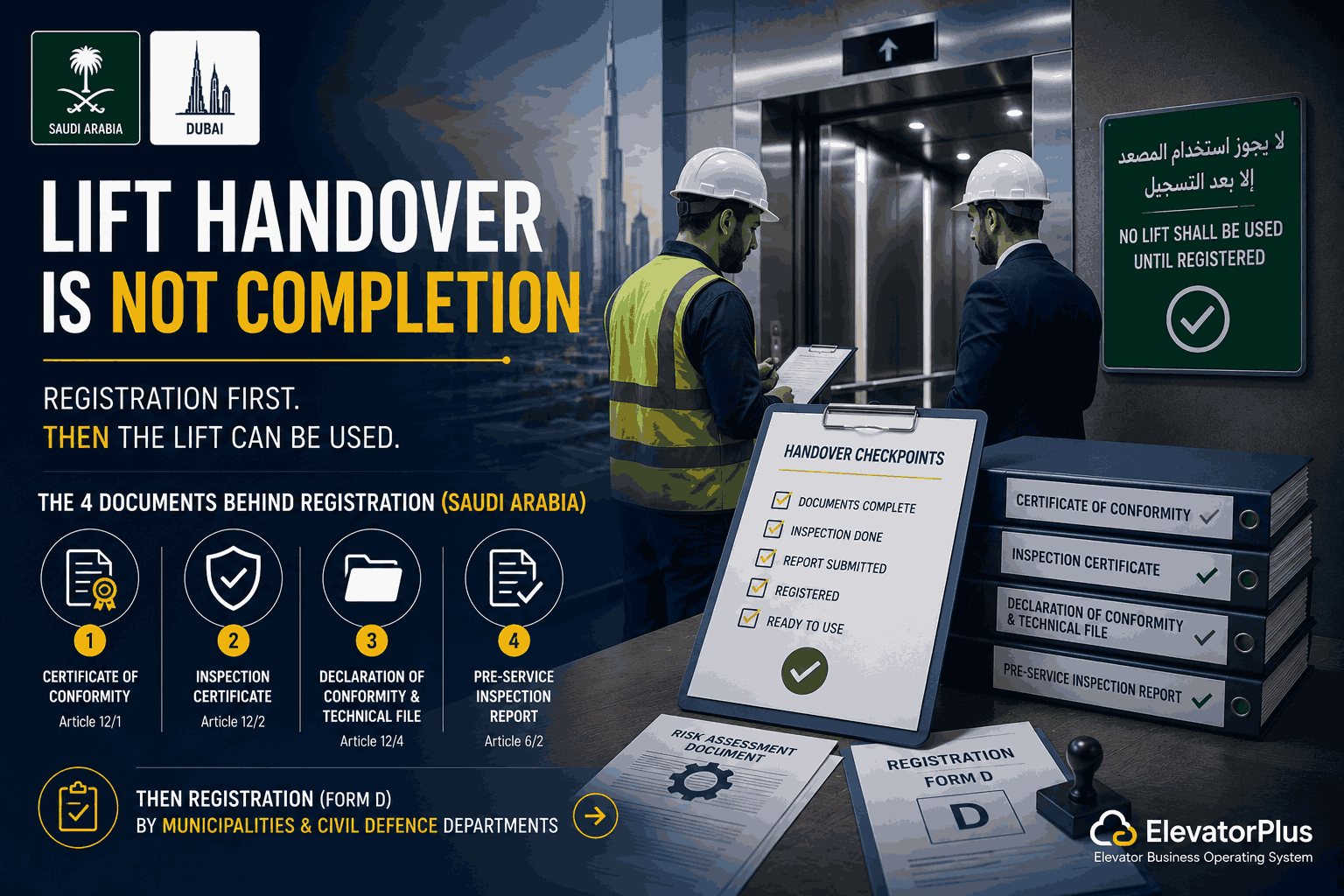
- Four distinct documents sit behind that registration, each signed by a different party: a Certificate of Conformity, an inspection certificate, a supplier Declaration of Conformity with its technical file, and a pre-service inspection report.
- The technical file is more than a folder of manuals. Article 12/4 requires the Declaration of Conformity, a risk assessment document and a certificate of origin.
- For Dubai we can confirm the inspection certificate obligation and little else. GU48 requires a certificate of safety from an EIAC-accredited body, kept on site. We could not verify a named handover checklist, so we are not publishing one.
- The failure mode is sequencing. These documents are produced at different moments by different parties, and a project that treats them as end-of-job paperwork discovers the gap after the client expects to use the lift.
What this guide covers: why handover is not completion · the four Saudi documents · who signs each · the registration step · what is verified for Dubai · how to sequence it · FAQs.
Why handover is not completion
On most Gulf installation projects the commercial milestone and the regulatory milestone are different events, and the gap between them is where money sits.
A lift can be fully installed, commissioned, load tested and demonstrated to the client's satisfaction, and still not be lawfully usable. In Saudi Arabia that is not a technicality. Article 12/8 of the SASO technical regulation is explicit:
"No service lift shall be used until registered with the competent authority, based on an inspection report including an inspection certificate issued by an approved inspection authority."
So the sequence is: install, inspect, certify, register, then use. A developer who has scheduled a building opening around practical completion has scheduled it around the wrong milestone.
The four documents Saudi Arabia requires
These come from different parties at different points in the project. Getting one late holds up everything downstream.
1. Certificate of Conformity
Article 12/1 places the obligation on the supplier:
"The supplier, responsible for the placement of lifts and their components, including safety components in the market, shall obtain a Certificate of Conformity…"
Issued by an approved body against the conformity assessment form in Annex 4. This is a product-side document and it runs through SABER, SASO's electronic conformity platform, whose published regulations list includes the technical regulation for electrical lifts.
Signed by: SASO or a SASO-approved notified body.
2. Inspection certificate
Article 12/2 covers the installed unit rather than the product:
"Lifts installed in the buildings shall obtain an inspection certificate issued by an approved body."
An approved body here means a conformity assessment body certified to ISO 17020 and accepted by SASO. This is the certificate that later gets affixed on the ground floor outside the car under Article 12/7.
Signed by: the SASO-approved ISO 17020 inspection body.
3. Declaration of Conformity and technical file
Article 12/4 sets out what the supplier must hold. Three components:
- The Declaration of Conformity, in the form at Annex 6
- A risk assessment document
- A certificate of origin
The risk assessment is the one most often missing on projects we see. It is a required part of the file, not an optional engineering nicety.
Signed by: the supplier.
4. Pre-service inspection report
Article 6/2 requires the inspection body to submit its report to the competent authority before the lift goes into service. This is the document that feeds the registration.
Signed by: the inspection body, submitted to the competent authority.
And then registration
With the report in hand, the competent authority registers the lift and its owner on form D, under Article 15. The competent authority is defined at Article 1 as the municipalities and Civil Defense departments, not SASO.
Only at that point is the lift lawfully usable.
| Document | Article | Produced by | Signed by |
|---|---|---|---|
| Certificate of Conformity | 12/1 | Supplier obtains it | SASO or approved notified body |
| Inspection certificate | 12/2 | Inspection body | SASO-approved ISO 17020 body |
| Declaration of Conformity + technical file | 12/4 | Supplier | Supplier |
| Pre-service inspection report | 6/2 | Inspection body | Inspection body, to competent authority |
| Registration, form D | 8/3, 15 | Owner applies | Competent authority |
👉 Building a handover pack template for Gulf projects?
Our free service checklist and report templates are a reasonable structure to adapt.
📲 Join our WhatsApp channel for compliance tips, updates: ElevatorPlus - Business Automation Tool
What we can and cannot confirm for Dubai ?
We would rather be short and accurate here than long and speculative.
What is verified. GU48, the Dubai Municipality Health and Safety Department guideline, requires at clause 4 that the EIAC-accredited third party issues a certificate of safety after due examination and test, and at clause 9 that the compliance certificate is kept at the site. That obligation is real and it applies from first examination onward.
The standards position is also clear. The Dubai Building Code 2021 clause D.5 requires one standards suite, ASME A17 or BS EN 81, to be selected per project and states the suites shall not be used interchangeably across design, installation, testing, commissioning and maintenance. That is a specification decision that has to be recorded at project level and survive into the maintenance contract.
What we could not verify. A named Dubai handover checklist. The lists circulating online, covering third-party examination certificates, a lift subcontractor letter confirming the fire alarm interface, and a Civil Defence completion certificate as a precondition for the Building Completion Certificate, come from consultancy blogs rather than from Dubai Municipality or Dubai Civil Defence. Some of it is probably right. None of it is something we can point you to a clause for.
So we are not going to publish a Dubai handover checklist. If you need one for a live project, get it from the authority or from your appointed consultant, not from an article.
How to sequence it so it does not bite
The pattern we see on delayed Saudi handovers is consistent, and it is rarely an engineering failure.
The supplier's conformity documentation was arranged around shipment rather than around handover, so the Certificate of Conformity exists but the technical file is incomplete. The risk assessment was never produced because nobody owned it. The inspection body was booked after commissioning rather than before, so the pre-service report goes to the competent authority weeks late. And the registration application waits on all of it.
The fix is to treat these as project milestones with owners and dates, not as closing paperwork. Specifically: the supplier's technical file including the risk assessment should be complete before the lift ships, not after it is installed. The inspection body should be engaged during installation with a date held. And the registration application should be prepared while the inspection is being scheduled rather than after the report arrives.
None of that is difficult. It fails because the documents belong to different parties and no single record shows which are done.
Frequently asked questions
Can a newly installed lift be used in Saudi Arabia once it is commissioned?
No. Article 12/8 states that no service lift shall be used until registered with the competent authority, based on an inspection report including an inspection certificate from an approved inspection body.
Who is the competent authority for lift registration in Saudi Arabia?
Article 1 defines it as the municipalities and Civil Defense departments. SASO issues the regulation and accepts inspection bodies but does not hold the register.
What must be in the technical file for a Saudi lift?
Article 12/4 requires the Declaration of Conformity in the form at Annex 6, a risk assessment document, and a certificate of origin.
Who signs the inspection certificate in Saudi Arabia?
A conformity assessment body certified to ISO 17020 and accepted by SASO. The certificate is later affixed on the ground floor outside the lift car under Article 12/7.
When must the inspection report be submitted?
Article 6/2 requires the inspection body to submit its report to the competent authority before the lift is put into service.
What documentation does Dubai require at handover?
What is verified is that GU48 requires a certificate of safety issued by an EIAC-accredited third party after examination and test, kept at the site. A complete named handover checklist could not be verified from a Dubai Municipality or Civil Defence source.
Does the choice of standards suite affect handover in Dubai?
Yes. The Dubai Building Code clause D.5 requires one suite, ASME A17 or BS EN 81, per project, and the suites shall not be used interchangeably across design, installation, testing, commissioning and maintenance. The selected suite should be recorded and carried into the maintenance contract.
What is SABER's role in a lift project?
SABER is SASO's electronic conformity platform, and its published regulations list includes the technical regulation for electrical lifts, so lifts and their components fall within its scope for the conformity route.
Installation contractors are measured on completion. Regulators measure something else, and in Saudi Arabia the gap between the two is a lift standing idle in a finished building while a risk assessment nobody owned gets written.
Four documents, four different signatories, one registration, and only then a usable lift. None of it is onerous. All of it is sequenced, and sequencing is exactly what falls apart when a project's documents live in four inboxes.
The projects that hand over cleanly are the ones where the certificate, the file, the report and the registration sit against the unit from the day it is ordered, with an owner and a date on each.
👉 See installation projects tracked from contract award to registration. Book a demo →
Related reading
- Elevator project management software for the Gulf
- The Saudi Lift Registration Clock: What SASO Actually Renews Every Year
- ASME or EN 81? The Gulf Is Not One Standards Market
- Is a Dubai Lift Inspected Every 12 Months or Every 6?
About the author. Mr. Sumeet Katariya is the founder of ElevatorPlus, the Elevator Business Operating System used by 200+ elevator companies across 20+ countries. Compliance reviewed by Mr. Sumeet Katariya.
Sources: SASO Technical Regulation for Electrical Lifts Used in Buildings and Facilities, Version 1 Amendment 1 (PDF) · SABER, Regulations list · Dubai Municipality DM-HSD-GU48-ECLA2 v4.0 (PDF) · Dubai Building Code 2021 Edition (PDF)
👉 Follow ElevatorPlus on,
Instagram LinkedIn Facebook YouTube Qoura Substack Twitter