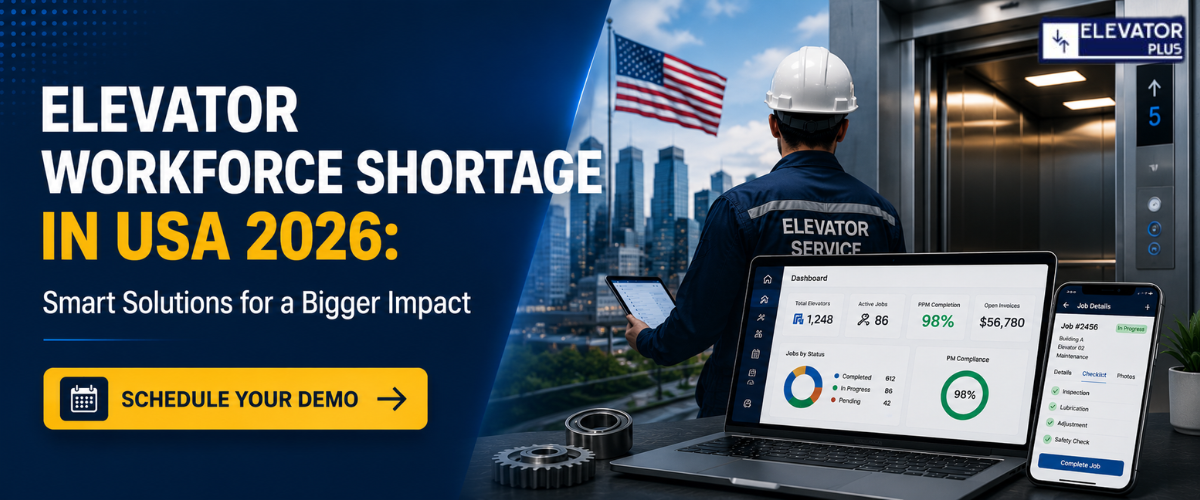
Elevator Workforce Shortage in USA 2026: Smart Solutions
The US elevator industry is entering one of the biggest workforce challenges it has faced in decades.
Across the country, elevator contractors are struggling to hire skilled technicians fast enough to keep up with rising service demand. From New York and Chicago to Dallas, Miami, Phoenix, and Los Angeles, the shortage is creating operational pressure that affects response times, preventive maintenance schedules, inspections, and customer satisfaction.
The problem is no longer temporary.
The elevator workforce shortage is becoming a long term operational crisis.
At the same time, elevator portfolios across the United States continue growing rapidly. More commercial buildings, residential towers, hospitals, airports, and mixed use developments mean more elevators require maintenance every single day.
But the number of experienced elevator technicians is not growing at the same pace.
This is exactly why forward thinking contractors are no longer relying only on recruitment.
Instead, they are focusing on smarter operations, better scheduling systems, and technology that helps maximise elevator technician productivity.
👉 Want to improve technician efficiency without increasing headcount?
👉 Modern elevator scheduling software helps small teams handle larger service portfolios more efficiently.
The Current Elevator Workforce Crisis in the United States
The elevator technician shortage in the US is being driven by several major industry shifts.
First, a large percentage of experienced elevator mechanics are approaching retirement age. Many technicians who entered the industry during the late 1990s and early 2000s are now leaving the workforce.
Second, apprenticeship pipelines are not producing enough qualified technicians quickly enough.
Unlike many trades, elevator technicians require years of training before becoming fully qualified. This creates a major supply gap.
Third, elevator demand across the United States continues increasing.
Rapid urban development across states like Texas, Florida, Arizona, Georgia, and North Carolina is adding thousands of new elevators every year.
More elevators mean:
• more preventive maintenance
• more inspections
• more emergency breakdown calls
• more modernization work
• higher service demand
For many contractors, this creates a dangerous operational imbalance.
The result is:
• delayed service schedules
• technician burnout
• customer frustration
• overtime pressure
• missed preventive maintenance visits
Many contractors are discovering that hiring alone cannot solve the problem.
Why Elevator Technician Recruitment Is Becoming More Difficult
The elevator industry is competing against several skilled trades for the same workforce pool.
Electricians, automation firms, and industrial maintenance companies are all hiring aggressively across the United States.
This makes lift technician recruitment increasingly competitive.
Younger workers are also entering the trades differently than previous generations. Many expect:
• mobile technology
• digital workflows
• modern scheduling systems
• clear communication
• career progression
• organized operations
Companies still relying on paper job cards, spreadsheets, and manual dispatch systems often struggle to attract younger technicians.
Today’s workforce expects modern tools.
And this is becoming a major competitive advantage for elevator contractors investing in digital operations.
👉 Still managing technician schedules manually?
👉 Digital elevator scheduling software helps contractors simplify dispatch and reduce operational chaos.
The Hidden Productivity Problem Most Elevator Companies Ignore
Many elevator companies believe they simply need more technicians.
But the bigger issue is often technician productivity loss.
In traditional operations, technicians lose significant time every day because of inefficient workflows.
Common productivity drains include:
• calling the office for job details
• waiting for dispatch instructions
• searching for service history
• incomplete maintenance records
• inefficient routing
• unnecessary travel time
• returning paper job cards
• unclear communication between office and field teams
Across many elevator service businesses, technicians may spend 25 to 35 percent of their day on non productive activities.
That means a six person team may effectively lose the equivalent of one or two technicians daily.
This is exactly why operational efficiency matters more than ever in 2026.
The companies succeeding today are not simply hiring faster.
They are maximising elevator technician productivity using better systems.
How Elevator Scheduling Software Helps Small Teams Do More
Modern elevator scheduling software allows smaller teams to handle larger service portfolios without overwhelming technicians.
Instead of managing dispatch manually, contractors use centralized digital systems that organize operations automatically.
Modern elevator service management software helps contractors:
• assign technicians based on location
• reduce unnecessary travel
• automate preventive maintenance schedules
• improve emergency response coordination
• provide mobile job information
• access service history instantly
• streamline work order completion
• track technician activity in real time
This dramatically improves technician efficiency.
Instead of wasting time on coordination, technicians spend more time performing actual maintenance and repairs.
For small and mid size elevator companies, this operational improvement is critical.
👉 Want to reduce wasted technician hours every week?
👉 Smarter scheduling systems help elevator teams complete more jobs with less stress.
Real World Example: Small Team, Bigger Capacity
Consider a mid sized elevator contractor operating across Texas.
The company manages approximately 700 elevators across commercial buildings and residential properties.
The business struggled with:
• delayed preventive maintenance visits
• technician overtime
• missed scheduling updates
• emergency call coordination issues
• paper based service tracking
The owner initially believed the only solution was hiring more technicians.
But after implementing elevator field service management software, the company identified major workflow inefficiencies.
By optimizing technician routing and digitizing service operations, the company achieved:
• faster dispatch coordination
• fewer scheduling conflicts
• reduced paperwork
• better technician visibility
• improved preventive maintenance completion rates
Most importantly, the company increased operational capacity without significantly increasing headcount.
The difference was not the workforce size.
The difference was the system.
Five Smart Strategies to Maximise Elevator Technician Productivity
1. Digitize Job Dispatch
Technicians should receive all job information directly on mobile devices before arriving on site.
This eliminates unnecessary office calls and improves preparation.
2. Optimize Scheduling by Geography
Grouping service visits by location reduces unnecessary travel and improves daily efficiency.
Even small routing improvements create major productivity gains over time.
3. Reduce Paperwork
Paper job cards slow down operations significantly.
Digital service reports allow technicians to complete documentation instantly from the field.
👉 Paper based workflows are quietly reducing technician efficiency every day.
👉 Digital job management systems help contractors recover lost operational time.
4. Improve Preventive Maintenance Planning
Emergency breakdowns consume valuable technician capacity.
Strong preventive maintenance programs reduce reactive service calls and create more predictable workloads.
5. Centralize Service Information
Technicians should instantly access:
• service history
• maintenance logs
• inspection records
• parts usage
• previous repairs
Centralized information prevents wasted time and repeat diagnostics.
Why Technician Retention Is More Important Than Recruitment
Replacing experienced elevator technicians is extremely expensive.
Beyond recruitment costs, contractors also lose:
• institutional knowledge
• customer familiarity
• equipment experience
• service consistency
• productivity during onboarding
This is why retention matters just as much as recruitment.
Technicians are more likely to stay when companies provide:
• organized operations
• modern tools
• reduced administrative frustration
• fair scheduling
• clear communication
• manageable workloads
Technology alone does not solve workforce problems.
But operational chaos absolutely makes them worse.
The Future of Elevator Workforce Management in the United States
Over the next several years, elevator service operations will become increasingly technology driven.
Contractors across the United States are already adopting:
• elevator field service management software
• technician tracking systems
• mobile maintenance platforms
• cloud based dispatch systems
• predictive maintenance tools
• AI driven scheduling platforms
The companies investing in operational efficiency today will have a major competitive advantage as workforce shortages continue.
This shift is no longer optional.
It is becoming necessary for survival.
The elevator workforce shortage in 2026 is not a temporary hiring challenge.
It is a structural shift affecting the entire US elevator industry.
The contractors that succeed will not simply be the ones hiring the fastest.
They will be the companies building smarter operations, maximizing technician productivity, and creating systems that help small teams perform at a higher level.
Because in today’s market:
Efficiency is becoming the real competitive advantage.
👉 Want to future proof your elevator service operations?
👉 Book Your Strategy Call Now
Discover how ElevatorPlus helps contractors simplify scheduling, improve technician productivity, and scale operations with less chaos.
👉 Follow ElevatorPlus for more insights on elevator workforce management, technician productivity, and digital transformation in the US elevator industry.
FAQ Section
1. What is causing the elevator workforce shortage in the United States?
The shortage is caused by technician retirements, growing elevator demand, limited apprenticeship output, and increasing competition from other skilled trades such as HVAC and electrical services.
2. How can elevator companies improve technician productivity?
Companies can improve productivity using elevator scheduling software, mobile dispatch systems, digital maintenance logs, and optimized technician routing to reduce wasted time and improve efficiency.
3. Why is technician retention important in the elevator industry?
Replacing experienced technicians is expensive and time consuming. Retaining skilled workers improves operational stability, customer satisfaction, and long term profitability for elevator contractors.
4. How does elevator scheduling software help small teams?
Elevator scheduling software automates dispatch, reduces travel time, improves preventive maintenance coordination, and helps technicians manage more service calls efficiently.
5. What technology trends are shaping elevator service operations in 2026?
Major trends include cloud based elevator software, mobile field service management, predictive maintenance systems, AI scheduling, and real time technician tracking platforms.
📢 𝗦𝘁𝗮𝘆 𝗔𝗵𝗲𝗮𝗱 𝘄𝗶𝘁𝗵 𝗘𝗹𝗲𝘃𝗮𝘁𝗼𝗿𝗣𝗹𝘂𝘀
Book Your Free Strategy Call Now.
Don’t miss more exclusive elevator industry updates, expo news, and smart business insights.
👉 𝗙𝗼𝗹𝗹𝗼𝘄 𝗘𝗹𝗲𝘃𝗮𝘁𝗼𝗿𝗣𝗹𝘂𝘀 𝗼𝗻:
Instagram | LinkedIn | Facebook | YouTube