Elevator Dispatch Software: Machine Room Duties
By Sujit Katariya, ElevatorPlus · Published 9 September 2026 · Last updated 9 September 2026 · ~12 min read · Reviewed by Mr. Sumeet Katariya
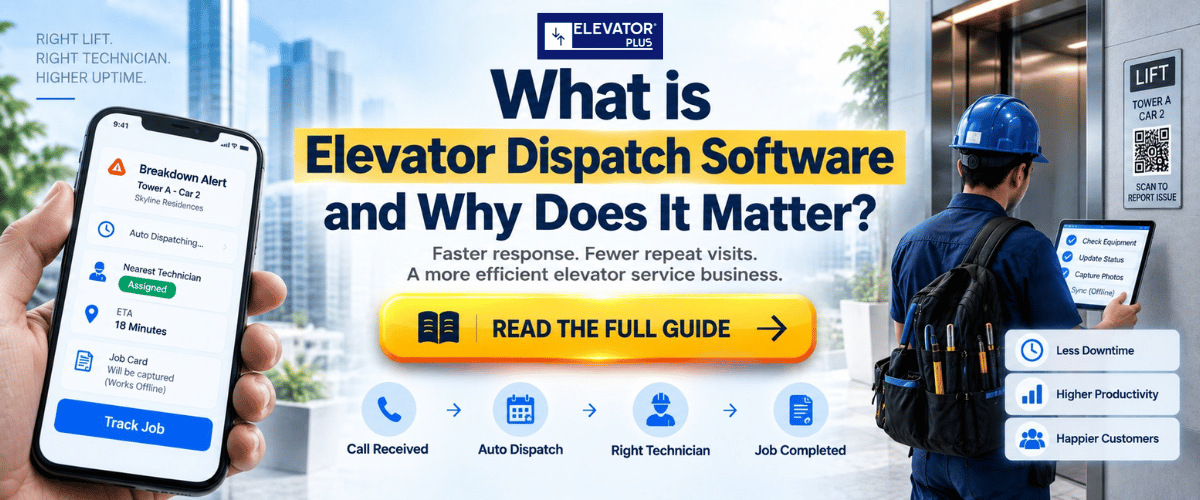
In short: Elevator dispatch software assigns a breakdown to the right technician and gets a completed job card back. In a lift business it has three specific problems to solve that generic dispatch tools do not: identifying the exact car in a building with several, working where there is no mobile signal, and reassigning a day that has already been planned. Solve those three and the reporting above them becomes worth reading. Leave any one of them unsolved and every number downstream is a guess.
Key takeaways
- A lift portfolio does not have the shape dispatch tools assume. Plumbing and courier software is built around one address, one job, one van. A single address can hold six machines under three different contracts, each with its own service history.
- The complaint has to attach to an asset record, not an address. Every car needs its own identity with its own drive, controller, capacity, installation date and fault history, so the technician knows which car and what happened to it last month.
- Offline capture is where data quality is decided. If the app cannot accept a completion in a basement or a roof machine room and sync later, job cards get written from memory in the evening, and a job card written from memory two days later is the same as no job card.
- Reassignment has to happen where the plan lives. If the supervisor moves jobs by phone, the schedule on the system and the schedule in reality diverge by ten in the morning and stay diverged for the rest of the day.
- Repeat visits within thirty days is the measure that exposes the other three. Attendance times are easy to improve by sending whoever is closest regardless of whether they know the machine, and a fast attendance that fixes nothing simply produces a second visit next week at your cost.
What this guide covers: what dispatch actually has to do · why identifying the right lift is hard · working with no signal · what happens when the plan breaks · the four measures that tell you whether dispatch works · a full breakdown walked end to end · FAQs.
What does elevator dispatch software have to do?
Dispatch is the part of the operation that turns a phone call into an attended job and an attended job into a record you can bill from. Everything else in a service business sits downstream of it. If dispatch is slow or vague, the contract renewal conversation gets harder every year.
Most software sold as dispatch was built for plumbers or courier work. Those trades share a shape: one address, one job, one van. A lift portfolio does not have that shape.
A single address can hold six machines under three different contracts, each with its own service history and its own set of recurring faults. The technician does not need to know where the building is. He needs to know which car, on which floor bank, and what happened to it last month.
Three things break in practice, and they break in the same order at almost every company we speak to. Identifying the lift. Working underground. Handling the moment the plan falls apart. Take them one at a time.
Why is identifying the right lift so hard?
A caller rings to say the lift is stuck. The building has four cars. The office now spends the next fifteen minutes working out which one, usually by asking the caller to describe the lobby, the floor they were on, or whether the car is nearest the entrance or the car park ramp.
That fifteen minutes sits at the front of every breakdown, several times a day, and it is the part of the process most likely to produce a wrong answer. A technician sent to the wrong car opens a controller cabinet, finds nothing unusual, and calls the office back.
The fix is structural rather than clever. The complaint has to attach to an asset record, not to an address. Every car gets its own identity in the system, with its own drive, controller, capacity, installation date and fault history.
The fastest route to that record is to stop asking the caller to describe anything. Put a code inside the car and let the resident or the security guard scan it. That is how customers report faults by scanning the lift, and the complaint lands already tagged to the right machine.
What this changes for the technician is not marginal. He accepts the job knowing the car number, the controller type and the last three faults logged against it. If the same door operator has failed twice since April, he sees that before he leaves the workshop and brings the part with him.
What happens when there is no signal?
Machine rooms are on the roof behind a steel door. Pits are in the basement. Both are where the work actually happens, and both are where the network is not.
Dispatch that requires connectivity at the moment of completion produces one predictable result. The technician finishes the job, cannot submit, tells himself he will do it later, and writes the job card from memory at nine in the evening or on Saturday morning. A job card written from memory two days later is the same as no job card at all.
The app has to hold the job on the device. It has to accept the completion offline, with the fault code, the parts used, the reading, the photograph and the customer signature, and then sync when the technician walks back up into daylight.
This is where data quality is decided. Not in the reporting module, not in the dashboard, not in the monthly review meeting. If capture fails at the point of work, every number downstream is a guess dressed up as a report, and no amount of filtering fixes it afterwards.
What happens when the plan breaks?
Every planned maintenance day gets interrupted. A breakdown comes in at half past nine, a technician is pulled off routine servicing, and two scheduled visits move to someone else or to tomorrow. That is normal and it will not stop.
The real question is whether the interruption is visible. If the supervisor handles it by phone, the schedule on the system and the schedule in reality start to diverge by ten in the morning and stay diverged for the rest of the day.
Do that for a week and nobody trusts the system. The supervisor's memory becomes the real schedule, and the company is back to whiteboards with a licence fee attached.
Reassignment has to happen in the same place the plan lives. When the supervisor moves a job, the technician's list updates, the customer's expected visit updates, and the record of who attended stays correct. Being able to see where every technician is and where every job stands is what makes that reassignment an informed decision rather than a guess about who is nearest.
One point worth being exact about: live technician location tracking is available on Android devices. That is the platform it runs on, and it is worth checking what your team carries before you plan around it.
👉 Wondering what a breakdown should look like from the scan to the closed job card? See how breakdown management works →
How do you measure whether dispatch is working?
Four numbers tell you almost everything.
| Measure | What it tells you |
|---|---|
| Time to acknowledge | How long a complaint sits before a named technician owns it |
| Time to attend | How long the customer waits from call to someone on site |
| First visit fix rate | Whether technicians arrive with the right information and the right parts |
| Repeat visits within thirty days | Whether the fix held, or whether the job was closed to make the clock stop |
The fourth is the one almost nobody tracks, and it is the one that exposes whether the first three are being gamed. Attendance times are easy to improve by sending whoever is closest, regardless of whether they know the machine. A fast attendance that fixes nothing simply produces a second visit next week, at your cost, against the same asset.
Read attendance time on its own and you will congratulate a team that is quietly doubling its own workload. The same logic applies to assessing individual performance, covered in more depth in this piece on elevator field technician management.
What does this look like on the ground?
A resident on the ninth floor finds the lift out of service. There is a sticker inside the car by the control panel. She scans it with her phone camera, types a line saying the doors are not closing fully, and submits.
The complaint arrives in the office already tagged to Car 3 of Tower B, contract number attached, with the last three faults visible in the same view. Nobody asks her what the lobby looks like.
The supervisor sees a technician finishing a routine service two buildings away. That technician's day already has four planned visits on it, so the supervisor moves the last of them to tomorrow and assigns the breakdown. Both changes happen in the schedule, so the afternoon plan on screen matches the afternoon that will actually occur.
The technician accepts on his phone, sees the fault history, and recognises that the same door operator was adjusted six weeks ago. He takes the relevant spare from the van rather than discovering he needs it once he is on site.
He works in the machine room on the roof with no signal at all. He records the fault code, the parts used, the adjustment made and a photograph of the work, then takes the customer signature at the lobby desk. The app holds all of it.
When he walks out of the building and his phone reconnects, the job card syncs. The office sees it closed before he has started the engine, and the record against Car 3 is complete on the day the work happened rather than reconstructed on Saturday.
That is the whole job of dispatch. Everything else is reporting on top of it. If you are still working out where dispatch sits in a wider system, start with What Is Elevator Service Software and come back to this.
Frequently asked questions
What is elevator dispatch software?
It is the system that turns a reported lift fault into an assigned job and a completed job card. In a lift business it has to identify the exact car rather than the address, hold the job on the technician's device where there is no signal, and let a planned day be reassigned without the schedule and reality drifting apart.
Does dispatch software work without mobile signal?
It has to. Machine rooms sit on the roof behind a steel door and pits sit in the basement, which is exactly where the network is not. The app holds the job on the device, accepts the completion offline with the fault code, parts used, readings, photograph and signature, then syncs when the technician gets back to coverage.
How do you assign the right technician to a lift breakdown?
Start from the asset, not the address. Once the complaint is tagged to a specific car, the supervisor can see the fault history, the controller type and who has worked on that machine before, alongside where technicians are and what is already on their day. Assigning on proximity alone is what produces a second visit.
What is a good first visit fix rate?
There is no single number worth quoting, because it depends on the age of the portfolio and the spares a company carries. What matters is reading it next to repeat visits within thirty days. A first visit fix rate that rises while repeat visits also rise means jobs are being closed rather than fixed.
Can a customer report a fault themselves?
Yes. A code placed inside the car lets a resident or a security guard scan it and describe the fault in a line of text. The complaint arrives already tagged to that car with its contract and its recent history attached, which removes the fifteen minutes normally spent working out which lift the caller means.
Why is generic field service software a poor fit for lifts?
Generic tools assume one address, one job, one van. A lift address can hold six machines under three contracts, each with a different service history and different recurring faults. Without a per car asset record the job is dispatched to a building, and the technician arrives without knowing which machine or what failed on it last.
Does ElevatorPlus track technician location?
Live technician location is available on Android devices. That is the platform it runs on, so it is worth checking what handsets your team carries before you build a process around it.
📲 Join our WhatsApp channel for compliance tips, updates: ElevatorPlus - Business Automation Tool
Dispatch is not a feature. It is the join between the phone call and the money, and everything a lift company reports on is a description of what dispatch did or failed to do.
The three failures are unglamorous and they are all structural. A complaint that points at a building instead of a car. A completion that needs a signal in a place that has none. A reassignment that happens in a phone call and nowhere else. None of them is solved by a better dashboard, because all three happen before any dashboard sees the data.
Fix them and the four measures start telling the truth. Time to acknowledge, time to attend, first visit fix rate, and repeat visits within thirty days become a fair account of the operation rather than a set of numbers that flatter whoever closes jobs fastest.
The test is simple enough to run this week. Take yesterday's breakdowns and ask, for each one, whether the record names the car, whether the job card was written on the day, and whether the schedule on screen at four in the afternoon matched the afternoon that happened.
👉 See dispatch, offline job cards and reassignment working on a real portfolio. Book a demo →
Related reading
- What Is Elevator Service Software
- Elevator Field Technician Management
- How to Reduce Elevator Breakdown Response Time
- The Clauses That Decide Whether a Lift AMC Makes Money
About the author. Sujit Katariya works with elevator companies implementing ElevatorPlus, the Elevator Business Operating System used by 200+ elevator companies across 20+ countries. Reviewed by Mr. Sumeet Katariya.
Sources: Operational patterns described here are drawn from ElevatorPlus onboarding across 200+ elevator companies in more than 20 countries. No third party study is cited because none was used.
👉 Follow ElevatorPlus on,
Instagram LinkedIn Facebook YouTube Qoura Substack Twitter