Elevator Preventive Maintenance Schedule Guide 2026
By Nutan Mandal, ElevatorPlus ·
In short: Preventive maintenance is what keeps lifts safe, compliant and out of the breakdown cycle but only if the schedule is actually followed. This guide explains what an elevator preventive maintenance (PM) schedule should include, how often lifts should be serviced, and how to automate PM so a visit never slips through the cracks.
Key takeaways
- Preventive maintenance (PM) is planned, scheduled servicing to keep a lift running safely the opposite of reactive 'fix it when it breaks' work.
- Most lifts need a routine visit at least monthly, with deeper quarterly, half-yearly and annual tasks layered on top exact intervals depend on usage, age and local code.
- A PM schedule is only as good as its follow-through; missed visits are usually a tracking failure, not a technician failure.
- Linking each unit to its own recurring schedule and checklist turns PM from a memory test into an automatic routine.
- ElevatorPlus runs AMC and service operations for 200+ elevator companies across 20+ countries.
What this guide covers: what PM is and why it matters · how often to service a lift · what's on a PM checklist · reactive vs preventive · automating the schedule · FAQs.
What is preventive maintenance for elevators?
Preventive maintenance is the planned, recurring servicing that keeps a lift safe and reliable lubrication, adjustments, safety-device checks and part inspections carried out on a schedule, before something fails. It stands in contrast to reactive maintenance, where the team only shows up after a breakdown or a complaint.
The business case is simple: a planned visit is cheaper, safer and far less disruptive than an emergency callout. Preventive maintenance reduces breakdowns, extends equipment life, protects you against liability, and keeps the buildings you serve happy which is exactly what protects your AMC renewals.
How often should an elevator be serviced?
Definition : PM interval: the frequency at which a given maintenance task is performed, from monthly routine checks to annual safety tests.
As a working baseline, most lifts should get a routine maintenance visit at least once a month, with heavier tasks layered on a quarterly, half-yearly and annual cycle. High-traffic lifts hospitals, busy commercial towers often need more frequent attention, while a low-use residential lift may need less. Local safety codes and the manufacturer's recommendations set the floor; usage and age decide the rest. The key is that each unit has its own schedule, not a one-size-fits-all rule applied from memory.
What should be on an elevator PM checklist?
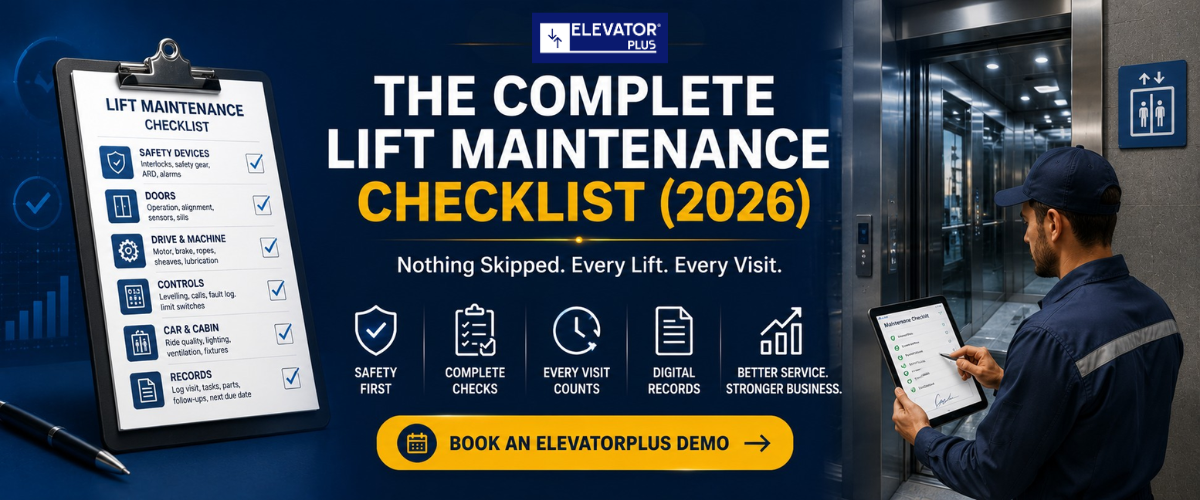
A good PM visit follows a checklist so nothing is skipped and every visit is comparable. While the exact items vary by equipment type, a typical schedule covers:
- Safety devices : door interlocks, safety gear, overspeed governor, buffers, emergency alarm and lighting.
- Doors : operation, alignment, sensors and reopening devices.
- Drive & machine : motor, brake, ropes/belts, sheaves, lubrication and noise/vibration checks.
- Controls : levelling accuracy, call/dispatch operation, fault logs.
- Car & cabin : levelling, ride quality, lighting, ventilation, ARD (automatic rescue device) test.
- Records : log the visit, tasks completed, parts used and any follow-up needed, against that specific unit.
That last point is where most companies lose the value of PM: the work gets done but the record doesn't, so there's no proof at renewal or inspection time.
Reactive vs preventive: the real cost
| Reactive (fix on breakdown) | Preventive (planned schedule) | |
|---|---|---|
| Cost per event | High — emergency callout | Low planned visit |
| Downtime | Unpredictable, disruptive | Minimal, scheduled |
| Equipment life | Shortened | Extended |
| Customer trust | Erodes with each breakdown | Builds with reliability |
| AMC renewals | At risk | Protected by proof of service |
How do you make sure PM visits actually happen?
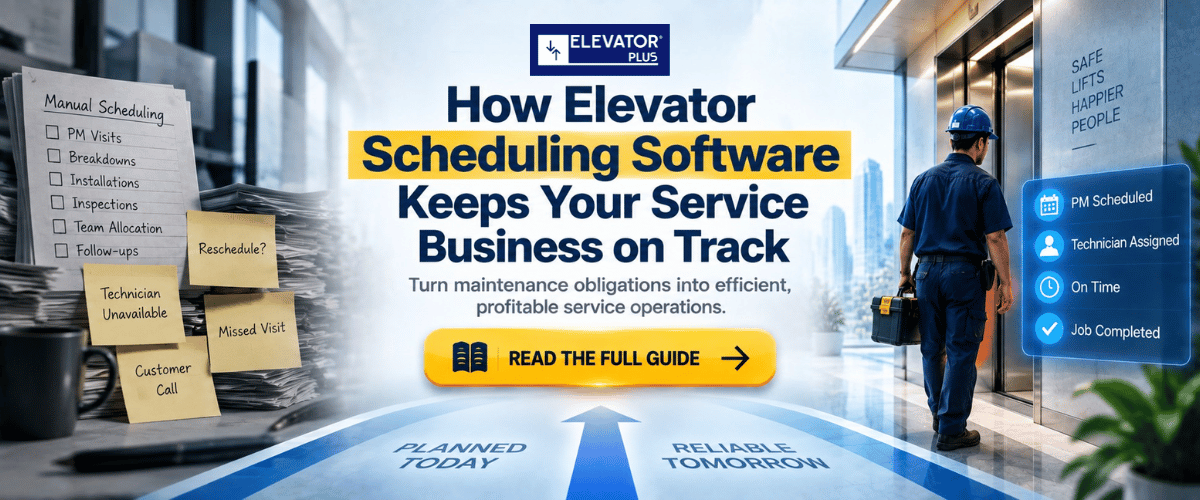
The hard part of preventive maintenance isn't knowing what to do it's making sure every visit happens, on time, across every unit. When the schedule lives in a spreadsheet or one person's head, visits slip the moment the team gets busy, and you only find out when a 'maintained' lift breaks down.
The fix is to give every unit its own recurring schedule in one system: the next visit is generated automatically, the team is alerted when it's due, the technician works from a per-unit checklist, and the completed visit is logged against that lift. Now nothing depends on memory, and at renewal you can show the building exactly what's been done. We go deeper on the renewal side in our AMC renewal playbook.
👉 Put every lift on an automatic maintenance schedule.
Frequently asked questions
1. How often should elevators be serviced?
Most lifts need a routine maintenance visit at least monthly, with deeper quarterly, half-yearly and annual tasks. High-traffic or older lifts need more frequent attention; intervals should follow local safety codes, manufacturer guidance and actual usage.
2. What is included in elevator preventive maintenance?
Checks and servicing of safety devices, doors, drive and machine, controls, and the car plus logging the visit, tasks and parts against the specific unit. A checklist keeps every visit consistent and comparable.
3. What is the difference between preventive and reactive maintenance?
Preventive maintenance is planned and scheduled to stop failures before they happen; reactive maintenance only responds after a breakdown. Preventive is cheaper, safer and far less disruptive.
4. How can software help with a preventive maintenance schedule?
It gives each unit its own recurring schedule, automatically generates and flags due visits, provides per-unit checklists, and logs completed work so PM happens on time without anyone tracking it manually.
A preventive maintenance schedule is the difference between an elevator business that firefights and one that runs on rhythm. The schedule itself is straightforward; the discipline of never missing a visit is what's hard — and that's exactly the part a system should handle for you.
👉 Never miss a maintenance visit again book a demo →
📲 Join our WhatsApp channel for compliance tips, updates: ElevatorPlus - Business Automation Tool
Related reading
- The Elevator AMC Renewal Playbook (2026)
- The Global State of the Elevator Service Industry 2026
- ElevatorPlus vs Spreadsheets & Generic FSM Tools
About the author : Nutan Mandal writes on elevator operations and field-service best practice for ElevatorPlus, the Elevator Business Operating System used by 200+ elevator companies across 20+ countries.
Sources: Preventive vs reactive maintenance cost and reliability benefits — field-service maintenance best-practice literature; elevator maintenance task categories and intervals ASME A17.1 / EN 81 maintenance guidance and OEM maintenance recommendations; ElevatorPlus Global Market Intelligence 2026.
👉 Follow ElevatorPlus on,