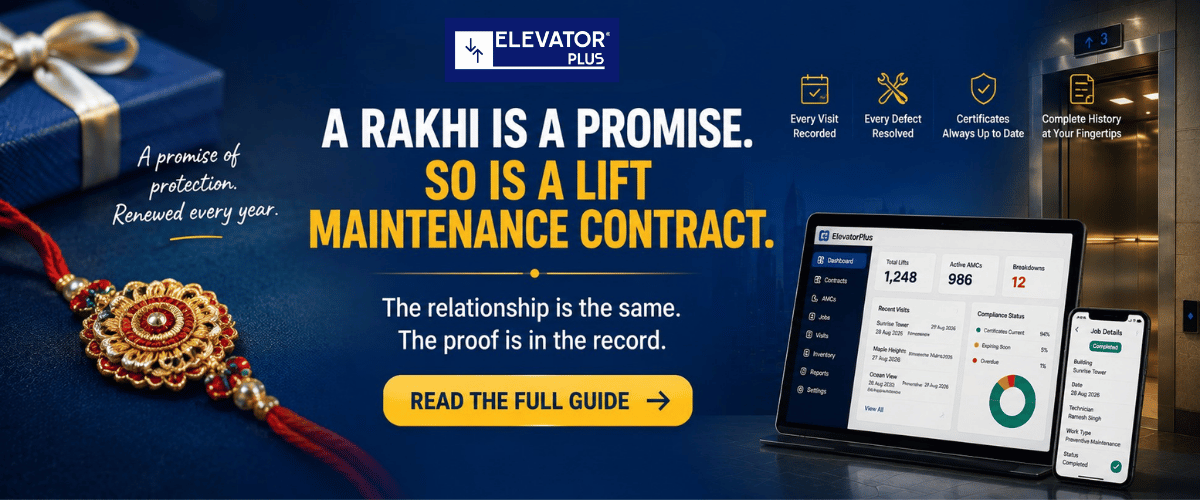
Who Protects the Lift? A Raksha Bandhan Note
By Mr. Sumeet Katariya, Founder & CEO, ElevatorPlus · Published 28 August 2026 · Last updated 1 September 2026 · ~7 min read
In short: Raksha Bandhan falls on 28 August 2026. A rakhi is a promise of protection, renewed every year whether or not anything went wrong. A maintenance contract has the same shape. The trouble is that protection which works is invisible, so the only way to show it is a record: every visit, every defect, every certificate, every part.
Key takeaways
- Raksha Bandhan 2026 falls on 28 August. The thread is a promise of protection, renewed annually, and renewed regardless of whether last year needed it.
- A lift maintenance contract is the same kind of promise, and it carries the same difficulty: when it works, nothing happens, and nothing is hard to charge for.
- ElevatorPlus observation from client onboarding, 2026: from the lobby, a contractor who quietly prevented eleven failures looks the same as one who prevented none but answered the phone fast.
- Evidence is the only way out of being invisible while you are good. Dated visits, defects raised and closed, certificates current, parts logged against the unit rather than against an invoice.
- At renewal, a rival quoting fifteen percent less is arguing about price. Three years of record lets you argue about something else.
What this guide covers: The promise in a thread · Why good maintenance hides itself · What the building sees versus what the record shows · What counts as evidence · Renewal season · FAQs
What does a rakhi actually promise?
Not much, if you look at the object. A few strands of thread, some coloured cotton, sometimes a small mirror in the middle.
The promise underneath it is larger, and stranger than we usually admit. A sister ties it and a brother accepts something open-ended: that he will be there, in a way not specified in advance, for a period not specified either. There is no schedule attached. There is no list of covered events.
And it gets renewed every year. That is the part worth sitting with. Nobody audits the previous twelve months first. Nobody says the thread was unnecessary because nothing bad happened, so let us skip this year. The renewal is not a reward for a crisis handled. It is the relationship continuing.
I have been in the lift business long enough to find that familiar.
Why does good lift maintenance make itself invisible?
Here is the odd economics of our trade: the better you are, the less anybody can see you.
Think about what a well-maintained lift produces. A door that closes when it should. A ride that stops level with the floor. A brake nobody has ever thought about. A rope tested and found fine. The output of good maintenance is an absence, and absences do not announce themselves.
Nobody in the building thanks a lift company on a Tuesday because the lift simply worked.
Meanwhile the contractor who does very little gets a strange advantage. Something fails, he arrives within the hour, he is heroic in the corridor for twenty minutes, and the residents talk about how responsive he is. The one who replaced a worn door operator roller in March, before anybody noticed a thing, gets no corridor conversation at all.
That asymmetry has a price, and the price appears at renewal. The invisible contractor is the one asked to justify his rate.
What does the building actually see?
This is the gap, laid out.
| What the client sees | What actually happened | What the record should show |
|---|---|---|
| "The lift has been fine all year." | Eleven visits, four defects found and corrected before failure. | Eleven dated visits, four defect entries, each closed with the date and the technician. |
| "You people hardly come." | Every visit made on schedule, mostly while the office was shut. | Visit timestamps, signed at site, visible to the client without asking. |
| "Why is your quote higher?" | Genuine parts, correct intervals, statutory tests actually done. | Part numbers logged against that specific unit, test certificates with expiry dates. |
| "We had one breakdown in March." | One breakdown in March, restored in ninety minutes. | Complaint logged, attended, resolved, cause recorded, part replaced. |
| "The other company said they would do it cheaper." | Cheaper by dropping two visits a year and using non-genuine spares. | Your own scope and frequency, in writing, next to theirs. |
Read the middle column and the left column together. They describe the same year. Only one of them is in the room at renewal, and it is usually not the true one.
That is not the client being unfair. It is a memory problem, and memory problems are solved with records, not with arguments.
👉 If your protection is real, it is worth being able to show it. Book an ElevatorPlus demo →
What counts as evidence?
Not a folder of service slips in the office. Evidence is what a building manager can look at, understand, and repeat to a committee that was not there.
Every visit, dated. Not "monthly as per contract" but the actual date, the actual technician, the actual signature. A schedule is an intention. A dated visit is a fact.
Every defect, raised and closed. A defect noted and never closed out is worse than one never noted, because it reads as negligence when somebody eventually reads it. Raised, actioned, closed, with dates on all three.
Every certificate, current. Whatever your jurisdiction requires, the test that matters is whether you can produce the certificate today without a search. Expiry dates belong in the system that reminds you, not in somebody's head.
Every part, against the unit. This is the one most contractors get wrong. A part logged against an invoice tells you what you sold. A part logged against that specific lift tells you its history: what has been replaced, when, and how often. That history is what makes a twelve-year-old machine legible, and it is what a competitor walking in cold does not have.
None of this needs to be elaborate. It needs to be consistent, and it needs to survive the departure of the person who remembers everything.
What happens at renewal season?
Somebody quotes fifteen percent less. This happens to every decent contractor, every year, and it will happen to you next month.
If all you have is a rate, you are in a price argument, and price arguments are won by whoever is willing to lose the most money.
If you have three years of record, the conversation changes shape. You are not defending a number. You are showing a building what has been done inside its own shafts since 2023: the visits, the defects caught early, the parts fitted, the tests passed. Then the fifteen percent is not a discount. It is a question about what the other quote leaves out.
Some clients will still leave. A few always do, and some of them come back. But you will have stopped losing the ones who only left because nobody ever told them what they were getting.
Who is actually riding the lift?
It is worth remembering what this is about on a day like today.
A lift is a piece of machinery, and we talk about it in the language of machinery: load, duty cycle, mean time between failures. But at eight in the morning it carries children down to the school van, and at three in the afternoon it carries a grandmother to a doctor's appointment she is already nervous about, and at eleven at night it carries somebody home from a shift.
They are not thinking about the brake. That is precisely the point. Their not thinking about it is the product.
You are the reason it is uneventful. Nobody will mention it.
Frequently asked questions
1. When is Raksha Bandhan in 2026?
28 August 2026.
2. What has a festival got to do with lift maintenance?
The shape of the promise. Protection given in advance, renewed on a cycle, not conditional on last year having been dramatic.
3. Why does good maintenance get punished at renewal?
Because prevention produces silence, and silence is easy to mistake for nothing having been needed. The remedy is a record the client can see without asking for it.
4. Is a service slip file not enough?
It is enough for you and not for the client. If the evidence lives in your office and has to be fetched, it is not working for you in the meeting where the decision gets made.
5. What is the single most useful thing to start recording?
Parts against the specific unit rather than against the invoice. It is the record that takes the longest to build and is worth the most once it exists.
6. How long should this history go back?
Long enough to cover the lift, not the contract. A machine has a life of two to four decades. Records that reset each renewal throw away the useful part.
7. Does this mean I should never lose a contract on price?
No. Some buildings will buy the cheapest option whatever you show them. Evidence stops you losing the ones who would have stayed if they had understood what they had.
8. Do we have to put all of this in a system?
It has to be somewhere consistent, retrievable and not dependent on one person's memory. Plenty of contractors run it on paper for years. It gets harder with every lift you add.
📲 Join our WhatsApp channel for compliance tips, updates: ElevatorPlus - Business Automation Tool
A rakhi is not a receipt for services rendered. It is a promise renewed because the relationship continues, and the year in which nothing went wrong is not evidence that the promise was unnecessary.
Maintenance is the same, with one difference: you have to be able to show your work, because nobody will notice it otherwise.
Happy Raksha Bandhan from all of us at ElevatorPlus. Look after the people in the car.
Related reading
- Seven Lift AMC Contract Clauses That Decide Whether You Make Money
- The Real Cost of Lift Downtime, Argued Properly
- The Complete Lift Maintenance Checklist for 2026
- The Second-Generation Question: When the Son Wants Systems
About the author · Mr. Sumeet Katariya is Founder and CEO of ElevatorPlus, the Elevator Business Operating System used by 200+ elevator companies across 20+ countries, and author of "ElevatorPlus How to run your operation stress-free and 3x your business".
Sources: ElevatorPlus client onboarding observations, 2026. Raksha Bandhan 2026 date: Shravana Purnima, 28 August 2026.
👉 Follow ElevatorPlus on,
Instagram LinkedIn Facebook YouTube Qoura Substack Twitter