
Lift AMC Charges in India 2026: Pricing Benchmark
By Sumeet Katariya, ElevatorPlus ·
In short: There is no single lift AMC rate in India. The price is built from technician time, visit frequency, travel, a parts provision, statutory scope and overhead recovery, costed per lift rather than per contract. What moves it most is unit age, make mix, floors served, response commitment, whether the contract is comprehensive, and which state the lift sits in, because Karnataka, Kerala and Maharashtra impose different recurring duties. Build your floor price first, then quote.
Key takeaways
- Cost per lift, never per contract. Site level averaging is where loss making units hide.
- Statutory scope is billable work, and it differs by state. Section 14(3) of the Karnataka Lifts, Escalators and Passenger Conveyors Act, 2012, with rule 12(4)(i) of the 2015 Rules, puts the owner under a duty to get every unit tested and maintained by a registered person once in every three months.
- The Maharashtra Lifts, Escalators and Moving Walks Act, 2017 is not in force. Maharashtra runs on the Maharashtra Lifts Act, 1939 and the Bombay Lift Rules, 1958, and section 11 requires inspection at least once in six months, not once a year.
- The owner's quarterly test and the authority's annual inspection under rule 17(1) are different obligations. Neither discharges the other.
- Comprehensive and non-comprehensive are two risk positions, not two price points. The gap is the parts provision, and a provision you have not calculated is a guess.
What this guide covers: how to build a floor price per lift · the variables that move the number · comprehensive against non-comprehensive · what the law requires in Karnataka, Kerala and Maharashtra · why old contracts bleed · how to hold your rate · which numbers to track · FAQs
How do you build a floor price per lift?
Most AMC quotes in India are built backwards. Someone remembers last year's number, adjusts it for the client's mood, and sends it. Nobody costs the contract afterwards to see whether it worked.
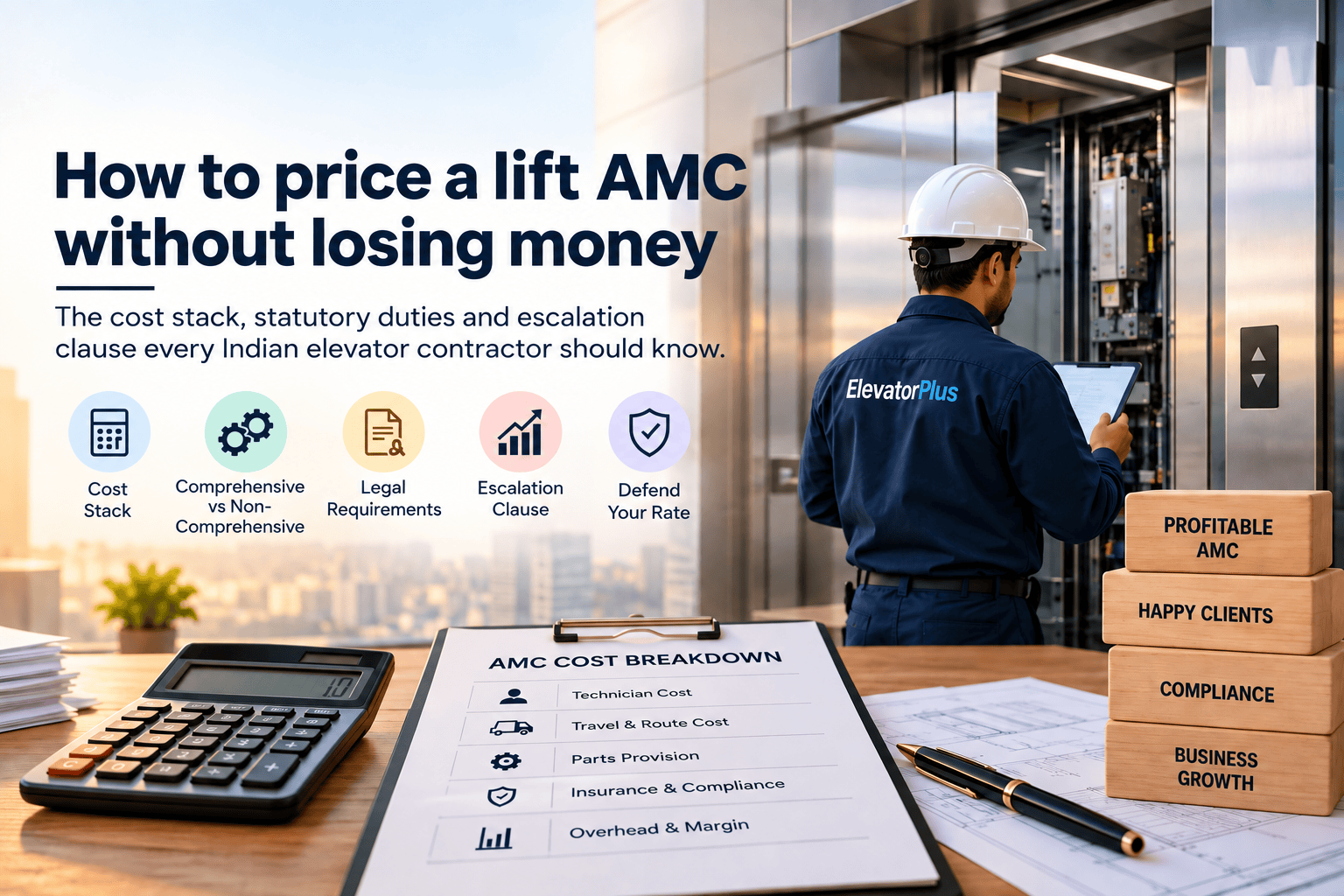
Your floor price is the number below which the contract loses money. It is not your quote. It is the line you refuse to cross. It has seven parts, every one of them measurable inside your own business.
Put four things in front of you: twelve months of job cards for a comparable unit, your fully loaded technician hour cost, your annual fixed overhead, and the number of units under contract. Then run this for one lift, one year.
- Preventive labour. Hours per visit times visits per year times the loaded hour cost. Loaded means wages plus statutory contributions, leave and idle time, not the basic wage.
- Travel. Round trip cost per visit times visits per year, plus travel hours at the same rate. That hour is paid whether or not the lift is touched.
- Breakdown provision. Expected callouts for this unit type and age, times average callout hours, times the loaded rate, plus an out of hours premium if you cover nights.
- Parts provision. Consumables only if the contract is non-comprehensive, everything inside the stated spares boundary if it is comprehensive. Take it from your own consumption for that age band, not a supplier list price.
- Statutory scope. The visits, tests, registers and reports the state requires. In Karnataka that is a quarterly cycle plus an annual report. In Maharashtra it includes a six monthly inspection.
- Overhead recovery. Annual fixed overhead divided by units under contract. If you have never done that division, do it now. It is the most underestimated line here.
- Risk provision. A percentage of the running total for bad debt and cost movement.
The first three are where most firms are wrong, because they are estimated rather than read off job cards. The fifth is where they are exposed, because scope is assumed rather than checked against the state's statute.
Add the seven. That is the floor per lift per year. Your quote is that floor divided by one minus your target margin, not the floor plus a round number. Run it on three units, your newest, your oldest and a mid life one. That spread is the real shape of your book.
Which variables actually move the number?
| Variable | Direction | Why it moves the price |
|---|---|---|
| Units at the site | Down per unit | One trip, one setup, several units |
| Unit age | Up | More callouts, more wear parts, longer visits |
| Make mix on the book | Up when mixed | Mixed spares, mixed training, slower diagnosis |
| Floors served | Up | More landings, more door gear, more calls |
| Contract type | Up for comprehensive | Parts risk moves to you |
| Travel distance | Up | Round trip and paid hour on every visit |
| Response commitment | Up as it tightens | Standby capacity is carried whether called or not |
| Spares boundary | Up as it widens | Rope and drive cover is not contactor cover |
| Statutory scope by state | Varies | Quarterly and six monthly are different volumes |
Two of these are routinely given away free: response commitment and spares boundary. A commitment you cannot meet is a penalty waiting to be claimed, and a boundary written as "all normal maintenance items" is an open ended liability.
Comprehensive or non-comprehensive, which should you quote?
The choice belongs to the parts provision, not to the client's preference.
A non-comprehensive contract covers labour, preventive visits and consumables, with parts billed as used. It prices lower and puts an argument about every failed component into the middle of a live breakdown.
A comprehensive contract covers parts inside a stated boundary. It prices higher, removes that argument, and transfers replacement risk to you. It suits an ageing book only if you know your parts consumption per age band.
Three drafting points decide whether comprehensive works.
- Write the spares boundary as a list, not an adjective. Rope, controller, machine and drive are the four items that decide profitability.
- Exclude damage that is not wear. Water ingress, vandalism, power abnormality and misuse are not maintenance events.
- Price the boundary from your own history. A supplier list price tells you replacement cost, not expected frequency, and frequency is what matters.
For a mixed book quote both, per lift, off the same floor calculation.
What does the law actually require, and why does it belong in the quote?
Statutory scope is work a client cannot argue you out of, because it is the state's requirement rather than your preference. Every claim below comes from the operative statute. This is general guidance on scope and pricing, not legal advice.
Karnataka
Governed by the Karnataka Lifts, Escalators and Passenger Conveyors Act, 2012 and the Rules of 2015.
- Section 5: a licence is valid ten years from grant, unless an addition or alteration is made, renewable for a further period of every five years on application with the prescribed fee.
- Section 14(3): the owner shall get the unit tested and maintained by any registered person once in every three months, keep a register, and submit a copy of the annual testing and maintenance report.
- Section 15(1): every owner shall enter into a contract with the registered person for satisfactory maintenance, including cleaning, oiling, adjusting and repairing.
- Section 15(2): the seat of arbitration for annual maintenance contract disputes is the State of Karnataka. An AMC naming a seat elsewhere is inconsistent with the statute governing it.
- Section 19: a fine which may extend to ten thousand rupees, or simple imprisonment which may extend to six months, or both, with a further fine up to one hundred rupees for every day a contravention continues after the first.
- Rule 12(4)(i): the owner shall enter into a contract agreement with the registered person and get the unit tested in the manner specified in the codes of the Bureau of Indian Standards or the International Electrotechnical Commission, as per section 14(3), at least once in every three months.
- Rules 12(4)(ii) and (iii): maintenance recorded in a register, Form H1, and an annual testing and maintenance report in Form C2 or Form C3.
- Rule 17(1): every unit in use shall be periodically inspected once in a year by an authorised officer or Inspector.
Keep the last two apart, because almost everyone conflates them. The quarterly test and maintenance under section 14(3) is the owner's duty, discharged through you as the registered person. The annual inspection under rule 17(1) is the authority's. Neither substitutes for the other, so the preventive cycle in Karnataka has a statutory floor of four events a year, a register and an annual report. Price all of it.
Kerala
Governed by the Kerala Lifts and Escalators Act, 2013, Act 18 of 2013, as amended by Act 14 of 2018.
- Section 4(5), as amended by Act 14 of 2018: a licence is valid three years from grant, renewed thereafter annually after an inspection.
- Section 6(1): every renewal application shall be made not less than three months before the date of expiry.
- Section 15: contravention is punishable with a fine of five thousand rupees which may extend to ten thousand rupees. There is no daily continuing fine and no imprisonment.
Annual renewal after the first three years, filed three months ahead, needs a calendar rather than a memory. That window belongs to Kerala. Do not carry it into another state.
Maharashtra
Read this carefully, because the position in wide circulation is wrong. The Maharashtra Lifts, Escalators and Moving Walks Act, 2017 has never been brought into force and governs nothing today. Anything quoting a twenty year licence, an annual inspection or a fifty thousand rupee penalty for Maharashtra is quoting an Act awaiting notification. The paper circulating since March 2026 as an amendment Act is L. A. Bill No. VII of 2026, a Bill.
Maharashtra operates under the Maharashtra Lifts Act, 1939 with the Bombay Lift Rules, 1958.
- Section 4: permission to erect "shall be valid only for a period of six months from the date on which it is granted."
- Section 7: "no lift shall be worked except under and in conformity with the terms of the licence granted in respect of the same".
- Section 11: "Every lift shall be inspected at least once in six months by an officer authorised in this behalf by the State Government."
- Section 13: a fine which may extend to five hundred rupees, and, for a continuing contravention, an additional fine which may extend to fifty rupees for every day.
- Rule 6(v) of the 1958 Rules: "Unless the licensee, in the opinion of the Inspector of Lifts, has suitable means for satisfactory maintenance of the lift, the licensee shall entrust the maintenance ... to an approved manufacturer".
Neither instrument states a licence validity term. Do not assume one, and do not carry the twenty year figure across from the 2017 Act.
The commercial consequence runs opposite to what most Maharashtra quotes assume. The interval is six monthly, not annual, so a firm that priced and staffed on an annual cycle has under scoped every Maharashtra contract on its book.
Other states
Several other states have their own lift legislation. The position has to be checked state by state against the bare Act and rules before it goes into a quote or a client conversation. We do not restate second hand summaries of statutes we have not read. If your contract references a Bureau of Indian Standards standard, name the standard and part, for example IS 17900, rather than "the applicable standard".
One terminology point worth more than it looks. The 1958 Rules say approved manufacturer. Karnataka says registered person. Different categories under different instruments, and the wrong one in a contract marks the document as copied rather than drafted.
👉 How many of your AMCs are due a statutory visit this quarter?
See how PM and AMC reminders work →
Why does an AMC signed three years ago lose money today?
Because every input moved and the contract value did not. Wages, travel and spares moved, and the unit aged, so callouts and visit duration rose with it.
Write escalation into every contract. Set the mechanism at signature, tied to a stated basis and a stated review date. It is far easier to agree at signature than mid term.
Recost every contract at renewal, per lift. A flat percentage across the book never finds the units that have drifted below floor.
Rank the tail deliberately. Most books carry units that have lost money for years, hidden inside a site average that looks acceptable. They surface only when you rank every unit by contribution.
How do you hold your rate when the client quotes a cheaper number?
Buyers arrive at a renewal having already searched what the maintenance rate is for whoever built the lift, so the price conversation starts before you do. You do not win it by discounting or by calling the other number fake. You win it by making the two quotes comparable, which they rarely are.
- Put scope side by side, in writing. Visits per year, response commitment, hours of cover, spares boundary, statutory tests and reports, and who keeps the register. Most cheaper quotes are cheaper because one of those is missing.
- Name the statutory floor for that state. In Karnataka, a quote priced on two visits a year does not meet the owner's quarterly duty under section 14(3), and the owner carries the consequence under section 19.
- Show the record, not the promise. Attendance against commitment, mean time to restore and breakdown frequency per unit. A client comparing two prices with no data takes the lower one.
If he still takes the cheaper number, let it go at your floor. A contract signed below floor is not revenue, it is a subsidy with an invoice attached.
Which numbers should you actually track?
Six, monthly, per unit, not per site.
| Metric | Why it matters to price |
|---|---|
| Contribution per unit per year | Finds the loss making tail |
| Preventive visit completion rate | Missed visits are both a cost saving and a liability |
| Breakdown callouts per unit per year | The best predictor of next year's cost |
| Mean time to restore | Shows whether the response commitment is real |
| Statutory events completed on time | The register and the annual report are the evidence |
| Renewal rate and days to decision | A renewal decided late is usually already lost |
If you can produce those six per unit today, pricing conversations get easier immediately, because you quote from evidence rather than memory. If you cannot, fix that before the price list.
Frequently asked questions
1. What is the average lift AMC charge in India in 2026?
There is no reliable single average, and any figure quoted as one hides a wide spread. The same building prices differently on unit age, make mix, contract type, response commitment, travel distance and statutory scope. Build the floor price per lift and quote from it.
2. Is a lift maintenance contract legally required in India?
It depends on the state. In Karnataka, section 15(1) of the 2012 Act requires every owner to enter into a contract with the registered person for satisfactory maintenance, including cleaning, oiling, adjusting and repairing. In Maharashtra, rule 6(v) of the Bombay Lift Rules, 1958 requires the licensee to entrust maintenance to an approved manufacturer unless the Inspector of Lifts considers that the licensee has suitable means.
3. How often must a lift be tested in Karnataka?
Section 14(3) of the 2012 Act, implemented by rule 12(4)(i) of the 2015 Rules, requires the owner to get the unit tested and maintained by a registered person at least once in every three months, with a register kept and an annual report produced. That is separate from the annual inspection under rule 17(1).
4. Is the Maharashtra Lifts, Escalators and Moving Walks Act, 2017 in force?
No. It has never been brought into force. Maharashtra operates under the Maharashtra Lifts Act, 1939 with the Bombay Lift Rules, 1958, and section 11 requires inspection at least once in six months by an officer authorised by the State Government.
5. How long is a lift licence valid?
It varies by state. Karnataka gives ten years from grant under section 5 of the 2012 Act, renewable for a further period of every five years. Kerala gives three years under section 4(5) as amended by Act 14 of 2018, renewed annually thereafter after an inspection. Neither the Maharashtra Lifts Act, 1939 nor the Bombay Lift Rules, 1958 states a validity term.
6. What penalties apply for non-compliance?
They differ sharply. Karnataka, under section 19 of the 2012 Act, reaches ten thousand rupees, or six months simple imprisonment, or both, with a daily continuing fine. Kerala, under section 15 of the 2013 Act, is a fine of five thousand rupees extending to ten thousand, with no daily fine and no imprisonment. Maharashtra, under section 13 of the 1939 Act, is five hundred rupees with fifty rupees for every day of a continuing contravention.
Lift AMC pricing in India feels arbitrary because most firms quote from memory and cost nothing afterwards. The number they defend in a renewal meeting has no calculation behind it, so it collapses when a client pushes.
Build the floor price per lift. Seven lines, your own job cards. Once that number exists the negotiation changes shape, because you stop arguing about whether the price is fair and start showing what it buys.
Then put statutory scope inside the quote and price it. Karnataka's quarterly duty under section 14(3) and Maharashtra's six monthly inspection under section 11 of the 1939 Act are not extras you absorb to win work. They are the work, and a great many quotes in the market are scoped to an Act that never came into force. Getting that right is worth more than any negotiation tactic.
👉 See how elevator companies run AMC, compliance and renewals in one system. Book a demo →
Related reading
- PM and AMC reminders: never miss a service or a renewal date
- Breakdown management: logging, assignment and restore time
- Inspection management: records, checklists and reports
- Equipment analytics: contribution and service load per unit
About the author. Sumeet Katariya is the founder of ElevatorPlus, the Elevator Business Operating System used by 200+ elevator companies across 20+ countries.
Sources: Karnataka Lifts, Escalators and Passenger Conveyors Act, 2012, sections 5, 14, 15 and 19 · Karnataka Lifts, Escalators and Passenger Conveyors Rules, 2015, rules 12 and 17 · Kerala Lifts and Escalators Act, 2013 (Act 18 of 2013), sections 4, 6 and 15, as amended by the Kerala Lifts and Escalators (Amendment) Act, 2018 (Act 14 of 2018) · Maharashtra Lifts Act, X of 1939, sections 4, 7, 11 and 13 · Bombay Lift Rules, 1958, rule 6 · Maharashtra Lifts, Escalators and Moving Walks Act, 2017, an Act not in force · Maharashtra Lifts, Escalators and Moving Walks (Amendment) Bill, L. A. Bill No. VII of 2026, a Bill · IS 17900 (Parts 1, 2 and 6):2022, Bureau of Indian Standards. Citations are given as act, section and year in plain text rather than as links, because we do not publish a government URL we have not confirmed.
👉 Follow ElevatorPlus on,
Instagram LinkedIn Facebook YouTube Qoura Substack Twitter