SA Lift Maintenance Regulations: The 4 Legal Intervals
By Nutan Mandal, ElevatorPlus · Compliance reviewed by Mr. Sumeet Katariya
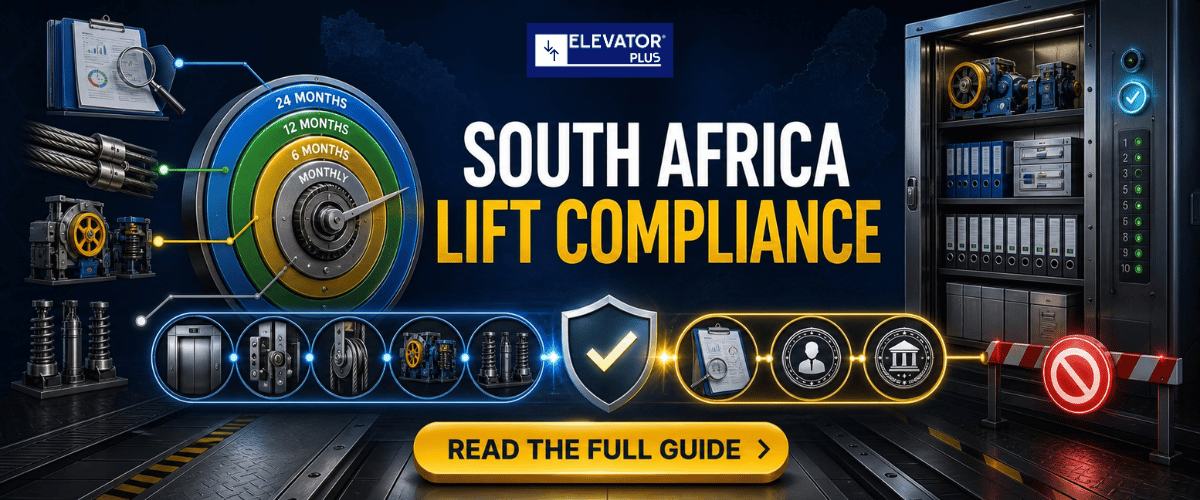
In short: South African lift compliance rests on one instrument, the Lift, Escalator and Passenger Conveyor Regulations, 2010. It sets four separate intervals: monthly maintenance, six-monthly rope examination, annual safety gear testing, and an independent inspection every 24 months. Three things the trade repeats about who regulates lifts are wrong, and this guide corrects them.
Key takeaways
- Lifts are governed by the Lift, Escalator and Passenger Conveyor Regulations, 2010 (GN R. 828, 17 September 2010) under the OHS Act 85 of 1993. The 1994 predecessor, GNR.797, is superseded.
- The Driven Machinery Regulations do not govern lifts. DMR 2015 defines "lifting machine" so that it "does not include an elevator, escalator or hand-powered lifting device", and imposes no duties on lifts anywhere else.
- Lift inspectors are registered by the Engineering Council of South Africa. No body called "SAQCC Lifts" exists, and LEEASA covers lifting equipment, cranes and rigging, not lifts.
- Four intervals apply: monthly maintenance, six-monthly rope examination, a safety gear, overspeed governor and buffer test not exceeding 12 months, and an inspection and test not exceeding 24 months.
- Your maintenance company cannot do your 24-monthly inspection. Competent lift service provider and accredited inspection service provider are different roles.
- The accredited authority is SANAS, the South African National Accreditation System, named in the definitions of the 2010 Regulations. Not a Department of Employment and Labour approval letter.
- Records must be kept in the machine compartment for at least 10 years, and regulation 3 prohibits using a lift at all without a valid comprehensive report.
What this guide covers: The one instrument that applies · The DMR myth, and the exact words that settle it · The four intervals in one table · Who registers lift inspectors, and who accredits the firm · Why maintenance and inspection are split · The incorporated SANS standards · The record you must keep for 10 years · How South Africa compares with the UK and the UAE · The December 2024 gazette notice
Which regulations actually govern lifts in South Africa?
Start with the instrument, because most site arguments come from two people quoting different rulebooks. Lifts, escalators and passenger conveyors fall under the Lift, Escalator and Passenger Conveyor Regulations, 2010, published as Government Notice No. R. 828 on 17 September 2010 under the Occupational Health and Safety Act 85 of 1993. Still current in 2026.
The 1994 predecessor, GNR.797, is superseded. If a maintenance contract or tender specification still cites it, that document is out of date, usually because a template was copied forward for twenty years unread.
Two duty holders run through the text: the user, in practice the building owner, who carries most obligations, and the competent lift service provider, your maintenance company.
Do the Driven Machinery Regulations cover lifts?
No, and this is the most common mistake in the South African trade.
The Driven Machinery Regulations 2015 (GN R540, GG 38905, corrected by GN R913, GG 39253, effective 30 September 2015) impose no duties on lifts, escalators or passenger conveyors, and the definitions section says so in as many words. "Lifting machine" is defined there as "a power-driven machine that is designed and constructed for the purpose of raising or lowering a load or moving it in suspension, but does not include an elevator, escalator or hand-powered lifting device". That exclusion is the whole argument. Print it and keep it in the file, because it ends the conversation faster than any explanation.
Regulation 23(1) repealed the 1988 DMR. The only other lift-adjacent text is regulation 23(2), a transitional clause giving goods hoist users five years from publication to comply with the separate 2010 LEPC Regulations, where "Access Goods only Lift" is defined.
That clause is the source of the confusion. The DMR does not regulate lifts, it points goods hoist users at the regulations that do. The pointer got remembered as jurisdiction, and now facility managers ask for DMR certificates on passenger lifts, which do not exist.
What are the four intervals, and which one are you missing?
Most buildings do the monthly and treat the rest as optional. There are four cycles, three under regulation 7 and one under regulation 6. They are not interchangeable.
| Interval | What is required | Regulation | Who performs it |
|---|---|---|---|
| At least monthly | Examine and maintain the lift, or at longer intervals prescribed by the manufacturer. All gates and door locks tested at each examination | Reg 7 | Competent lift service provider |
| Six-monthly | Examination of the suspension ropes | Reg 7 | Competent lift service provider |
| Not exceeding 12 months | Testing of safety gear, over speed governor and buffers | Reg 7 | Competent lift service provider |
| Not exceeding 24 months | Inspection and test against the relevant standards, with a comprehensive report | Reg 6 | Inspection service provider employing a registered lift inspector |
The 24 months is not the only trigger under regulation 6. A lift must also be inspected before first use, after modification, after a reportable incident under section 24 of the Act, and on a change of designated competent lift service provider. That last one catches people out. Switch contractors and you have triggered an inspection.
Find a defect that endangers persons and the wording is blunt: the inspection service provider "shall report such defect or weakness forthwith to the user, the competent lift service provider and the provincial director", and the equipment may not operate until rectified.
👉 Four intervals, four evidence trails, one place to keep them.
Who registers lift inspectors in South Africa?
The Engineering Council of South Africa. Not SAQCC.
The 2010 Regulations define a "registered lift inspector" as a person registered with ECSA in terms of the Engineering Profession of South Africa Act, 2000. ECSA runs it as a Specified Category, with its own application document, APP-REG-SC-LI. That is the register to check.
There is no such body as "SAQCC Lifts". SAQCC covers Gas, Fire, IPE and CP. The name gets borrowed because the pattern is familiar from other trades, and once it lands in a tender it spreads.
LEEASA is the other mix-up: the Lifting Equipment Engineering Association of South Africa, cranes, hoists, wire rope, rigging. A Lifting Machinery Inspector is not a registered lift inspector.
Why can your maintenance company not sign off your own inspection?
A "competent lift service provider" employs competent lift mechanics and a competent operator, or is a self-employed competent lift mechanic, contracting with the user to perform maintenance. The user designates that provider under regulation 7. No accreditation requirement attaches.
An "inspection service provider" employs a registered lift inspector, contracts with the user to perform inspections, and is accredited by the accredited authority. The 2010 Regulations define that authority as "the South African National Accreditation System established by section 3 of the Accreditation for Conformity Assessment, Calibration and Good Laboratory Practice Act, 2006". So the gate is SANAS accreditation, not a letter from the Department of Employment and Labour, and it is checkable in about two minutes. Regulation 9 requires such providers to register with that authority, and the Chief Inspector may withdraw approval.
If you are used to the "approved inspection authority" language from other parts of the OHS Act, note that lifts do not use it. The pairing here is ECSA registration for the individual and SANAS accreditation for the firm. Get either wrong and the comprehensive report you are relying on is worth nothing.
The party doing the work does not certify it. Tell clients early: your maintenance contract, however good, does not discharge the 24-monthly obligation. Separate appointment, separate provider, separate budget line.
Which standards apply, and does EN 81-20 have legal force here?
The list sits in Government Notice 2683, Government Gazette 47373, 28 October 2022, "Incorporation of Safety Standards for Lift, Escalator and Passenger Conveyor Regulations, 2010".
It incorporates SANS 1543 for escalators and passenger conveyors; SANS 1545-1, -2, -3, -5, -6 and -9; SANS 21-1; SANS 50081-20, "Safety rules for the construction and installation of lifts, Lifts for the transport of persons and goods, Part 20: Passenger and goods passenger lifts"; SANS 50081-50, on design rules, calculations, examinations and tests of lift components; SANS 50081-3, -21, -22, -41 and -70; SANS 53015 on lift and escalator maintenance; and EN 12159:2012 for builders hoists.
Underline this part. SANS 50081-20 and SANS 50081-50 are the South African national adoptions of EN 81-20 and EN 81-50, so those standards carry direct legal force here. Engineers already working to EN 81-20 abroad are not learning a new standard, they are citing it by its South African number.
One drafting note: the notice publishes no edition years, so quote SANS numbers without one. "SANS 50081-20:2020" in a specification invents precision the gazette does not give you.
What must be in the lift record, and for how long?
Regulation 8 is the one that trips contractors during an inspection visit, because the file is expected to be there, in the machine compartment, and complete.
It requires the user to keep a record containing the user's contact details, the service provider's name, address and telephone number, the results of examinations and tests together with modifications and repairs, the latest comprehensive report, suspension rope certificates, the technical dossier as specified in the applicable SANS standard, the commissioning acceptance report, and incident reports made under section 24 of the Act. Records must be preserved for at least 10 years.
Regulation 3 is blunt about the consequence of a gap. No person may put a lift, escalator or passenger conveyor into use, or permit its use, unless there is a valid comprehensive report. An expired report is not a paperwork problem. It is a prohibition on operating the lift, and the building has to take it out of service.
What a South African contractor should be recording
- The current comprehensive report for every lift, with its issue date and the 24 month expiry calculated from that date, not from the last service visit.
- The registration number of the ECSA registered lift inspector who signed the report, and the SANAS accreditation number of the inspection service provider that employed them.
- Monthly maintenance examinations, with the gate and door lock test recorded each time, because regulation 7 requires the test at every examination.
- Six-monthly suspension rope examinations and rope certificates, filed against the specific lift and retained for the full 10 years.
- The 12-monthly safety gear, over speed governor and buffer test results.
- The technical dossier and commissioning acceptance report for each installation, including modernisations.
- Every modification and repair, with dates, because regulation 6 triggers a fresh inspection after a modification regardless of where you are in the 24 month cycle.
- Section 24 incident reports, cross referenced to the lift and to the report issued afterwards.
- The date you were designated, and the date any predecessor was replaced, because a change of competent lift service provider triggers an inspection.
How does South Africa compare with the regimes you may be used to?
| Question | South Africa | United Kingdom | United Arab Emirates |
|---|---|---|---|
| Governing instrument | LEPC Regulations 2010, GN R. 828 | LOLER 1998 | Emirate level, varies |
| Independent inspection interval, passenger lift | Not exceeding 24 months | 6 months | Varies by emirate |
| Who inspects | ECSA registered lift inspector at a SANAS accredited provider | Competent person | Approved third party |
| Record retention | At least 10 years | 2 years for reports | Varies |
| EN 81 status | Adopted as SANS 50081, with direct legal force through GN 2683 | Applied via BS EN 81 | Commonly specified |
Treat the non South African columns as orientation only. Each has its own article on this site.
Twenty four months is generous next to the UK's six. The requirement that the individual inspector holds ECSA registration and the firm holds SANAS accreditation is not generous at all, and it is the point where most non compliance is actually found.
What is the December 2024 notice, and does it change anything?
A notice was gazetted on 13 December 2024, Government Gazette No. 51740, Notice No. 5653, titled "Incorporation of the National Code of Practice for Inspection and Testing of Lift, Escalator and Passenger Conveyor into Lift, Escalator and Passenger Conveyor Regulations, 2010".
We have not seen the operative text. Its existence is indexed, but the content, commencement date and transitional provisions are not something we can describe. Treat it as a document to obtain and read, not a requirement you already have to meet.
Frequently asked questions
Which regulations govern lifts in South Africa?
The Lift, Escalator and Passenger Conveyor Regulations, 2010, Government Notice No. R. 828, 17 September 2010, under the OHS Act 85 of 1993.
How often must a lift be serviced in South Africa?
At least once a month, or at such longer intervals as prescribed by the manufacturer. Gates and door locks are tested at each examination.
How often does a lift need an independent inspection?
At intervals not exceeding 24 months, plus before first use, after modification, after a reportable incident under section 24, and on a change of designated competent lift service provider.
Do the Driven Machinery Regulations apply to lifts?
No. DMR 2015 defines "lifting machine" so that it excludes elevators and escalators, and imposes no duties on lifts anywhere else. Regulation 23(2) is a transitional clause pointing goods hoist users to the 2010 Regulations.
Who is a registered lift inspector?
A person registered with the Engineering Council of South Africa under the Engineering Profession of South Africa Act, 2000.
Can our maintenance contractor carry out the 24-monthly inspection?
No. It must come from an inspection service provider that employs a registered lift inspector and is accredited by the accredited authority.
How often are suspension ropes and safety gear checked?
Suspension ropes at six-monthly intervals. Safety gear, over speed governor and buffers at intervals not exceeding 12 months.
Does EN 81-20 apply in South Africa?
Yes, through SANS 50081-20, the South African adoption, incorporated by Government Notice 2683, Government Gazette 47373, 28 October 2022. EN 81-50 applies through SANS 50081-50.
How long must lift records be kept?
At least 10 years, in the relevant machine compartment, under regulation 8.
What happens if the comprehensive report expires?
Regulation 3 prohibits putting the lift into use, or permitting its use, without a valid comprehensive report. Take it out of service.
Who accredits an inspection service provider?
SANAS, the South African National Accreditation System, named as the accredited authority in the definitions of the 2010 Regulations.
Is SAQCC registration required for lift work?
We could not establish any SAQCC body covering lifts from a primary source. SAQCC operates for Gas, Fire, IPE and CP. If a tender demands it for your lift crew, ask for the certificate, and confirm with the Department of Employment and Labour before accepting the requirement.
Can the 24-monthly interval be shortened?
Yes. Twenty four months is a maximum, not a target, and many high traffic sites run 12 months by choice or on the strength of their own risk assessment.
South African lift compliance is simpler than the folklore around it, and stricter where people look away. One instrument, the 2010 Regulations. Four intervals. Two separate company roles, so the firm maintaining the lift never certifies it.
If you change one thing operationally, make it the evidence. Buildings rarely fail because nobody did the work. They fail because the records are scattered and nobody can produce the 24-monthly report on the day it is asked for.
Run every interval, unit and report from one place. Book an ElevatorPlus demo →
Related reading
- BCA lift maintenance, Singapore
- LOLER and passenger lifts, UK
- UAE lift maintenance compliance
- Lift maintenance checklist 2026
About the author · Nutan Mandal is part of the ElevatorPlus team, which builds the Elevator Business Operating System used by 200+ elevator companies across 20+ countries. Compliance reviewed by Mr. Sumeet Katariya.
Sources: LEPC Regulations 2010, GN R.828, Gazette 33561, 17 September 2010 · LEPC Regulations 2010, alternative copy · Department of Employment and Labour copy of the lift regulations · gov.za notice page · Guidelines, GN R.763, GG 39132 · Driven Machinery Regulations 2015, consolidated text, definition of "lifting machine" and regulation 23 · ECSA specified categories of registration · ECSA, APP-REG-SC-LI, registration as a Registered Lift Inspector · Government Notice 2683, Government Gazette 47373, 28 October 2022, incorporation of safety standards · SABS Notice 329 of 2017 listing SANS 50081-50:2017/EN 81-50:2014 · GN 52 of 2018, draft code of practice for inspection and testing, comments invited · GN R.5588 of 29 November 2024, code of practice for lifting machine operator training providers, which concerns lifting machines and not lifts · SAQCC Fire · SAQCC Gas · Wind turbine tower lifts, GN 2500, GG 46917 · Department of Employment and Labour
We have not read the operative text of the 13 December 2024 notice in Government Gazette 51740, and we could not open it from an official source. Its existence is indexed; its content is not something we can describe. Ask your SANAS accredited inspection service provider for their copy, or confirm with the Department of Employment and Labour, before you change any procedure on the strength of it.
👉 Follow ElevatorPlus on,
Instagram LinkedIn Facebook YouTube Qoura Substack Twitter