
Malaysia DOSH Certificate of Fitness: The 15-Month Cycle
By Mr. Sumeet Katariya, ElevatorPlus · Compliance reviewed by Mr. Sumeet Katariya.
In short: The Factories and Machinery Act 1967 no longer governs lifts in Malaysia. It was repealed, and since 1 June 2024 the certificate of fitness for a lift has sat under Part VIA of the Occupational Safety and Health Act 1994 and the Occupational Safety and Health (Plant Requiring Certificate of Fitness) Regulations 2024. This guide reads the 15-month cycle straight out of the gazette, and names the citations that are now wrong.
Key takeaways
- Fifteen months, from the date of inspection. Regulation 5(6) of P.U. (A) 99/2024: "The certificate of fitness issued under subregulation (1) shall be valid for a period of fifteen months from the date of inspection." Not fifteen months from issue. From inspection.
- The re-inspection window opens at month twelve. Regulation 6(2)(a) bars a fresh inspection earlier than the first day of the twelfth month after the last one. So the usable window is months 12 to 15, and it is three months wide, not fifteen.
- The Factories and Machinery Act 1967 is repealed and must not be cited. The repeal was effected by the Factories and Machinery (Repeal) Act 2022 [Act 835], section 3. Vendor pages, tender documents and service contracts across the market still cite Act 139.
- Lifts are covered as "lifting machinery", with one carve-out. Regulation 3 prescribes steam boilers, pressure vessels and lifting machinery. The regulation 2 definition of "lift" excludes lifts with a rated speed of less than 0.15 metres per second.
- DOSH is not the only issuer. Section 27D(1) of Act 514 permits the certificate to be issued by "an officer or a licensed person". Licensed persons are licensed by the Minister under section 7A(1).
What this guide covers: what replaced the FMA and when · the 15-month rule as drafted · the 12-to-15 month window · what counts as lifting machinery · the pre-first-use sequence · who inspects · penalties · the citations to stop using · FAQs.
What actually changed, and when
Malaysia rebuilt the plant certification regime in one move.
Part VIA was inserted into the Occupational Safety and Health Act 1994 [Act 514] by the Occupational Safety and Health (Amendment) Act 2022 [Act A1648], and the new sections came into operation on 1 June 2024. Section 27B gives the Minister power to prescribe plant requiring a certificate of fitness. Section 27C covers approval to install. Section 27D is the operating prohibition. Section 27E is periodical inspection.
The Minister then exercised that power. The Occupational Safety and Health (Plant Requiring Certificate of Fitness) Regulations 2024 were gazetted as P.U. (A) 99 on 2 April 2024, and regulation 1(2) brings them into operation on 1 June 2024. They are made under sections 27B, 27C, 27D, 27E and 66 of Act 514.
The commencement orders: P.U.(B) 127/2024 and 128/2024
Two commencement orders sit behind the 1 June 2024 date most articles quote. P.U.(B) 127/2024 brought the Factories and Machinery (Repeal) Act 2022 [Act 835] into force, formally repealing the Factories and Machinery Act 1967. P.U.(B) 128/2024 brought the corresponding Occupational Safety and Health Act 1994 amendments into force on the same date. Both were needed before the Occupational Safety and Health (Plant Requiring Certificate of Fitness) Regulations 2024 [P.U.(A) 99/2024] gazetted 2 April 2024 could actually take effect.
Separately, the Factories and Machinery Act 1967 was repealed. The repealing instrument is the Factories and Machinery (Repeal) Act 2022 [Act 835], whose section 3 reads:
"The Factories and Machinery Act 1967 is repealed."
That last point is worth stating precisely, because the common version of it is wrong in an interesting way. The amending Act and the repealing Act were passed together and are constantly conflated. Act A1648 inserted Part VIA. Act 835 repealed the FMA. They are two separate instruments. Anyone citing Act A1648 as the repeal has the outcome right and the authority wrong.
The fifteen months, exactly as drafted
Regulation 5(6):
The certificate of fitness issued under subregulation (1) shall be valid for a period of fifteen months from the date of inspection.
In Malay: "Perakuan kelayakan yang dikeluarkan di bawah subperaturan (1) hendaklah sah bagi tempoh lima belas bulan dari tarikh pemeriksaan."
Regulation 6(2)(i) repeats it for renewals. Same fifteen months, same running date.
Two things follow, and both get missed.
The clock starts at inspection, not at issue. If the inspection happens on 4 March and the certificate is issued on 2 April, the certificate expires fifteen months from 4 March. Administrative delay eats the validity period rather than extending it.
It is stated as the validity period, not as a ceiling. The Act leaves the period to the Minister under section 27D(4). The Minister set fifteen months. Describing it as "up to fifteen months" or "a maximum of fifteen months" reads a discretion into the regulation that is not there.
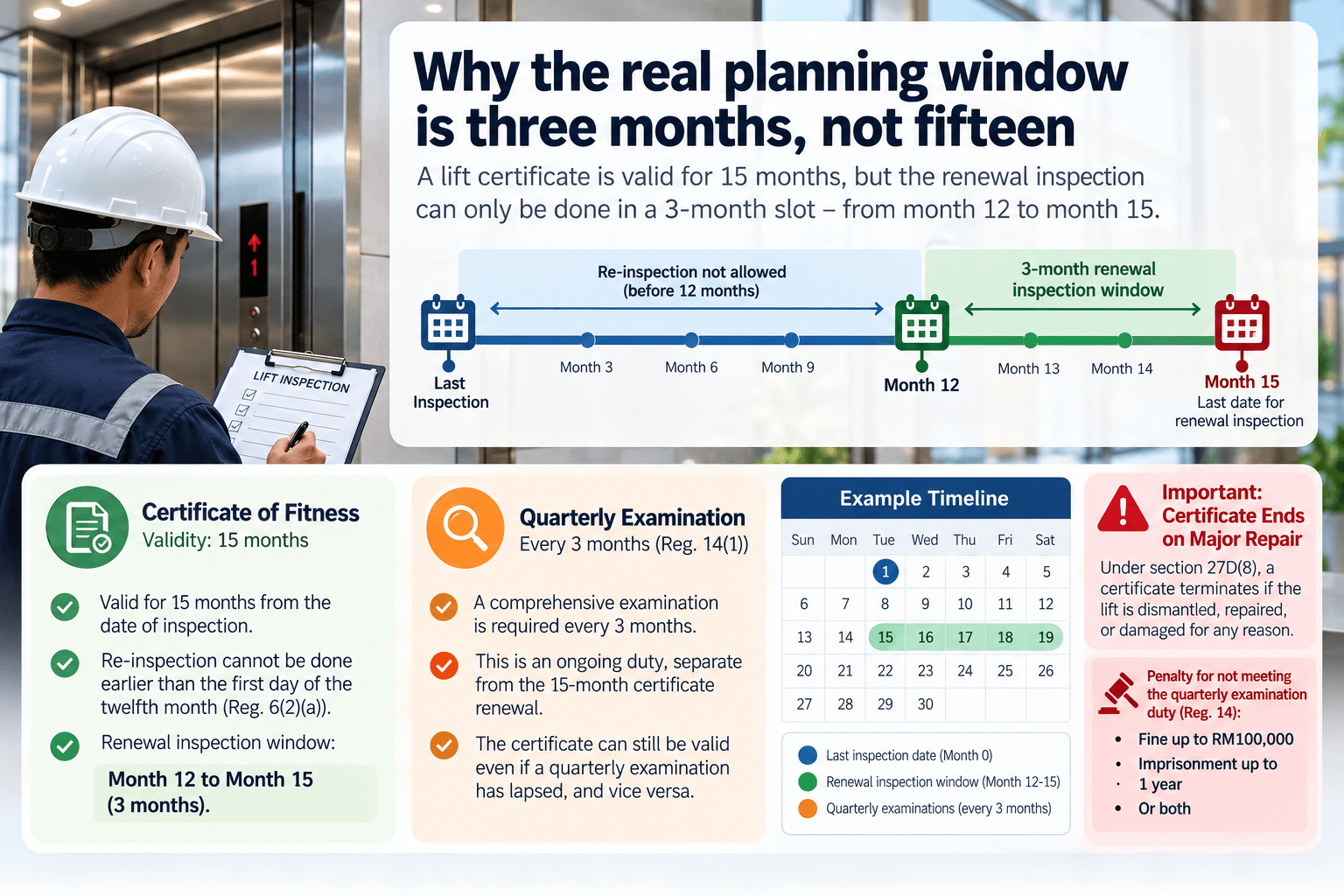
Why the real planning window is three months, not fifteen
This is the operational point that changes how a service company schedules.
Regulation 6(2)(a) prevents re-inspection earlier than the first day of the twelfth month after the last inspection. Combined with the fifteen-month validity, the window in which a renewal inspection can actually take place runs from month twelve to month fifteen.
So the cycle is not "book it before it expires". It is a three-month slot that opens on a fixed date and closes on a fixed date.
A contractor holding several hundred units across Klang Valley, Penang and Johor is therefore managing a rolling set of three-month windows that never align, because each one is anchored to the date of that unit's last inspection. Batch scheduling by building does not survive contact with this rule. Neither does scheduling by calendar quarter.
We learned this the slow way on our own implementation planning, having initially modelled it as a simple expiry date with a reminder, which is the version most systems ship with and the version that quietly produces early rejections.
One further trap sits in section 27D(8). A certificate in respect of plant which is being dismantled or repaired, or which is damaged for any reason, terminates upon that dismantlement, repair or damage. A major repair does not pause the certificate. It ends it.
The other three-month clock: the examination duty under Regulation 14(1)
The fifteen-month certificate is not the only clock running. Regulation 14(1) of the Occupational Safety and Health (Plant Requiring Certificate of Fitness) Regulations 2024 separately requires a comprehensive examination of the lift every three months an ongoing duty that exists independently of when the certificate itself is due for renewal. Confusing the two is common: the certificate can still be valid while a quarterly examination has lapsed, and vice versa.
Operating without meeting the Regulation 14 examination duty carries its own penalty a fine of up to RM100,000, imprisonment of up to one year, or both. Track the two dates separately: the certificate's 15-month validity, and the standing three-month examination requirement.
What counts as lifting machinery
Regulation 3 prescribes three classes of plant: steam boiler, pressure vessel, and lifting machinery. Lifts sit inside the third one rather than having a class of their own.
Regulation 2 defines "lifting machinery" as any equipment for lifting, raising, transporting or lowering loads. It then defines "lift" separately: lifting machinery with traction, positive or hydraulic drive, functioning at specific levels, with a carrier moving along rigid guides inclined at more than 15 degrees to the horizontal, for the transportation of persons only or persons and goods.
That definition carries one exclusion worth knowing. It does not include lifts with a rated speed of less than 0.15 metres per second. Slow platform lifts below that threshold fall outside the lift definition.
Hoists are defined separately again, covering passenger hoists and material hoists. Escalators and walkalators are also caught by the Regulations.
Tower cranes are on the list too
Lifts and hoists are not the only equipment this regime covers. Tower cranes and passenger hoists used on construction sites fall under the same Regulations, alongside escalators and walkalators. If a site operates a tower crane as well as a passenger or goods lift, both need separate certificates of fitness — one does not cover the other.
Regulation 21 sets out non-application. Certain pressure vessels in the Second Schedule and certain manual or listed lifting machinery in the Third Schedule are out of scope. Lifts are not in the Third Schedule. They are fully in.
👉 Tracking certificate windows rather than expiry dates? Start from our free lift service checklist and breakdown report templates and rebuild your scheduling around the month-12 opening.
The citations to stop using
| Still commonly cited | Status | What to cite instead |
|---|---|---|
| Factories and Machinery Act 1967 [Act 139] | Repealed by Act 835, s 3 | Occupational Safety and Health Act 1994 [Act 514], Part VIA |
| FMA machinery regulations for lift certification | Superseded | P.U. (A) 99/2024, in operation 1 June 2024 |
| "PMA" or "PMT" as the legal term | Trade shorthand only | Perakuan kelayakan, defined in Act 514 s 2 as a certificate issued under s 27D |
| "DOSH must inspect the lift" | Incomplete | An officer or a licensed person, per Act 514 s 27D(1) |
| "Certificate valid up to 15 months" | Misstates the drafting | Valid for fifteen months from the date of inspection, reg 5(6) |
The PMA and PMT abbreviations are worth a sentence on their own. Neither string appears anywhere in P.U. (A) 99 or in Act 514. They are administrative and trade shorthand. Using them in a compliance document is not an error of substance, but it does tend to travel alongside the FMA citations, and it is a reliable signal that a document has not been updated since 2024.
Before the lift ever runs
The Regulations gate first use in stages, and none of them are the old machinery registration step under a new name.
Design verification. Regulation 4(1)(a) requires design verification from the Director General, supported by the Fifth Schedule documents and the Sixth Schedule fee. Regulation 2 defines it as a document issued by the Director General certifying that the design complies with the recognised standard. Where the plant is manufactured domestically, the application must come from a competent-person manufacturer under regulation 4(1)(b)(i).
Written approval to install. Section 27C(1) and regulation 4(2). Regulation 4(3) requires this again when an already-certified plant is relocated to a new site, waiving only the earlier document steps.
Inspection, then the certificate. Section 27D(1) and (2), with regulation 5. For lifting machinery, regulation 5(2)(d) requires the inspection to include a load test at the load specified in the design verification and a functional test on all safety devices.
Marking. Regulation 18: the owner shall make a marking of the registration number and display it prominently on the plant.
Note what regulation 18 requires and what it does not. The registration number goes on the plant. There is no requirement anywhere in P.U. (A) 99 to display the certificate of fitness itself in the car, the lobby or the machine room. That is a widely repeated instruction with no basis in the Regulations.
What the Thirteenth Schedule does require, for lifts, escalators and walkalators, is a displayed notice giving contact particulars for anyone to call on service disruption, a displayed guide on using the emergency or call button when the lift malfunctions, and bilingual signage adjacent to each lift machinery room entrance reading Bilik Jentera Lif – Bahaya / Lift Machinery Room – Danger / Dilarang Masuk Tanpa Kebenaran / No Entry Without Permission.
Who inspects, and what non-compliance costs
Section 27D(1) permits the certificate to be issued by "an officer or a licensed person". Section 7A(1) gives the Minister power to license a person to carry out inspection of prescribed plant and issue a certificate of fitness for it. So the market is not DOSH-only by design.
Registered competent persons appear throughout regulation 4, in manufacture, installation and pre-installation examination, and are named on the certificate form. They do not issue the certificate.
Authorized inspecting bodies, listed in the First Schedule, have a narrower function again. Regulation 4(1)(f) uses them to certify integrity and remnant-life reports for used imported plant.
Section 27F(1) allows an occupier to apply to the Director General for approval of a special scheme of inspection for certain classes of plant, notwithstanding section 27E.
The penalties are on the face of the Act.
Operating without a certificate of fitness, section 27D(5): a fine not exceeding one hundred thousand ringgit, or imprisonment not exceeding one year, or both. Installing without written approval, section 27C(4): the same. Where there is a contravention, section 27D(6) requires an officer to serve a written notice prohibiting operation, or to render the plant inoperative, until a certificate is issued. Failing to comply with that prohibition, section 27D(7): a fine not exceeding five hundred thousand ringgit, or imprisonment not exceeding two years, or both.
The step from RM100,000 to RM500,000 is the part worth reading twice. The expensive offence is not being out of certificate. It is running the lift after being told to stop.
Frequently asked questions
How long is a DOSH certificate of fitness for a lift valid in Malaysia?
Fifteen months from the date of inspection, under regulation 5(6) of P.U. (A) 99/2024. The same period applies to renewals under regulation 6(2)(i). The clock runs from the inspection date, not the issue date.
Can the Factories and Machinery Act 1967 still be cited for lifts?
No. It was repealed by section 3 of the Factories and Machinery (Repeal) Act 2022 [Act 835]. Lifts now sit under Part VIA of the Occupational Safety and Health Act 1994 and P.U. (A) 99/2024.
When can a renewal inspection be carried out?
Regulation 6(2)(a) bars re-inspection earlier than the first day of the twelfth month after the last inspection. With fifteen-month validity, that gives a three-month window from month twelve to month fifteen.
Which regulations govern lift certificates of fitness now?
The Occupational Safety and Health (Plant Requiring Certificate of Fitness) Regulations 2024, gazetted as P.U. (A) 99 on 2 April 2024 and in operation from 1 June 2024, made under sections 27B, 27C, 27D, 27E and 66 of Act 514.
Are all lifts covered by the Regulations?
Lifts are covered as "lifting machinery" under regulation 3. The regulation 2 definition of "lift" excludes lifts with a rated speed of less than 0.15 metres per second. Regulation 21 sets out further non-application, but lifts are not in the Third Schedule exclusions.
Does DOSH have to be the one that inspects the lift?
No. Section 27D(1) of Act 514 permits the certificate to be issued by an officer or by a licensed person. Licensed persons are licensed by the Minister under section 7A(1) to inspect prescribed plant and issue certificates.
Does the certificate of fitness have to be displayed in the lift car?
There is no such requirement in P.U. (A) 99. Regulation 18 requires the registration number to be marked and displayed prominently on the plant. The Thirteenth Schedule separately requires service-contact and emergency-button notices, and bilingual machinery room signage.
What happens to the certificate if the lift is repaired?
Section 27D(8) provides that a certificate in respect of plant being dismantled or repaired, or damaged for any reason, terminates upon that dismantlement, repair or damage. It does not pause and resume.
The Malaysian regime did not change quietly. An Act was repealed, a new Part was inserted into a different Act, and a fresh set of Regulations was gazetted, all landing on 1 June 2024.
What has changed slowly is the paperwork in the market. Service contracts, tender responses, vendor comparison pages and internal SOPs across the industry still cite the Factories and Machinery Act 1967 for lift certification. The requirement being described is often broadly right. The authority given for it no longer exists.
The operational fix is smaller than the citation fix. Move scheduling off the expiry date and onto the month-twelve opening, track validity from the inspection date, and treat a major repair as ending the certificate rather than suspending it.
The citation fix is just work. Somebody has to open the documents and change the reference.
Related reading
- Elevator service software for South East Asia
- Elevator Service Management Software for Singapore and South East Asia in 2026
- Elevator Business Growth in South East Asia 2026
- The Complete Lift Maintenance Checklist for 2026
About the author. Mr. Sumeet Katariya is the founder of ElevatorPlus, the Elevator Business Operating System used by 200+ elevator companies across 20+ countries. Compliance reviewed by Mr. Sumeet Katariya.
Sources: Occupational Safety and Health (Plant Requiring Certificate of Fitness) Regulations 2024, P.U.(A) 99/2024, published by the Department of Occupational Safety and Health, Malaysia · Occupational Safety and Health Act 1994 (Act 514), reprint incorporating amendments up to 1 June 2024 · Factories and Machinery (Repeal) Act 2022 (Act 835), with the notification of its coming into operation, P.U.(B) 127/2024 · Occupational Safety and Health (Amendment) Act 2022 (Act A1648) · Department of Occupational Safety and Health, Malaysia.
👉 Follow ElevatorPlus on,
Instagram LinkedIn Facebook YouTube Qoura Substack Twitter