Passenger Lift LOLER: Inspection, Testing & Reports
By Nutan Mandal, ElevatorPlus · Published 4 August 2026 · Last updated 4 August 2026 · ~8 min read · Compliance reviewed by Mr. Sumeet Katariya
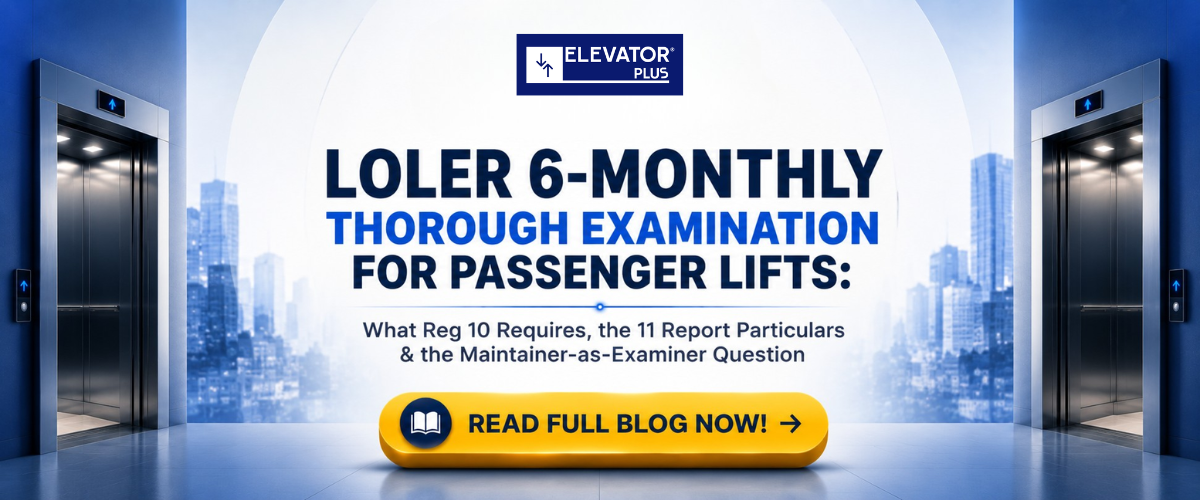
In short: Passenger lifts used at work need a thorough examination by a competent person, in most cases every six months, under LOLER 1998. This is written for the company carrying out and recording those examinations. It covers what reg 10 actually requires, the eleven particulars a report must contain, and the maintainer-as-examiner question that most contractor guidance gets wrong.
Key takeaways
- Reg 9(3)(a)(i) sets the interval for lifting equipment used to lift persons at at least every 6 months. That is a maximum, not a target. A day over is a breach. Lifting accessories are also 6-monthly whether or not they lift people.
- The 28-day rule is not in the Regulations. Reg 10(1)(b) says only "as soon as is practicable". The 28 days comes from ACOP L113 para 359, which carries weight in court but is not the statutory wording.
- Schedule 1 lists eleven particulars, not ten. Two of them, the premises address and the safe-to-operate statement, are routinely missed on reports we see.
- LOLER does not prohibit the maintainer from also examining. L113 para 298 says it is not expressly precluded but should not normally happen, and para 299 requires a documented risk-assessment justification if it does. A lot of published guidance states this as a flat ban. It isn't one.
- There is no such thing as a LOLER certificate. The statutory output is a report of thorough examination. Getting that word wrong in front of a facilities manager is a small thing that says a lot.
What this guide covers: thorough examination versus maintenance · intervals and examination schemes · what reg 10 requires and when · the eleven Schedule 1 particulars · the competent person question · records · FAQs.
Thorough examination is not maintenance, and neither replaces the other
HSE puts it plainly in INDG339: "Thorough examination should not be confused with preventive maintenance. Thorough examination may act as a check that maintenance is being carried out properly, but is not intended to replace it."
Definition, thorough examination: a systematic and detailed examination of the lift and its safety-critical components by a competent person, at statutory intervals, resulting in a written report. Its purpose is to detect defects that are, or might become, dangerous.
Maintenance is a different duty under different regulations. It sits in PUWER reg 5, not LOLER. So the two obligations run in parallel and each has to be discharged on its own terms. A maintenance visit does not satisfy reg 9. A thorough examination does not satisfy PUWER reg 5.
One further distinction that trips up a great deal of published copy. Under LOLER, "inspection" is a specific and lesser thing: interim checks under reg 9(3)(b), recorded under reg 10(2), which can be done in-house. Calling a thorough examination a "LOLER inspection" is the most common terminology error in this sector.
How often, and what the examination scheme route actually is
Reg 9(3)(a) sets the intervals, subject to the equipment being exposed to conditions causing deterioration liable to result in dangerous situations:
- Lifting equipment for lifting persons, or a lifting accessory: at least every 6 months.
- Other lifting equipment: at least every 12 months.
Note the accessory point. A sling or eyebolt that only ever lifts loads is still on the six-month cycle, which catches people out.
The alternative is reg 9(3)(a)(iii): examination in accordance with an examination scheme drawn up by a competent person. Reg 2 defines this as a suitable scheme specifying appropriate intervals. HSE has confirmed that whoever writes the scheme need not be the person who carries out the examination, and that the scheme does not have to exist as a formal published document, but you must be able to produce a written copy when asked.
Two further triggers sit outside the routine cycle:
Reg 9(2) requires examination after installation, and after assembly at a new site, where the safety of the equipment depends on the installation conditions. For a passenger lift assembled on site, which is nearly all of them, that condition is met. The idea that a new lift with a fresh Declaration of Conformity needs nothing is wrong for the overwhelming majority of installations.
Reg 9(3)(a)(iv) requires examination each time exceptional circumstances liable to jeopardise safety have occurred. HSE's examples are damage or failure, long periods out of use, and major changes affecting integrity such as modification or replacement of critical parts. Those are HSE's illustrations rather than statutory wording.
What reg 10 requires, and by when
This is where a lot of contractor guidance, including some of ours before we checked it properly, gets the detail wrong. There are three distinct duties with three different triggers.
| Duty | Trigger | Timing |
|---|---|---|
| Reg 10(1)(a) notify the employer | A defect which is or could become a danger to persons | Forthwith, meaning immediately (L113 para 363) |
| Reg 10(1)(b) written report to the employer | Every thorough examination | "As soon as is practicable." ACOP L113 para 359 expects within 28 days in normal circumstances |
| Reg 10(1)(c) copy to the enforcing authority | A defect involving existing or imminent risk of serious personal injury | As soon as is practicable. No fixed period |
Three things follow that are worth being precise about.
The 28 days is ACOP, not statute. Write "as soon as is practicable, which the ACOP expects to mean within 28 days in normal circumstances". Do not write "the law requires 28 days". ACOP is not merely advisory, since failure to follow it is admissible in criminal proceedings, but it is not the regulation either.
The enforcing authority trigger is narrower than the notification trigger. L113 para 364 narrows it further to risk arising from failure that could happen at any moment or within a reasonably short time. Under reg 10(4) the enforcing authority is HSE where equipment is hired or leased, and otherwise the authority for the premises, often the local authority EHO.
Reg 10(3) then bars the employer from using the equipment until the defect is rectified. But note Schedule 1 para 8(c): where a defect is one that could become dangerous rather than one that is dangerous, the report specifies a date, and the equipment may be used until then.
The eleven particulars
Schedule 1 sets out what a report must contain. HSE is explicit that there is no prescribed form, provided all eleven items are included.
- Name and address of the employer for whom the examination was made
- Address of the premises at which the examination was made
- Equipment identification, including its date of manufacture where known
- Date of the last thorough examination
- Safe working load, or SWL for the last configuration examined
- For a first examination after installation or assembly: a statement that it is such an examination, that the equipment was installed correctly and would be safe to operate
- For other examinations: which limb of reg 9(3)(a) applies, and a statement that the equipment would be safe to operate
- Defect identification and description; repairs required to remedy a present danger; for a defect not yet dangerous, the time by which it could become so plus the remedy; the latest date for the next thorough examination; particulars of any test; the date of the examination
- Name, address and qualifications of the person making the report, and whether self-employed or the name and address of their employer
- Name and address of the person authenticating the report on the author's behalf
- Date of the report, which is distinct from the date of the examination
Items 2, 6 and 7 are the ones most often absent from reports we see. Item 11 gets conflated with 8's examination date.
The competent person, and the maintainer question
There is no definition of "competent person" in LOLER. HSE says so directly. The wording sits in ACOP L113.
Para 296 requires appropriate practical and theoretical knowledge and experience of the equipment sufficient to detect defects or weaknesses and assess their importance.
Para 297 requires the person to be "sufficiently independent and impartial to allow objective decisions to be made", and where in-house examiners are used, that they have "the genuine authority and independence to ensure that examinations are properly carried out and that the necessary recommendations arising from them are made without fear or favour".
Now the part that most guidance gets wrong. L113 para 298: LOLER "does not expressly preclude the person carrying out the maintenance from also conducting the thorough examination. However, the competent person should not normally be the same person who performs routine maintenance, except where the risk of injury to others is low." Para 299 requires a documented risk-assessment justification where you do it.
So it is not a prohibition. It is a strong default with a documented exception route. Anyone telling you it is illegal is overstating the position, and anyone doing it routinely without the risk assessment is understating it.
👉 See what audit-ready lift records look like across your own portfolio. Book an ElevatorPlus demo →
Records: how long, and what actually goes wrong
Retention under reg 11(2) is not a flat two years, which is the figure people tend to quote.
- Periodic reg 9(3) examinations: keep until the next report is made, or two years, whichever is later.
- Reg 9(2) post-installation reports: until you cease using the equipment at that location.
- Reg 9(1) pre-first-use reports: until you cease using the equipment.
- Declaration of Conformity under reg 11(1): for as long as you operate the equipment.
Three failure patterns account for nearly every difficult conversation with a duty holder.
The examination happened but the report cannot be produced. Filed with an engineer who has left, in a van, in an email thread.
The date slipped and nothing flagged it. Forty buildings on independent six-month cycles, no alerting, discovered at renewal or later.
The defect was reported and what happened next is not traceable. This is the serious one, because it converts a compliance record into evidence against you.
Who holds the duty
Reg 9 imposes duties on "every employer". Reg 3 extends them to the self-employed and to any person with control of lifting equipment, to the extent of that control. HSE's INDG339 is direct: a lift owner or the person responsible for its safe operation, such as a facilities manager, is the dutyholder.
So the legal duty sits with the owner or occupier, not the maintenance company, and it cannot be contracted away. Two caveats worth stating fairly. A lift company can be a dutyholder to the extent of its own control under reg 3(3)(b). And reg 10 places duties directly on the competent person, independently of the employer's duties.
Frequently asked questions
1. How often must a passenger lift be thoroughly examined under LOLER?
At least every six months under reg 9(3)(a)(i), or in accordance with an examination scheme drawn up by a competent person. Examination is also required after installation or assembly where safety depends on installation conditions, and after exceptional circumstances.
2. Is a thorough examination the same as a service visit?
No. Maintenance is a PUWER reg 5 duty. Thorough examination is a LOLER reg 9 duty carried out by a competent person and resulting in a formal report. Neither discharges the other.
3. Does the law require the LOLER report within 28 days?
The Regulations say "as soon as is practicable" (reg 10(1)(b)). The 28 days comes from ACOP L113 para 359, which expects that timescale in normal circumstances. ACOP is admissible in criminal proceedings but is not the statutory wording.
4. Can the company that maintains the lift also carry out the thorough examination?
LOLER does not expressly preclude it. ACOP L113 para 298 says it should not normally be the same person except where the risk of injury to others is low, and para 299 requires a documented risk-assessment justification.
5. Is there such a thing as a LOLER certificate?
No. The statutory output is a report of thorough examination under reg 10(1)(b), containing the eleven particulars in Schedule 1.
6. What is the difference between LOLER and PUWER?
PUWER applies to all work equipment and covers suitability, maintenance and inspection. LOLER builds on it with duties specific to lifting equipment, including thorough examination and reporting. Both apply to a passenger lift.
7. Who is responsible for LOLER compliance?
The employer or person in control of the equipment, typically the building owner or occupier. The duty cannot be contracted away, though a lift company can be a dutyholder to the extent of its own control.
8. Does LOLER cover escalators?
No. Escalators and moving walkways fall under reg 19 of the Workplace (Health, Safety and Welfare) Regulations 1992. HSE and SAFed guidance nevertheless recommends six-monthly thorough examination.
The rule itself is not complicated. Six months for passenger lifts, a competent person, a report with eleven specified particulars, immediate notification of defects that are or could become dangerous.
What defeats firms is forty buildings on independent cycles with nothing holding the dates, and reports that exist somewhere but cannot be produced on the day someone asks. Get every lift's examination schedule, report, defect and closure onto one record and compliance stops being something you chase.
One last thing worth fixing today, because it costs nothing: check what your own documents call things. If they say "LOLER certificate" or "LOLER inspection", they are using terms the regulations do not.
👉 Never miss a thorough examination date. Book a demo →
Related reading
- Elevator Maintenance Software UK 2026: Scaling While Meeting LOLER & EN 81
- How Much Does Lift Maintenance Software Cost in the UK?
- The Complete Lift Maintenance Checklist for 2026
- Elevator Maintenance Software in Ireland: Thorough Examinations, EN 81 & Growth
About the author. Nutan Mandal is part of the ElevatorPlus team, which builds the Elevator Business Operating System used by 200+ elevator companies across 20+ countries. Compliance reviewed by Mr. Sumeet Katariya.
Sources: LOLER 1998 reg 9, legislation.gov.uk · LOLER 1998 reg 10 · LOLER 1998 Schedule 1 · HSE, Safe use of lifting equipment, ACOP and guidance L113 (PDF) · HSE, Thorough examinations of lifting equipment · HSE INDG339, Thorough examination of lifting equipment (PDF) · HSE, Passenger lifts
👉 Follow ElevatorPlus on,
Instagram LinkedIn Facebook YouTube Qoura Substack Twitter