LOLER Report Defects: Tracking Remedial Work to Close
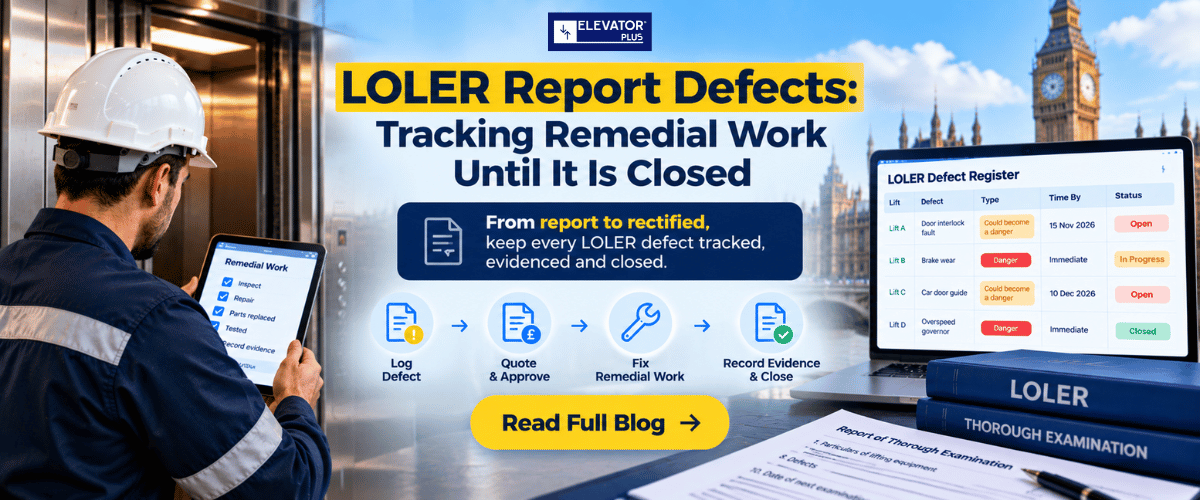
LOLER Report Defects: Tracking Remedial Work Until It Is Closed
By Mr. Sujit Katariya, ElevatorPlus ·
In short: LOLER report defects are listed under Schedule 1, paragraph 8 of the Regulations: the part, the defect, the repair needed and, for a defect that could become a danger, the time by which it could. Under Regulation 10(3), a notified lift must not be used before the defect is rectified, or after that stated time. Log every defect the day the report arrives, then triage, quote, fix and record the evidence. A defect is closed when it is rectified and the dutyholder told, not when the quote goes out.
Key takeaways
- The report already tells you what to track. Schedule 1, paragraph 8 asks for the defective part, a description, the repair required and, where it applies, the time by which a defect could become a danger.
- Two kinds of defect run on two clocks. A defect that is a danger stops use until it is rectified. A defect that could become a danger carries a date, and use must stop after that date if it is still open.
- The legal duty sits with the employer, the work usually sits with you. Where LOLER applies, regulation 10(3) puts the duty not to use the lift on the employer notified. The remedial work is normally quoted and done by the maintenance contractor.
- Most defects stay open in the office, not on site. The report never reaches you, the quote waits, or the fix is never recorded.
- Closed means rectified, evidenced and reported back. Date of the work, who did it, what was replaced, photos or a job sheet, and the date the dutyholder was told.
What this guide covers: What the report says about defects · Who has to act · Why defects stay open · The defect register · The eight stages from report to closed · Working to the time-by date · What counts as closed · FAQs
What does a LOLER report say about defects?
Schedule 1 of the Lifting Operations and Lifting Equipment Regulations 1998 lists eleven items a Report of Thorough Examination must contain. Paragraph 8 is the one your remedial work runs on.
Regulation 10(1) sets the order of events. The person making the thorough examination must "notify the employer forthwith of any defect in the lifting equipment which in his opinion is or could become a danger to persons". The written report follows "as soon as is practicable". Where the examiner sees "an existing or imminent risk of serious personal injury", a copy of the report also goes to the relevant enforcing authority.
For lifting equipment for lifting persons, regulation 9 sets the thorough examination at "at least every 6 months", unless an examination scheme sets otherwise. So each lift produces at least two reports a year, and each can carry defects.
| Schedule 1, para 8 | What your defect record needs |
|---|---|
| 8(a) The defective part and a description of the defect | The examiner's wording, copied exactly, against the specific lift |
| 8(b) The repair, renewal or alteration needed for a defect that is a danger | The remedial job, the quote reference and the parts |
| 8(c)(i) For a defect that could become a danger, the time by which it could | The time-by date, entered as a date, not left in a PDF |
| 8(c)(ii) The repair needed for that defect | The remedial job for that defect |
| 8(d) The latest date for the next thorough examination | The date by which open defects should be cleared |
| 8(f) The date of the thorough examination | The report date, which starts your clock |
Copy the examiner's description word for word. A defect paraphrased by the office is a defect nobody can match back to the report six months later.
This guide sits inside our wider guide to what maintenance software has to do: Elevator Maintenance Software: What It Has to Do (2026). For the examination itself, see Passenger Lift LOLER: Inspection, Testing & Reports.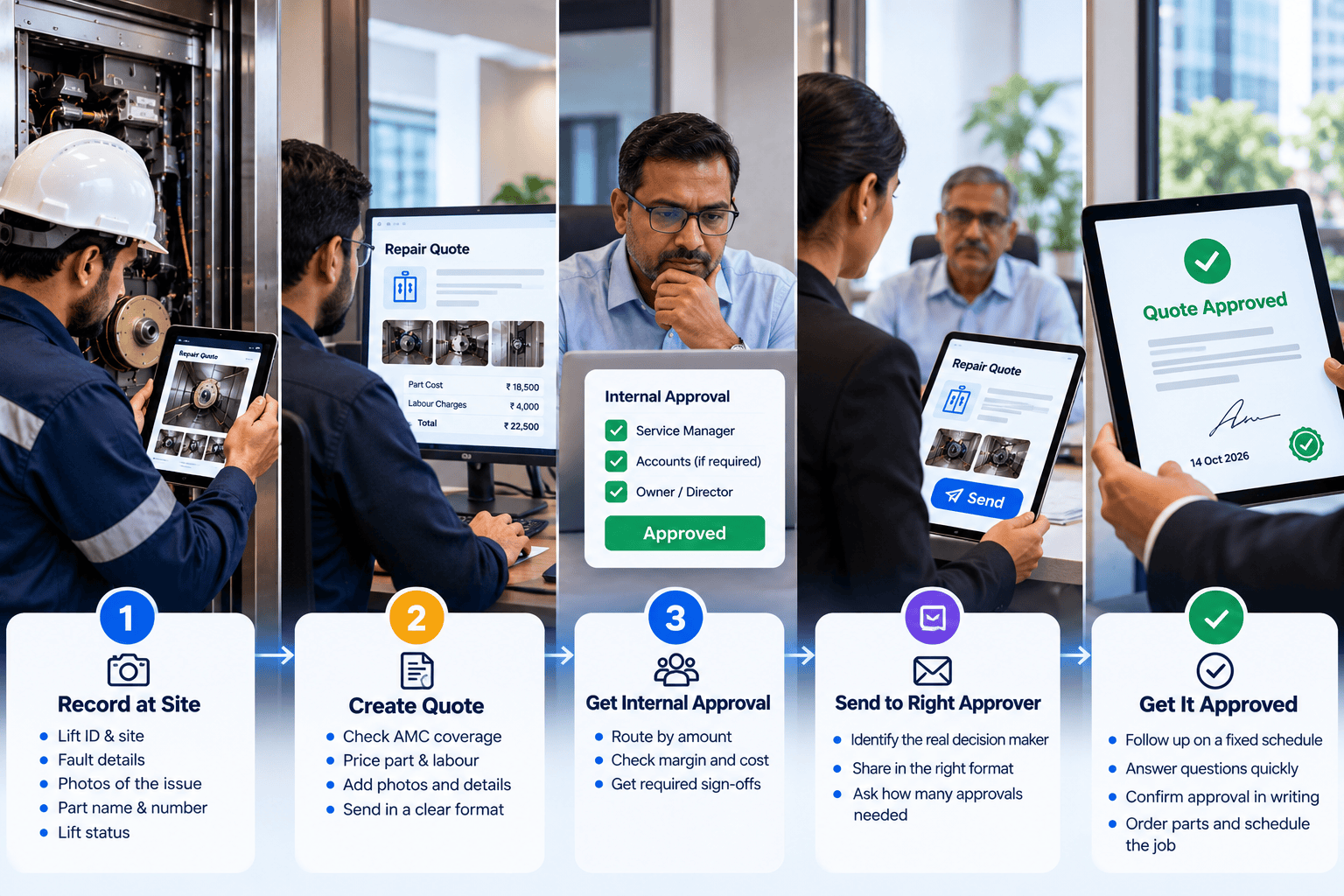
Who has to act on a LOLER defect, and where does the lift company sit?
Regulation 10(3) is written to the employer who has been notified. That employer "shall ensure that the lifting equipment is not used" before the defect is rectified. Where the report gives a time under Schedule 1, paragraph 8(c), the lift must not be used after that time and before the defect is rectified.
In practice, the employer is often a building owner, or a managing agent acting for one. Whether LOLER applies to a given lift at all depends on the premises and who uses the lift at work. That question is covered in PUWER or LOLER: Which One Applies to Your Lift?.
The lift company's position is different. You are usually the one asked to quote the remedial work and carry it out, either under the maintenance contract or as chargeable work. The legal duty not to use the lift is not yours. The practical ability to make it usable again usually is. The dutyholder cannot clear a defect without your work, and you cannot schedule the work without their approval. If neither side holds the full picture, the defect sits.
Why do LOLER defects stay open?
Rarely because the repair is hard. Usually because it falls between two inboxes.
| Where it stalls | The fix |
|---|---|
| The report goes to the dutyholder only, and you hear when they chase | Ask every dutyholder to copy you on each report, and record the date received |
| The defect wording is vague | Query the examiner in writing the same week |
| The quote waits for approval past the time-by date | Put the time-by date on the quote and the covering note |
| A part has a long lead time and nobody tells the dutyholder | Record order date and expected delivery against the defect |
| The work is done but not recorded, so the next report repeats it | Do not close a defect without evidence attached |
| One engineer holds the history | Keep defect history against the lift, not the person |
What should a LOLER defect register hold?
One row per defect, not one row per report. A report with four defects is four rows, each with its own owner and its own date.
| Field | What to enter |
|---|---|
| Lift and site | The lift's reference and the site address |
| Report date | Date of the thorough examination |
| Date received | Date the report reached your office |
| Defect description | The examiner's wording, copied exactly |
| Type | Is a danger, or could become a danger |
| Time-by date | Date from para 8(c)(i), where given |
| Lift status | In use, or not in use, as the dutyholder has told you |
| Quote | Quote number and date sent |
| Approval | Date, and the approver's name and role |
| Engineer and job | Who did the work, and the job reference |
| Parts used | Part and quantity |
| Date rectified | Date the work was completed |
| Evidence | Photos, job sheet, test notes |
| Dutyholder told | Date and method |
| Closed by | Name |
A spreadsheet with these fifteen columns will work. The hard part is keeping it current across forty buildings when the evidence lives in engineer phones.
What are the stages from report to closed?
Eight stages. Each has one owner and one piece of evidence that proves it happened.
| Stage | What happens | Owner | Evidence |
|---|---|---|---|
| 1. Receive | Log every defect on the register the day the report arrives | Office | Row created, date received |
| 2. Triage | Mark each defect: is a danger, or could become a danger with a time-by date | Service manager | Type and date entered |
| 3. Confirm status | Ask the dutyholder, in writing, whether the lift is in use | Office | Their reply, dated |
| 4. Quote | Send the remedial quote, with the time-by date stated on it | Service manager | Quote reference and date |
| 5. Approve | Chase approval against the time-by date, not your own calendar | Office | Approval, dated, with the approver's name |
| 6. Schedule | Book the engineer and order parts | Planner | Job reference, part order date |
| 7. Rectify | Do the work and record it on the job | Engineer | Job sheet, photos, parts used |
| 8. Report back | Tell the dutyholder the defect is rectified, with the evidence | Office | Date and copy of the message |
Stage 3 is the one most often skipped. The dutyholder, not your company, decides whether a defective lift is used. Ask, and keep the answer.
👉 Can you list every open LOLER defect across your portfolio, with its time-by date, in under a minute? See how UK lift companies track examinations and defects in ElevatorPlus →
How do you work to the time-by date?
Work backwards from it. The time-by date under paragraph 8(c)(i) is the latest point at which the defect could become a danger. After it, regulation 10(3)(b) means the lift is not to be used until the defect is rectified.
So the date that matters for planning is the last day you can start and still finish before it. That depends on parts lead time, how long this dutyholder takes to approve, and when an engineer with the right experience is free.
Run one review a week. List every open defect by time-by date, with days remaining. Any defect where days remaining are fewer than parts lead time plus approval time is this week's problem, not next week's.
These are our working rules, not the Regulations. Set your own thresholds and apply them the same way to every contract.
What counts as closing a LOLER defect?
Three things, all recorded. The work is done. The evidence is attached. The dutyholder has been told the date.
A quote sent, a job booked, or an engineer saying "done" on the phone is not a close.
The record has a second reader. At the next thorough examination, the examiner sees the lift again. If the earlier defect was rectified, your record should show when and how.
How ElevatorPlus handles LOLER defects
ElevatorPlus keeps the full service history against each lift, so a defect, the remedial job and the evidence sit on the same record as the lift's breakdowns and service visits. Each job is assigned to an engineer and carries its own time stamps. A new engineer opening the lift sees the defect history before starting work.
Checklists are fully configurable, set up aligned to LOLER, so the defect record can carry exactly the fifteen fields in the register above. ElevatorPlus does not certify compliance and does not ship a built-in LOLER module. Your team sets up the checklists to match your own procedure and your customers' contracts.
Work orders can be raised straight from the repair job. Where part of the remedial work goes to a subcontractor, work order management carries that work order from the same job, so the defect, the repair and the subcontracted part stay linked. Photo evidence and notes are required before the work order can be marked complete.
Frequently asked questions
1. What does a LOLER report have to say about defects?
Schedule 1, paragraph 8 requires the part with a defect that is or could become a danger, a description of it, the repair needed and, for a defect that could become a danger, the time by which it could.
2. Can a lift with a LOLER defect stay in use?
Under regulation 10(3), the employer notified must ensure the lift is not used before the defect is rectified. Where the report states a time under Schedule 1, paragraph 8(c), the lift must not be used after that time and before the defect is rectified.
3. Who is responsible for putting right a LOLER defect?
The duty not to use the lift falls on the employer notified, often the building owner or managing agent. The remedial work is usually quoted and carried out by the lift maintenance company.
4. How quickly must the examiner report a defect?
Regulation 10(1)(a) requires the examiner to notify the employer forthwith of any defect that is or could become a danger. The written report follows as soon as is practicable.
5. When does a LOLER report go to the enforcing authority?
Under regulation 10(1)(c), when in the examiner's opinion a defect involves an existing or imminent risk of serious personal injury, a copy of the report is sent to the relevant enforcing authority.
6. When is a LOLER defect closed?
When the work is done, the evidence is recorded and the dutyholder has been told the date it was rectified. A quote sent or a job booked is not a close.
7. Does ElevatorPlus have a LOLER module?
No. ElevatorPlus provides fully configurable checklists, set up aligned to LOLER, and keeps defects, remedial jobs and evidence against each lift. It does not certify compliance.
📲 Join our WhatsApp channel for compliance tips, updates: ElevatorPlus - Business Automation Tool
The Regulations already tell you what to track. Paragraph 8 of Schedule 1 is a defect list with deadlines. Most UK lift companies hold it as a PDF in an inbox.
Turn every report into rows the day it arrives. One row per defect, one owner, one date. Then the weekly question becomes simple: which defects run out of time before we can fix them?
A defect you fixed but cannot prove looks the same as one you ignored. The evidence is the part of the job that protects you.
Related reading
- Passenger Lift LOLER: Inspection, Testing & Reports
- PUWER or LOLER: Which One Applies to Your Lift?
- Lift Entrapment Records: What a UK Lift Company Should Log After Every Release
- Lift Maintenance Software Cost in the UK (2026 Guide)
About the author. Mr. Sujit Katariya is the Team of ElevatorPlus, the Elevator Business Operating System used by 200+ elevator companies across 20+ countries.
Sources: The Lifting Operations and Lifting Equipment Regulations 1998 (SI 1998/2307), regulation 9 · regulation 10 · Schedule 1, legislation.gov.uk, read 3 October 2026. · Drawn from ElevatorPlus onboarding work with 200+ elevator companies across 20+ countries.