CSA B44: Why No Big Province Is on the Current Edition
Why does the current CSA B44 edition not apply where you work?
Canada has no federal elevator code. Safety of elevating devices is provincial, and each province declares a specific edition of the binational code in force through its own instrument. The gap between publication and adoption is routinely three to six years.
ASME A17.1-2025/CSA B44:25 was published in 2025 as the seventh edition of the harmonised code, developed jointly by the CSA B44 Technical Committee and the ASME A17 Committee. It supersedes the 2022 edition, which itself superseded 2019, 2016, 2013 and back through the CSA B44 line to 1938.
Now look at what is actually in force. Ontario's Elevating Devices Code Adoption Document Amendment 295/22 states at section 3.1.1(a) that the adopted code is "ASME A17.1-2019/CSA B44-19 Safety Code for Elevators and Escalators", with parts taking effect across February, March and August 2022. Alberta's published list of elevating devices codes shows "ASME A17.1-2019/CSA-B44-19 Safety Code for Elevators and Escalators" as "Declared in force on December 1, 2022". Quebec's Construction Code, chapter B-1.1 r.2, Chapter IV, references the same 2019 edition. British Columbia's Elevating Devices Safety Regulation adopts "ASME A17.1-2016/CSA B44-16" at section 17(1), and Technical Safety BC dates that adoption to 30 April 2020.
A contractor working Toronto, Calgary, Montreal and Vancouver is therefore running two code editions, and neither is the current one. Quoting B44:25 in a specification is a good way to start an argument with an inspector.
What about CSA B44.1 and ASME A17.5?
CSA B44.1/ASME A17.5, Elevator and Escalator Electrical Equipment, is the certification standard for the electrical equipment that goes into the device. It works by reference rather than as a free standing duty.
Ontario's code adoption document is explicit at section 3.1.1(c)(4): "electrical equipment where required in this standard shall be certified / listed to the requirements of CAN/CSA B44.1/ASME A17.5, Elevator and Escalator Electrical Equipment as required by 2.26.4.2 of the adopted code". The same requirement is carried into the manlift and construction hoist sections. If you are sourcing a controller or a drive from outside North America, this is the clause that decides whether it can be installed.
👉 One record per device, per province, with the code edition it was built to and the permit that keeps it running. Book an ElevatorPlus demo
How do the four largest provincial regimes compare?
| Item | Ontario | British Columbia | Alberta | Quebec |
|---|---|---|---|---|
| Authority | Technical Standards and Safety Authority (TSSA) | Technical Safety BC | Alberta Municipal Affairs, with the Safety Codes Council and accredited agencies | Régie du bâtiment du Québec (RBQ) |
| Principal instrument | Technical Standards and Safety Act 2000, O. Reg. 209/01 Elevating Devices | Safety Standards Act, Elevating Devices Safety Regulation | Safety Codes Act | Building Act, Construction Code chapter IV, Safety Code chapter IV |
| Code edition in force | ASME A17.1-2019/CSA B44-19 | ASME A17.1-2016/CSA B44-16 | ASME A17.1-2019/CSA B44-19, in force 1 December 2022 | ASME A17.1-2019/CSA B44-19 |
| Who inspects | TSSA inspectors, scheduled by risk model | Safety officers under the regulation | Accredited agency, confirm locally | RBQ, confirm locally |
| Mechanic credential | TSSA Elevating Device Mechanic certificate, classes EDM-A to EDM-T | Elevating devices certificates, valid three years | Confirm with the Safety Codes Council | RBQ contractor licence, elevator subcategory |
Two of those cells carry honest gaps. Alberta's own codes page names AEDARSA and the Safety Codes Council but does not set out who performs periodic inspections, and we could not confirm the split between accredited agencies and municipalities from a primary source. Quebec's Safety Code chapter IV contains a Division III on putting into service, use and maintenance, but we could not extract the inspection frequency from the official consolidated text. Confirm both directly before you build a schedule on them.
Who may work on an elevator, and is it a compulsory trade?
Ontario is the clearest and the most misunderstood.
TSSA issues Elevating Device Mechanic certificates in classes EDM-A for general elevator work, EDM-B for construction hoists, EDM-C for owner and operator staff, EDM-D for cab renovations, EDM-E for lifts for persons with physical disabilities, EDM-F for inspector and consultant work, EDM-CE and EDM-CM for the electrical and mechanical owner and operator specialisms, and EDM-T for mechanics in training. Certificates "expire on the second anniversary of the holder's date of birth after the certificate has been issued". Renewal requires 12 hours from an accredited training provider, split as 6 hours on safe work practices and 6 hours of technical training. Let it lapse by more than twelve months and you reapply, with a written examination for classes A through F.
Here is the part people get wrong. Skilled Trades Ontario classifies Elevating Devices Mechanic, trade code 636E, as non compulsory, stating that "as this trade is non-compulsory, the information of individuals practicing this trade will not appear on the Skilled Trades Ontario Public Register". That does not mean you can put an uncertified person on a lift. The apprenticeship is voluntary. The TSSA certificate under O. Reg. 209/01 is not. Two separate systems, one of which is mandatory.
On the Red Seal question: Elevator Constructor and Mechanic appears in the Ellis Chart under non Red Seal trades, so there is no interprovincial Red Seal endorsement to move a mechanic between provinces. Each province's credential stands on its own.
How often are devices inspected, and who does it?
Ontario does not run a fixed calendar. TSSA states that it "uses a risk model to determine the frequency of elevating device periodic inspections" and that "periodic inspections are scheduled automatically by TSSA". Your job as the contractor is to keep the Maintenance Control Program current, because TSSA's compliance standards make the MCP logbook the first thing an inspector looks for, and a missing or out of date logbook on site draws an order on its own.
British Columbia works through operating permits. Section 9(1) of the Elevating Devices Safety Regulation requires evidence that "any required mandatory maintenance program is in place for the elevating device" before a permit issues, and section 14 sets inspection in accordance with the codes adopted under section 17, carried out by safety officers.
We could not verify from a primary source the renewal cycle for an Ontario device licence, nor the periodic inspection interval in Alberta and Quebec. Those are the three items to confirm with the authority before you promise a client a date.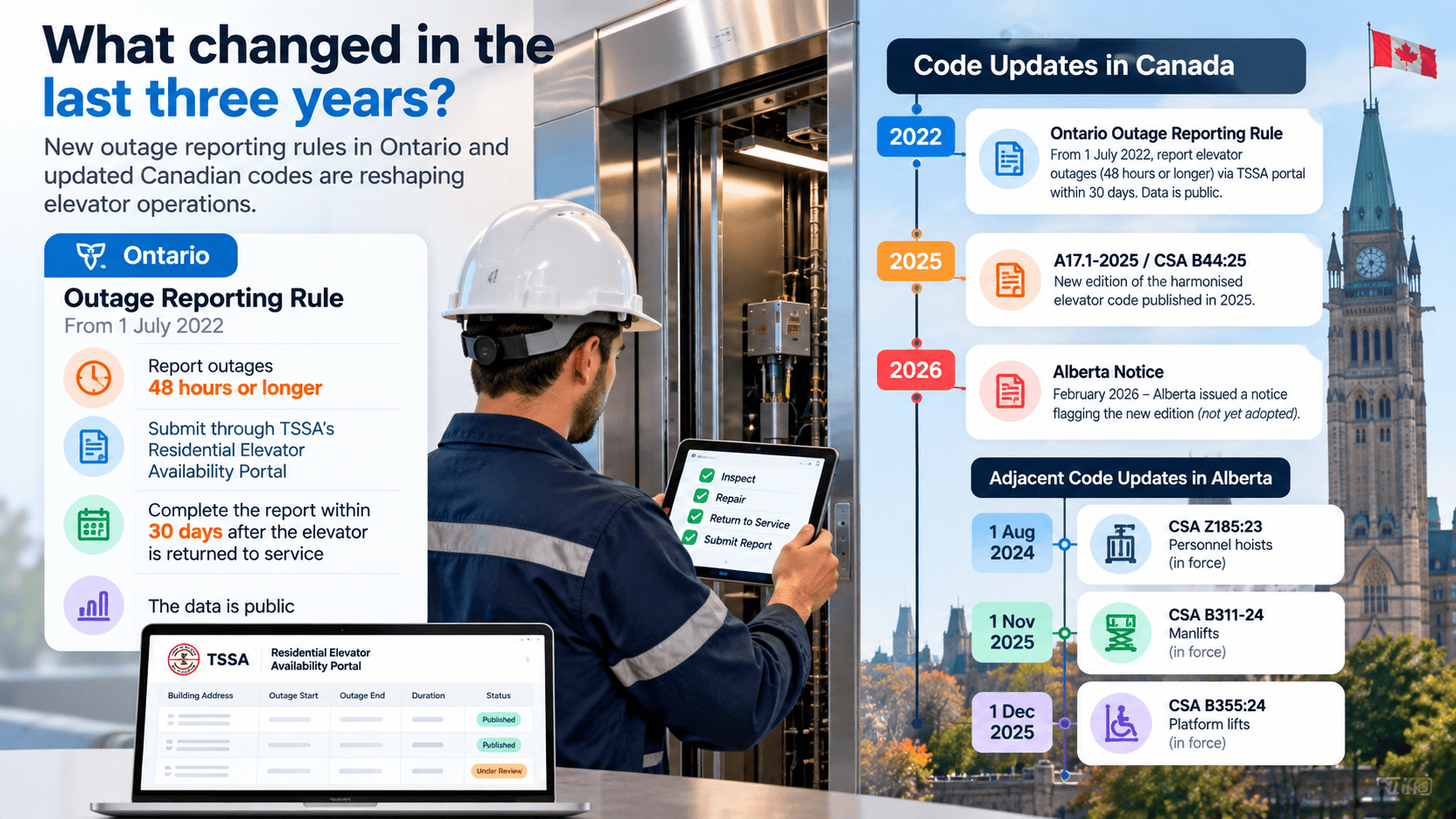
What changed in the last three years?
The outage reporting rule is the one that reshaped operations in Ontario. From 1 July 2022, owners and licensees of elevators in residential buildings and long term care homes must report outages lasting 48 hours or longer through TSSA's Residential Elevator Availability Portal, and "the reporting needs to be completed within 30 days after the day the elevator was returned to service". The data is public. That changes how a maintenance contractor's response times get discussed in a tender.
Alongside that, the code moved. A17.1-2025/CSA B44:25 landed in 2025, and Alberta issued a notice in February 2026 flagging the new edition without adopting it. Alberta has been updating adjacent codes though: CSA Z185:23 for personnel hoists in force 1 August 2024, CSA B311-24 for manlifts on 1 November 2025, and CSA B355:24 for platform lifts on 1 December 2025.
What a Canadian contractor should be recording
- The code edition in force in each province you work, with the instrument and the date it was declared, refreshed at least yearly.
- The Maintenance Control Program logbook on site for every device, current, device specific, and holding the OEM manuals and bulletins.
- Each mechanic's certificate class and its expiry, calculated from the second anniversary of their birth date, not from the issue date.
- The 12 hours of continuing education per renewal cycle per mechanic, split 6 and 6, with the accredited provider named.
- Certification evidence to CSA B44.1/ASME A17.5 for every controller and drive you install, filed against the device.
- Outage start and restoration times for every Ontario residential and long term care device, with the portal submission date inside the 30 day window.
Frequently asked questions
Is CSA B44:25 the code that applies to my work?
Only if your province has declared it in force. As of research, Ontario, Alberta and Quebec were on the 2019 edition and British Columbia on 2016.
Is there a national Canadian elevator code?
No. Safety of elevating devices is provincial. The binational code is a standard that provinces adopt individually.
Is Elevating Devices Mechanic a Red Seal trade?
No. Elevator Constructor and Mechanic is listed among the non Red Seal trades in the Ellis Chart.
Is the trade compulsory in Ontario?
The Skilled Trades Ontario apprenticeship is non compulsory, but a TSSA Elevating Device Mechanic certificate is required to do the work.
How often does TSSA inspect?
On a risk model, scheduled automatically. There is no fixed statutory interval published for every device class.
How long does an EDM certificate last?
It expires on the second anniversary of the holder's date of birth after issue. Renewal needs 12 hours of accredited training.
Do I need an operating permit in British Columbia?
Yes, and section 9(1) requires evidence that a mandatory maintenance program is in place before it issues.
What is the Ontario outage reporting rule?
Outages of 48 hours or more in residential buildings and long term care homes must be reported via TSSA's portal within 30 days of the device returning to service.
The single most expensive mistake in Canadian elevator compliance is assuming the newest code is the operative one. It almost never is. Build your engineering standards around what each province has declared in force, keep the Maintenance Control Program in a state where an inspector can read it without asking, and treat Ontario's outage clock as an operational metric rather than a filing task. Everything else follows from those three.
Related reading
- Elevator inspector certification in the US
- LOLER and passenger lifts in the UK
- Philippines lift certificate of operation
- Lift maintenance checklist 2026
About the author · Nutan Mandal is part of the ElevatorPlus team, which builds the Elevator Business Operating System used by 200+ elevator companies across 20+ countries. Compliance reviewed by Mr. Sumeet Katariya.
Sources: CSA Group, ASME A17.1-2025/CSA B44:25 · TSSA Elevating Devices Code Adoption Document Amendment 295/22 · TSSA, elevating devices inspections · TSSA, certification of Elevating Device Mechanics · TSSA Elevating Device Mechanic policies and procedures · TSSA, requirement to report elevator outages via portal · TSSA compliance standards, electric and traction elevators · Ontario Regulation 209/01, Elevating Devices · BC Elevating Devices Safety Regulation · Technical Safety BC, elevating devices regulations · Alberta, elevating devices codes and standards · Alberta notice on ASME A17.1-2025/CSA B44:25 · Quebec Construction Code, chapter B-1.1 r.2 · Quebec Safety Code, chapter B-1.1 r.3 · RBQ fields of jurisdiction · Skilled Trades Ontario, Elevating Devices Mechanic · Ellis Chart, Elevator Constructor and Mechanic, non Red Seal
👉 Follow ElevatorPlus on,
Instagram LinkedIn Facebook YouTube Qoura Substack Twitter