Philippines Elevator Compliance 2026: Certificate of Operati
By Nutan Mandal, ElevatorPlus · Compliance reviewed by Mr. Sumeet Katariya
In short: The document that keeps a Philippine lift legally running is not the Mechanical Permit. It is the Certificate of Operation, NBC Form M-08, and it expires twelve months from the date of inspection. The duty to renew it sits on the building owner, which is precisely why it gets missed, and why the contractor who tracks it is the one who keeps the account.
Key takeaways
- The Mechanical Permit is a one-time permit to install. The Certificate of Operation (NBC Form M-08) is the annual one, valid "for a period of one (1) year from the date of inspection".
- The form puts the duty on the owner or lessee, who must notify the Office of the Building Official in writing for issuance of the certificate, and "yearly thereafter". Not the maintenance contractor. Which is why so many buildings quietly fall out of compliance.
- Elevators are one of a small set of installations the Building Code refuses to let an ordinary licensed Mechanical Engineer sign for. Plans and permit documents must be signed and sealed by a Professional Mechanical Engineer.
- Lift work sits under two separate legal regimes: the National Building Code (PD 1096) on the building side, and the DOLE Occupational Safety and Health Standards, Rule 1220 on the labour side. Most compliance advice covers only one.
- Let the annual inspection fee run more than thirty days past due and the Code adds a 25 percent surcharge.
What this guide covers: which law applies · permit versus certificate · who must sign · contractor licensing · which standards are actually cited · what to record.
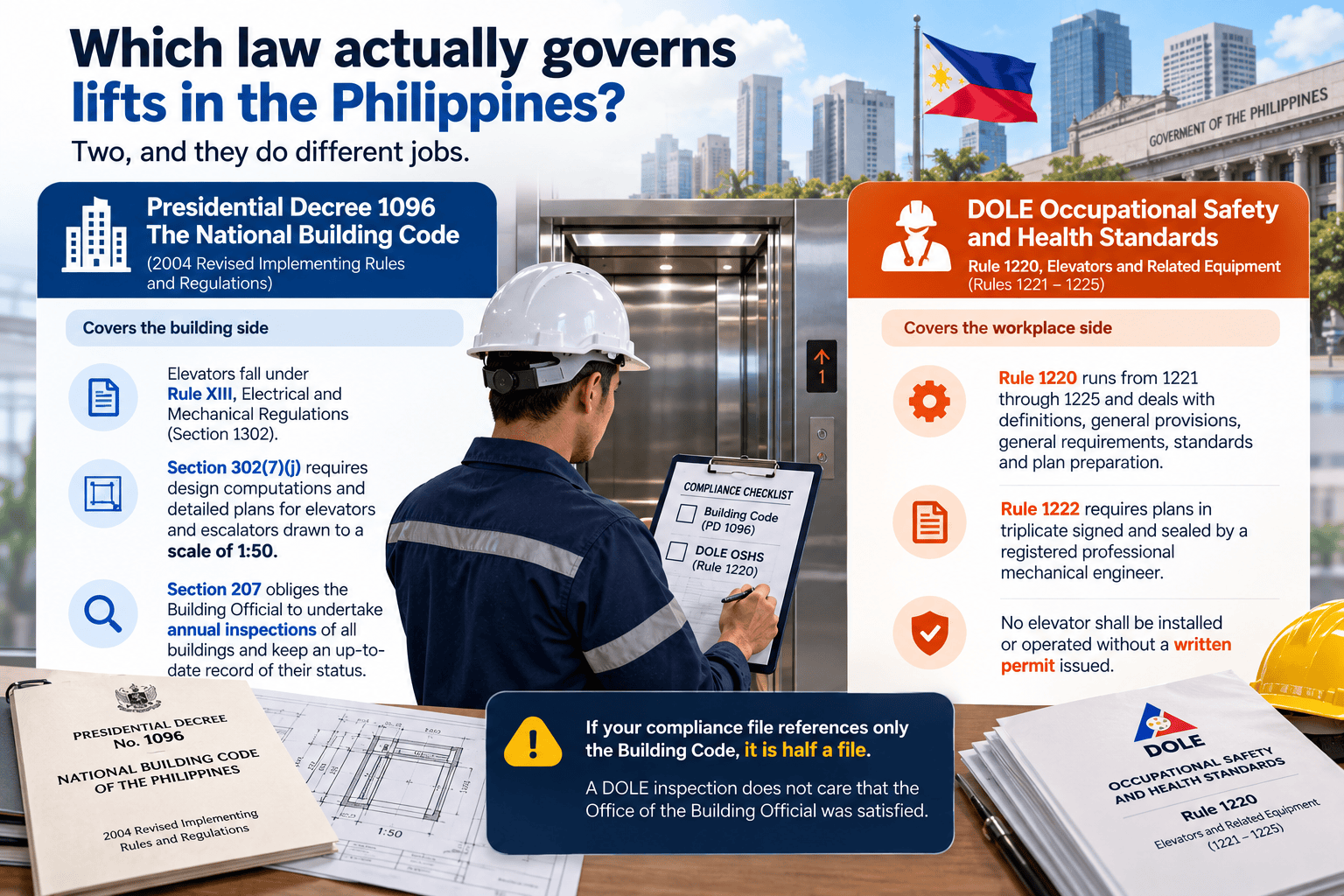
Which law actually governs lifts in the Philippines?
Two, and they do different jobs.
Presidential Decree 1096, the National Building Code, with its 2004 Revised Implementing Rules and Regulations, covers the building side. Elevators sit under Rule XIII, Electrical and Mechanical Regulations, at Section 1302. Section 302(7)(j) requires design computations and detailed plans for elevators and escalators drawn to a scale of 1:50, and Section 207 obliges the Building Official to undertake annual inspections of all buildings and keep an up-to-date record of their status.
The DOLE Occupational Safety and Health Standards cover the workplace side, and they give lifts their own dedicated rule. Rule 1220, Elevators and Related Equipment, runs from 1221 through 1225 and deals with definitions, general provisions, general requirements, standards and plan preparation. Rule 1222 requires plans in triplicate signed and sealed by a registered professional mechanical engineer, and is explicit that no elevator shall be installed or operated without a written permit issued.
If your compliance file references only the Building Code, it is half a file. A DOLE inspection does not care that the Office of the Building Official was satisfied.
Permit or certificate? These are not the same document
This is the most common error in Philippine lift compliance, and it costs buildings their legal standing without anyone noticing.
| Mechanical Permit | Certificate of Operation | |
|---|---|---|
| What it is | Permission to install | Permission to operate |
| Form | Mechanical Permit application, per installation | NBC Form No. M-08 |
| Frequency | One time, per installation | Every twelve months |
| Who applies | Owner, firm or corporation installing | Owner or lessee of the building |
| Who signs it off | Office of the Building Official | Mechanical Inspector, Chief of Mechanical Section, and the Building Official |
Read the notice printed on Form M-08 itself. The equipment may be operated "for a period of one (1) year from the date of inspection", and the owner or lessee must notify the Office of the Building Official in writing for the granting of a Certificate of Operation, for a period of one year from issuance, and yearly thereafter.
That last phrase is doing a lot of work. It creates a recurring annual obligation, and it puts it on a building owner who almost certainly has no reminder set for it.
Why this is a commercial opportunity, not just a compliance note
Because the duty sits with the owner and the knowledge sits with you.
A property manager running eleven buildings is not tracking eleven Certificate of Operation expiry dates against eleven inspection dates. They think the lift is fine because it is running and because they pay somebody to service it. The first they usually hear about a lapsed certificate is when it has already become a problem.
A contractor who walks into a renewal meeting with a per-lift schedule showing certificate status, inspection date, expiry date and days remaining is having a different conversation from one who walks in with a price. One of those is a service provider. The other is the person who keeps the building legal.
The Code also gives you a number to point at. Failure to pay the annual inspection fee within thirty days of the prescribed date attracts a surcharge of twenty-five percent of the fee. Small money in absolute terms, and a concrete consequence when you are explaining why a date matters.
Who is legally allowed to sign for a lift
The Philippine Mechanical Engineering Act of 1998, Republic Act 8495, sets three ranks of registration: Professional Mechanical Engineer, Mechanical Engineer, and Certified Plant Mechanic. Section 3(b) brings lifts squarely into mechanical engineering practice, listing "hoists, elevators, escalators, mechanized dumbwaiters, moving ramps and walkways" among materials handling equipment.
Section 35 is the one that matters for permits. Designs, plans, layouts and specifications must be prepared by or under the responsible charge of, and signed and sealed by, a Professional Mechanical Engineer. A PME needs four or more years of active practice on top of ME registration under Section 14.
The Building Code reinforces it from the other direction. Section 302(7)(j) of the IRR allows a licensed Mechanical Engineer's signature to suffice for installations up to 14.9 kW, and then carves out the exceptions: fired and unfired pressure vessels, elevators, escalators and dumbwaiters. Lifts are placed in the same bracket as pressure vessels. That is the Code telling you what it thinks of the consequence of getting one wrong.
In practice, at LGU level, this means a full document set. Pasig City's Office of the Building Official, to take a published example, requires four sets of forms originally signed and sealed by a PME and the Mechanical Engineer in charge, plans signed and sealed by the PME, a bill of materials signed and sealed, an erection methodology signed and sealed, plus the PME's current PRC ID and Professional Tax Receipt.
One distinction worth being careful about, because it is often overstated. A PME signs and seals the plans and permit documents. The Certificate of Operation itself is issued by the Office of the Building Official, signed by the Mechanical Inspector, the Chief of the Mechanical Section and the Building Official. A private PME does not independently certify a lift fit to operate. Anyone telling a client otherwise is selling something.
Contractor licensing
The licensing framework for constructors sits under RA 4566 and its implementing rules, administered by PCAB within CIAP. The classification list includes a specialty entry for Mechanical work (Elevator-conveyor), alongside general mechanical work and ventilation and refrigeration work. Specialty contractors run from category AAA down to E. A sole proprietor must personally be the Authorised Managing Officer of the firm.
Where it gets genuinely unclear is maintenance. The classification plainly covers installation and modernisation. Whether routine servicing counts as construction work requiring a PCAB licence is not something we could establish from a primary source, and we are not going to assert it either way. If you are quoting a large institutional client who asks, get the position in writing from PCAB rather than from a competitor's tender document.
Which standards actually apply
Less than you might expect, and probably not the one you have on your letterhead.
The Building Code IRR references the Philippine Mechanical Code and the National Structural Code of the Philippines. The OSHS Rule 1224 references the ASME Elevator Code and the PSME Code for inspection and approval, without naming an edition year.
Two things follow from that. First, cite the ASME Elevator Code generically rather than claiming a specific A17.1 edition, because the regulation does not name one and you cannot defend a year you invented. Second, EN 81 has no legal standing in the Philippines. European standards may well be what your equipment was built to, and that is a perfectly good specification argument to make to a client, but do not present EN 81 compliance as a Philippine regulatory requirement. It is not.
👉 See certificate expiry, inspection dates and service history on one screen, per lift. Book an ElevatorPlus demo →
What a Philippine contractor should be recording
- Certificate of Operation status per lift, with the inspection date, the issue date and the expiry, alerted at ninety days.
- Which LGU each building sits in, because fees, forms, processing times and inspector availability are set per local government unit. A Makati timeline is not a Cebu timeline.
- The PME of record for each installation, with PRC ID and PTR currency, because an expired PTR stops a submission dead.
- Every service visit, dated and attributed, against the manufacturer's schedule.
- Defects raised and rectified, with dates. This is what you produce when a DOLE inspector arrives, and it is a different file from the one the Building Official sees.
- Annual inspection fee payment dates, because the thirty-day clock runs on the fee, not on the inspection.
At twenty units this is a diary. At two hundred, across four LGUs, it is an operating system.
Frequently asked questions
Do elevators in the Philippines need an annual permit?
Not a permit. They need an annual Certificate of Operation, NBC Form M-08, valid for one year from the date of inspection. The Mechanical Permit is a one-time permit to install.
Who is responsible for renewing a lift's Certificate of Operation?
The owner or lessee of the building. Form M-08 requires them to notify the Office of the Building Official in writing for issuance of the certificate, and yearly thereafter.
Who can sign elevator plans in the Philippines?
A Professional Mechanical Engineer. Under Section 302(7)(j) of the National Building Code IRR, elevators, escalators and dumbwaiters are excepted from the rule that a licensed Mechanical Engineer's signature suffices for smaller installations, and RA 8495 Section 35 requires PME sign-off on designs and plans.
Can a private engineer certify that a lift is safe to operate?
The Certificate of Operation is issued by the Office of the Building Official and signed by its mechanical inspectorate. A Professional Mechanical Engineer signs and seals plans and permit documents rather than issuing the operating certificate.
What happens if the annual inspection fee is not paid on time?
The Code provides a surcharge of twenty-five percent of the inspection fee for failure to pay within thirty days of the prescribed date.
Does ASME A17.1 apply in the Philippines?
The OSHS references the ASME Elevator Code and the PSME Code for inspection and approval, without specifying an edition. Cite it generically rather than naming a year.
Does EN 81 apply in the Philippines?
No. EN 81 has no legal standing in Philippine regulation. It may be relevant as an equipment specification, but it is not a compliance requirement.
What licence does an elevator contractor need in the Philippines?
PCAB maintains a specialty classification for Mechanical work (Elevator-conveyor) under RA 4566, which covers installation and modernisation work. Whether routine maintenance falls within PCAB's remit is not clearly established in published rules, so confirm it directly with PCAB.
The compliance story in the Philippines is simple to state and easy to get wrong. One document keeps the lift legal, it lasts twelve months, and the person legally responsible for renewing it is the person least likely to be watching the date.
Build the list. Every lift, every building, every certificate, every expiry, sorted by days remaining. Then take it to your next renewal meeting and put it on the table before anyone mentions price.
That is not a software pitch. It is the difference between being the company that services the lifts and the company that keeps the building operating.
👉 Put every certificate date in one place. Book a demo →
Related reading
- Singapore Lift Maintenance Requirements 2026
- Elevator Business Growth in Southeast Asia: Philippines, Indonesia & Malaysia
- Elevator Service Management Software in Singapore & Southeast Asia
- The Complete Lift Maintenance Checklist for 2026
About the author · Nutan Mandal is part of the ElevatorPlus team, which builds the Elevator Business Operating System used by 200+ elevator companies across 20+ countries. Compliance reviewed by Mr. Sumeet Katariya.
Sources: National Building Code of the Philippines, Revised IRR (PD 1096) · NBC Form M-08, Certificate of Operation: Elevator/Dumbwaiter, Cagayan de Oro City (PDF) · Pasig City Office of the Building Official Citizen's Charter (PDF) · Republic Act 8495, Philippine Mechanical Engineering Act, PRC (PDF) · IRR of RA 4566, Licensing of Constructors, CIAP/PCAB (PDF) · DOLE Occupational Safety and Health Standards, 2020 Edition (PDF)
👉 Follow ElevatorPlus on,
Instagram LinkedIn Facebook YouTube Qoura Substack Twitter