Elevator service software built for Indian AMC books and state lift rules
Your AMC renewals, breakdown calls, installations and technicians in one system. Built in Pune, with every lift carrying the licence dates, inspection cycle and log book your state actually asks for.

What ElevatorPlus Is?
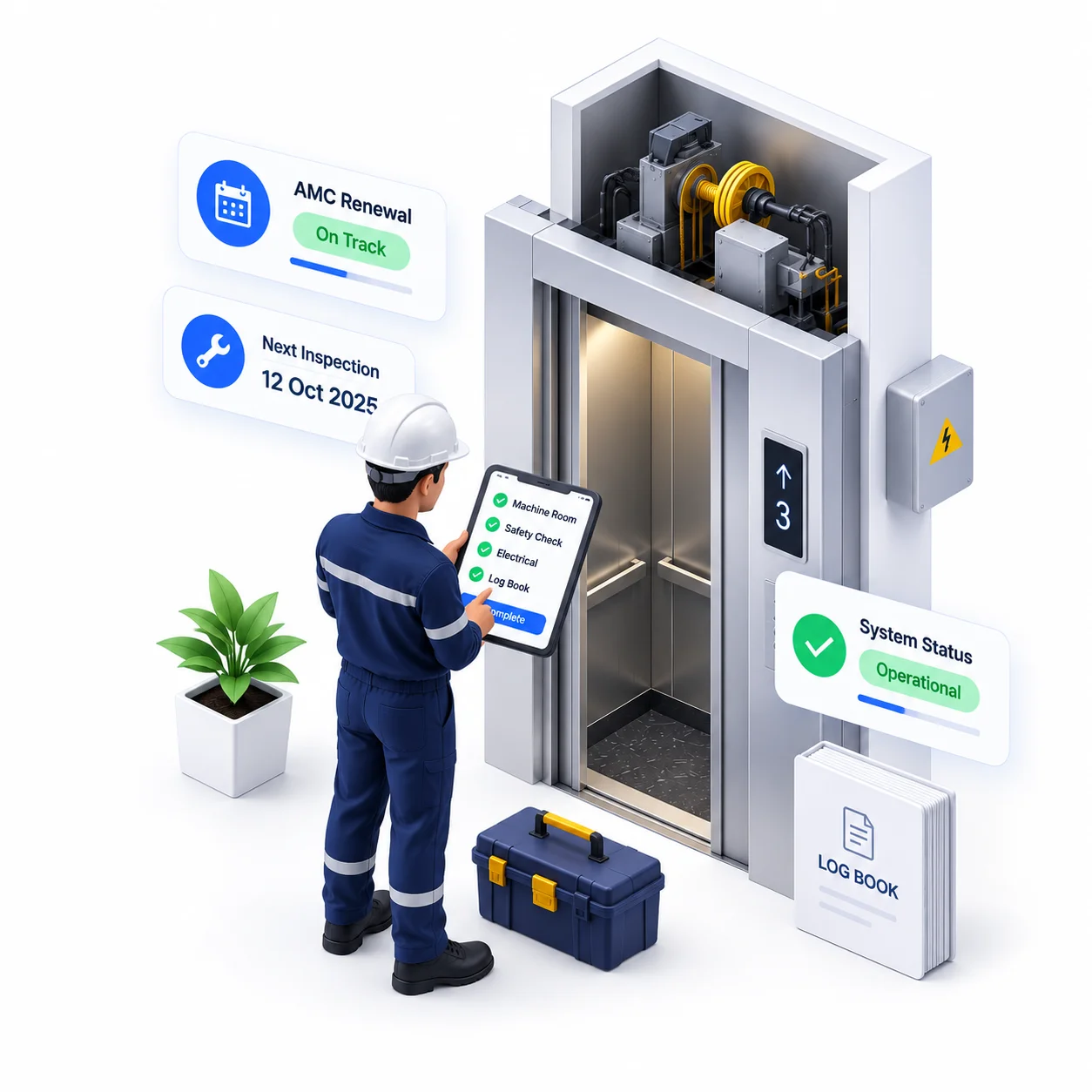
Elevator service software for India is the system a lift company runs its AMC book on. It holds every contract and its renewal date, every breakdown call and how fast it was answered, every preventive maintenance visit, and the per-lift records that state Lift Acts and AMC contracts both require.
ElevatorPlus replaces the spreadsheet, the WhatsApp group and the technician's memory with one record per lift. The contract it sits under, the licence and inspection dates your state sets, every visit made to it, the parts changed, the photographs taken and the customer's signature on each service report. When a society asks what you did last quarter, or an Electrical Inspector asks for the log book, the answer is on one screen.
The problems
Renewals that belong to nobody
A book of 400 units carries 400 renewal dates. In most offices the expiry date is not anyone's job, so renewals slip quietly. The customer does not ring to remind you. The first sign is a competitor's technician on site.
Breakdown calls answered from memory
The complaint reaches a phone, somebody decides who is nearest, and the technician arrives without knowing what the last three visits found. That history sits in a branch register or on a phone that was replaced last year, so the same fault gets diagnosed twice.
Records you cannot produce on the day you need them
Every state Act and every AMC contract asks for records. They are only worth having if they can be produced on demand, in full, for a date somebody else chooses.
Twenty-eight states, no single lift law
India has no national lift law. Each state writes its own, and the differences are not small. A company working Pune, Bengaluru and Hyderabad runs three regimes at once. In ElevatorPlus the cycle is set per installation rather than per company, which is the only way a book spread across state lines stays correct.
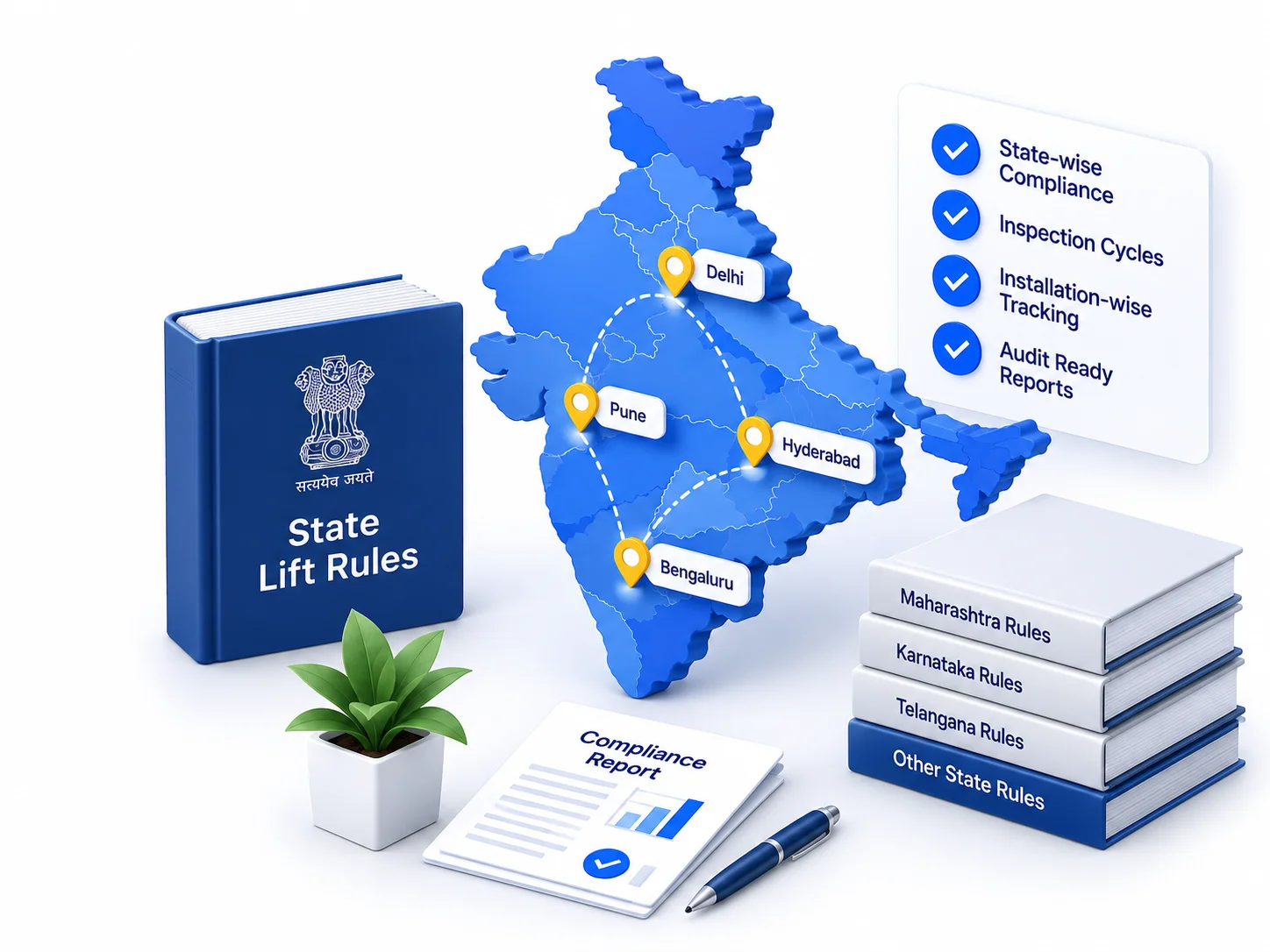
Every inspection and renewal is scheduled, completed against a checklist, and stored on the lift it belongs to, with the certificate and its expiry date on the same record.
Maharashtra: the 1939 Act, not the 2017 one
Lifts in Maharashtra are governed by the Maharashtra Lifts Act X of 1939 with the Bombay Lift Rules 1958. Inspection is at least once in six months, and a log book is kept at each lift. The Maharashtra Lifts, Escalators and Moving Walks Act 2017 is widely quoted and has never been brought into force, so none of its figures describe what you owe today.
Tamil Nadu: the log is signed by your customer
Since 3 February 2026 the maintenance log in Tamil Nadu is uploaded at every preventive maintenance visit or repair, and it closes with two signatures: the technician's, and the owner's or authorised signatory's. Test records are produced to the Inspector on demand.
Delhi and Kerala: an inspection clock, and no log book at all
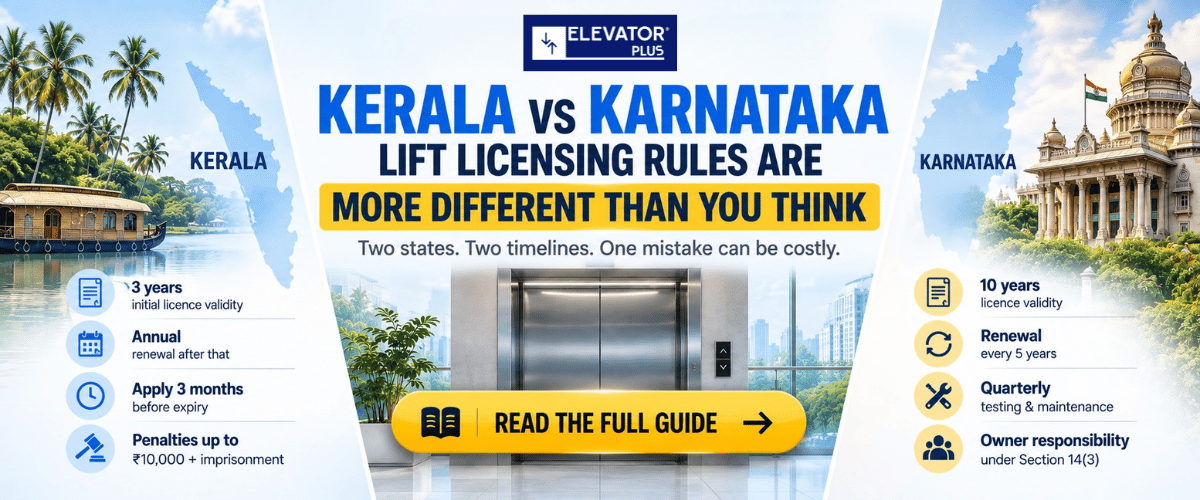
Delhi has no Act of its own. It runs on the Bombay Lifts Act 1939 as extended, with the Delhi Lifts Rules 1942 and the 2017 amendment, and neither the Act nor the Rules require a log book, register or maintenance record. Kerala is the same on records: the licence runs three years and then renews annually after inspection, and no log book duty sits in the Act or the Rules. Most operators assume every state runs the same way. Two of the largest do not.
The states where your contract is the only rule
Telangana has no lift Act in force. Bihar and Jharkhand have Acts on the books that were never brought into force. In those states the only record obligations you carry are the ones in your own AMC contract, which is exactly what the Supreme Court examined in July 2026.
In July 2026 the Supreme Court held that a lift is a common carrier. The manufacturer, the operator and the owner of the premises are jointly and severally liable for a passenger's safety. It upheld compensation of Rs 3,01,48,195 for a death in a lift under a comprehensive maintenance contract. The maintenance contractor "produced no attendance register, duty chart, log book, or other contemporaneous record" to show its mechanic was on site. Its own contract had required all of them. Supreme Court of India, 2026 INSC 756, 29 July 2026.
Features
AMC Contract Management
Comprehensive and non-comprehensive contracts on one book, each with its own scope, billing cycle and renewal date. Alerts at 60, 30 and zero days.
PM and Job Scheduling
Visits planned by route, technician and contract, on the cycle the contract promises. A missed visit shows as missed rather than as silence.
Breakdown Management
Complaints logged with the lift, the fault and the time received, then assigned to the nearest available technician, with every fault and fix kept on that lift's record.
Technician App, Fully Offline
Machine rooms have no signal. The job opens, the checklist is answered, photographs attach and the customer signs, then it all syncs when coverage returns.
Inventory and Spares
Stock by branch and by van, dead stock flagged, reorder alerts before a job stops, and parts posted to both the job and the lift's history.
Reports, Branches and Access
Each branch sees its own book and the owner sees all of them, with over 100 role-based access controls deciding who sees money, stock and jobs.
Indian lift companies already run on it
What your state actually requires
India has no national lift law. These are the fifteen states where most of the country's AMC book sits, read from the Act and Rules text in September 2026.
| State | What governs it today | Government inspection | Per-lift log book |
|---|---|---|---|
| Andhra Pradesh | Lifts and Escalators Act 2025, Rules notified March 2025 | At licensing and at five-year renewal | Yes |
| Assam | Lifts and Escalators Act 2006, Rules 2010 | Every 3 years | Yes |
| Bihar | Lift and Escalators Act 2024, enacted but never brought into force | Not in force | Not in force |
| Delhi | Bombay Lifts Act 1939 as extended, Delhi Lifts Rules 1942, amended 2017 | At least every 6 months | No |
| Gujarat | Lifts and Escalators Act 2000 as amended, Rules 2001 as amended | Every 5 years | Yes |
| Haryana | Lifts and Escalators Act 2008 as amended, Rules 2009 | Every 3 years | Yes |
| Himachal Pradesh | Lifts Act 2007, Rules 2009 | At least every 6 months | Yes |
| Jharkhand | Lift and Escalators Act 2017, enacted but never brought into force | Not in force | Not in force |
| Karnataka | Lifts, Escalators and Passenger Conveyors Act 2012, Rules 2015 | Yearly | Yes |
| Kerala | Lifts and Escalators Act 2013 as amended 2018, Rules 2012 | Licence 3 years, then yearly | No |
| Maharashtra | Maharashtra Lifts Act 1939, Bombay Lift Rules 1958 | At least every 6 months | Yes |
| Tamil Nadu | Lifts and Escalators Act 1997 as amended 2025, in force 3 February 2026 | Allotted through the state portal | Yes, uploaded at every visit |
| Telangana | No lift Act | None | None |
| Uttar Pradesh | Lifts and Escalators Act 2024, Rules 2024 | On complaint only | Yes |
| West Bengal | Lifts, Escalators and Travelators Act 2019, Rules 2022 | At least every 5 years | Yes |
Where no state duty exists, the records you must produce are the ones your own AMC contract requires. That is exactly what the Supreme Court examined in July 2026. - Get the one-page checklist for your state →
From contract award to go-live in weeks, not months
Discovery & Scope
Reviewing your current site plans and compliance guidelines.
Setup & Integration
Mapping towers, shafts, milestones, and uploading historical logs.
Live Team Training
Training back-office dispatchers and field crews on the mobile app.
Continuous Handover
Going live, migrating historical service records, and setting up your maintenance schedules.
Works with what you already run
WhatsApp Business API
More than 30 automated triggers, from breakdown assignment through to AMC expiry reminders and completed service reports. Runs on the official WhatsApp Business API. If you do not have an API account, we set it up and integrate it for you.
Accounting and ERP
Xero integration is live. MYOB, QuickBooks, Tally, SAP and most other accounting and ERP systems connect through n8n, our automation layer, without custom development.
Mobile app, fully offline
iOS and Android, rated 4.7. Checklists, photos, readings and signatures are captured with no signal in a pit or machine room, and sync the moment coverage returns.
Open API and AI connectivity
Connect ElevatorPlus to your own systems through our API, or to AI assistants through our MCP integration layer.
Simple pricing.
Everything included.
All modules, no per-user fees, no per-seat scaling. One flat price - contracts, PM, breakdown, inventory, installation, reporting.
See full pricing details- Contract & AMC Management
- PM & Job Scheduling
- Breakdown Checklists & Reports
- Warehouse & Inventory
- Installation Project Tracking
- Technician Mobile App
- Role-Based User Access
- MIS Reports & Dashboard
Flat annual fee. No per-user or per-seat charges. All modules included.
Operating in more than one market?
One account runs every country you work in, each lift on its own compliance schedule.
Who this is for
Business owner
You see the whole book without asking anyone: renewals due, jobs open, money outstanding, and which branch is carrying which load. The questions that used to take three phone calls are answered on one screen before the first meeting of the day.
Operations manager
Every complaint has an owner, a clock and a history. You dispatch on who is nearest and free rather than who answers the phone. The visit closes on your screen in real time, not in a report at the end of the day.
Accounts
Parts used, hours spent and visits made arrive from the job itself, so invoices go out on what actually happened. AMC billing and renewal status sit next to each other, which is where most leakage is found.
Technician
The day's jobs arrive in route order with the lift's full history. The checklist, photographs and the customer's signature are captured on the phone with no signal, and the report reaches the customer without a trip to the office.
What switching actually looks like
The real objection is rarely the software. It is twenty years of records in spreadsheets and registers, and nobody with time to move them.
We import the unit list, the contracts, the service history and the PM schedules. One company brought thirty years of records across. Paper records are not retyped wholesale: the live book comes over first, then history is added where it exists in a file that can be read. What is genuinely on paper and genuinely old stays on paper, indexed against the lift so you know where to look.
Parallel running lasts a few weeks, not months. Our team does the data work and the configuration. What your team has to do is the part nobody can do for you: agree who owns each number, and use the system for the first month even when the old habit is faster. That is the month most software gets abandoned, and it is the month we stay closest.
Objection handling
"We tried software before and the team stopped using it after three months."
Usually because it was built for generic field service and every elevator workflow needed a workaround. ElevatorPlus was built for lift companies only, so there are no missing fields to work around, and nothing to configure before a technician can log a job.
"Our technicians aren't comfortable with technology."
The app is a checklist and a camera. Most technicians are working jobs on it within a day, and it works with no signal, so nobody loses work to a basement with no coverage. Training is included and takes a few hours.
"What happens to our data if we ever leave?"
It is yours. You can export your full contract, service and inspection history at any time, in standard formats. There is no lock-in clause and no exit fee.
"We already pay for an ERP. Why do we need this?"
An ERP records that a job happened. It does not schedule a statutory inspection, hold the certificate against the lift, or produce the evidence an inspector asks for on site. Most of our customers keep their accounting system and connect it. Xero integration is live, and everything else connects through n8n.
The terms that matter in India
The language your inspectors and your customers use, defined plainly.
AMC
The Annual Maintenance Contract between a lift company and a building owner, comprehensive where spares are included and non-comprehensive where they are billed separately.
Full definitionLift Act
A state law governing lifts. There is no national one, so the rules that apply to a lift depend on the state it stands in, and in some states no Act is in force at all.
Full definitionPermission to erect
The state authority's permission to install a lift, valid six months in Maharashtra and one year in Kerala.
Full definitionLicence to work a lift
The permission to operate the lift once installed, renewed on the state's own cycle after an inspection.
Full definitionElectrical Inspector
The state officer who inspects lifts and issues the licence, and in several states decides who is allowed to maintain a lift at all.
Full definitionLog book
The per-lift record of repairs, maintenance and accidents, required by most state Acts and by most AMC contracts, and the first thing anyone asks for after an incident.
Full definitionSee the full glossary of elevator industry terms → glossary
What changes in the first ninety days
Less manual paperwork
Job sheets, service reports and certificates are generated from the work itself rather than typed up afterwards.
Faster quote turnaround
Standard pricing templates and approval workflows replace rebuilding every quotation from scratch.
Less downtime
Preventive maintenance that actually happens on schedule, and callbacks dispatched to the nearest qualified technician.
Reporting you can trust
Every job, part and hour logged against the unit, so the monthly numbers reconcile without anyone rebuilding them.
Free templates for lift companies
No sign-up call required. Download, use them today, and see how we think about the work.
Breakdown Checklist
AMC Service Report
Frequently asked questions
ElevatorPlus is built for lift companies rather than adapted from generic field service software. It tracks comprehensive and non-comprehensive AMCs, renewal dates, breakdown response, spares and the per-lift records state Lift Acts require, with a technician app that works offline and in eight Indian languages.
Yes. Scope, billing and renewal cycle are set per contract, so the two are priced, renewed and reported separately.
It depends on the state, and the differences are larger than most owners expect. Maharashtra, Karnataka, Gujarat, Uttar Pradesh, West Bengal, Assam, Haryana, Himachal Pradesh and Andhra Pradesh require a log book for each lift. Tamil Nadu requires a maintenance log uploaded at every visit and signed by the technician and the owner. Delhi and Kerala require no log book at all, and Telangana has no lift Act. The table above covers fifteen states, and the one-page checklist for your own state sets out what to keep and when.
Yes. The technician app runs in eight Indian languages: Hindi, Marathi, Tamil, Telugu, Kannada, Gujarati, Bengali and Malayalam. The system supports more than 15 languages.
Yes. The job, the checklist, the photographs and the customer's signature are captured offline and sync when a connection returns.
Yes, including units still under an OEM maintenance contract. Your book is one list regardless of who supplied the lift.
Weeks, not months. The variables are the size of your book and how much history you want migrated.
Yes. Each branch runs its own book with its own technicians, while head office sees consolidated figures, and each lift keeps the compliance cycle its own state sets.
From Our Blog
Last updated: 17 September 2026
Ready to see it on your own units?
Book a 30-minute call. We will walk through AMC renewals, breakdown response and the records your state asks for, using your own contracts, not a generic demo.
Join 200+ elevator businesses across 20+ countries.
Last updated: 17 September 2026