Elevator Software vs Generic ERP: Which One Actually Fits
By Mr. Sumeet Katariya, Founder & CEO, ElevatorPlus · Published 13 July 2026 · Last updated 13 July 2026 · ~7 min read
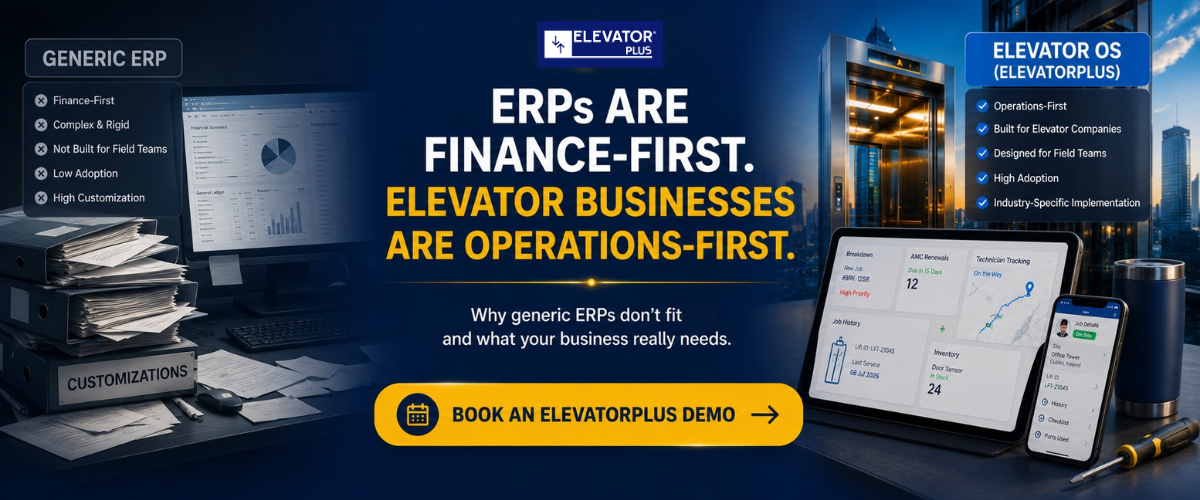
In short: Plenty of elevator companies try to run operations on a generic ERP SAP, Oracle, Zoho, Tally or similar and quietly give up. The problem isn't the brand. It's that ERPs are built finance-first, and elevator businesses live or die on operations: installation, AMC, breakdown service and inventory as one connected flow. Here's the difference, and why it decides adoption.
Key takeaways
- A generic ERP is finance-first; an elevator business is operations-first. That mismatch is why ERPs get abandoned.
- Elevator work is unit-by-unit: each lift has its own history, AMC, parts and compliance trail detail generic tools flatten.
- The cost of forcing a generic ERP to fit is heavy customisation, poor adoption, and a team that drifts back to WhatsApp.
- A purpose-built elevator operating system fits out of the box and comes with hands-on implementation.
- ElevatorPlus runs AMC and service operations for 200+ elevator companies across 20+ countries.
What this guide covers: what an ERP is built for · where it breaks for lifts · a feature comparison · the real cost of forcing a fit · FAQs.
What is a generic ERP actually built for?
ERPs were designed to put finance, procurement, HR and inventory onto one ledger for manufacturers and large enterprises. They're excellent at accounting and stock valuation. But they assume a world of purchase orders and GL codes not a world where a technician is dispatched to a stuck lift, pulls its 8-year history, replaces a door sensor, and needs that logged against the unit and the AMC in seconds.
Where does a generic ERP break for elevator companies?
Elevator operations are unit-centric and field-heavy. Every lift is its own little asset with a service history, a maintenance schedule, a compliance trail, a parts list and a contract. A generic ERP can be bent to approximate some of this, but it doesn't natively understand a 'breakdown', a 'thorough examination', an 'AMC renewal' or a 'technician on site'. So you customise expensively and still end up with a tool your field team finds clumsy. That's the moment they go back to WhatsApp and the ERP becomes a very costly accounting system.
Feature comparison
| Generic ERP | Elevator OS (ElevatorPlus) | |
|---|---|---|
| Built for | Finance & procurement | Elevator operations |
| Unit-level history | Bolt-on, flattened | Native, per lift |
| Breakdown dispatch | Not native | Built-in, location-based |
| AMC renewals | Manual workaround | Automated triggers |
| Field adoption | Low clumsy for techs | High built for the job |
| Implementation | Long, costly customisation | Hands-on, industry-specific |
We break the spreadsheet-and-FSM angle down further in ElevatorPlus vs spreadsheets & generic FSM tools.
👉 See what 'built for elevators' actually means.
📲 Join our WhatsApp channel for compliance tips, updates: ElevatorPlus - Business Automation Tool
Frequently asked questions
1. Is an ERP good for an elevator company?
For accounting and procurement, an ERP can be fine. For running elevator operations installation, AMC, breakdowns, unit history and field work. it's a poor fit, which is why teams abandon it. An industry-specific system fits the operational side natively.
2. Why do elevator companies abandon generic software?
Because it doesn't match how they actually work, so it requires heavy customisation and feels clumsy in the field. The team reverts to WhatsApp and the investment is wasted.
3. What's the difference between an ERP and an elevator operating system?
An ERP is finance-first and general-purpose; an elevator operating system is operations-first and built around lifts units, AMCs, dispatch, compliance and parts with implementation support to drive adoption.
4. Can I keep my ERP for accounting and use an elevator system for operations?
Many companies do exactly that keep finance where it works and run operations on a purpose-built platform that the field team will actually use.
The ERP question isn't about brand or budget it's about fit. Finance-first software can't run an operations-first business without expensive contortions and poor adoption. Run operations on something built for elevators, and keep the ERP for what it's good at.
👉 Compare it on your own operation — book a demo →
Related reading
- ElevatorPlus vs Spreadsheets & Generic FSM Tools
- The Global State of the Elevator Service Industry 2026
About the author Mr. Sumeet Katariya is the Founder & CEO of ElevatorPlus, the Elevator Business Operating System used by 200+ elevator companies across 20+ countries.
Sources: ERP design intent and vertical-SaaS fit enterprise software literature; elevator-operations requirements and adoption patterns ElevatorPlus Global Market Intelligence 2026.
👉 Follow ElevatorPlus on,