
EN ISO 8100-1:2026: What Changes and When It Applies
By Nutan Mandal, ElevatorPlus · Compliance reviewed by Mr. Sumeet Katariya
In short: EN ISO 8100-1:2026 and EN ISO 8100-2:2026 are published, and a lot of industry commentary has already declared EN 81-20 dead. It is not. The new standards are not yet cited in the Official Journal, so EN 81-20:2020 still gives presumption of conformity. This is written for European lift companies planning the transition, and it covers what actually changes, what the dates are, and one widely repeated error we made ourselves.
Key takeaways
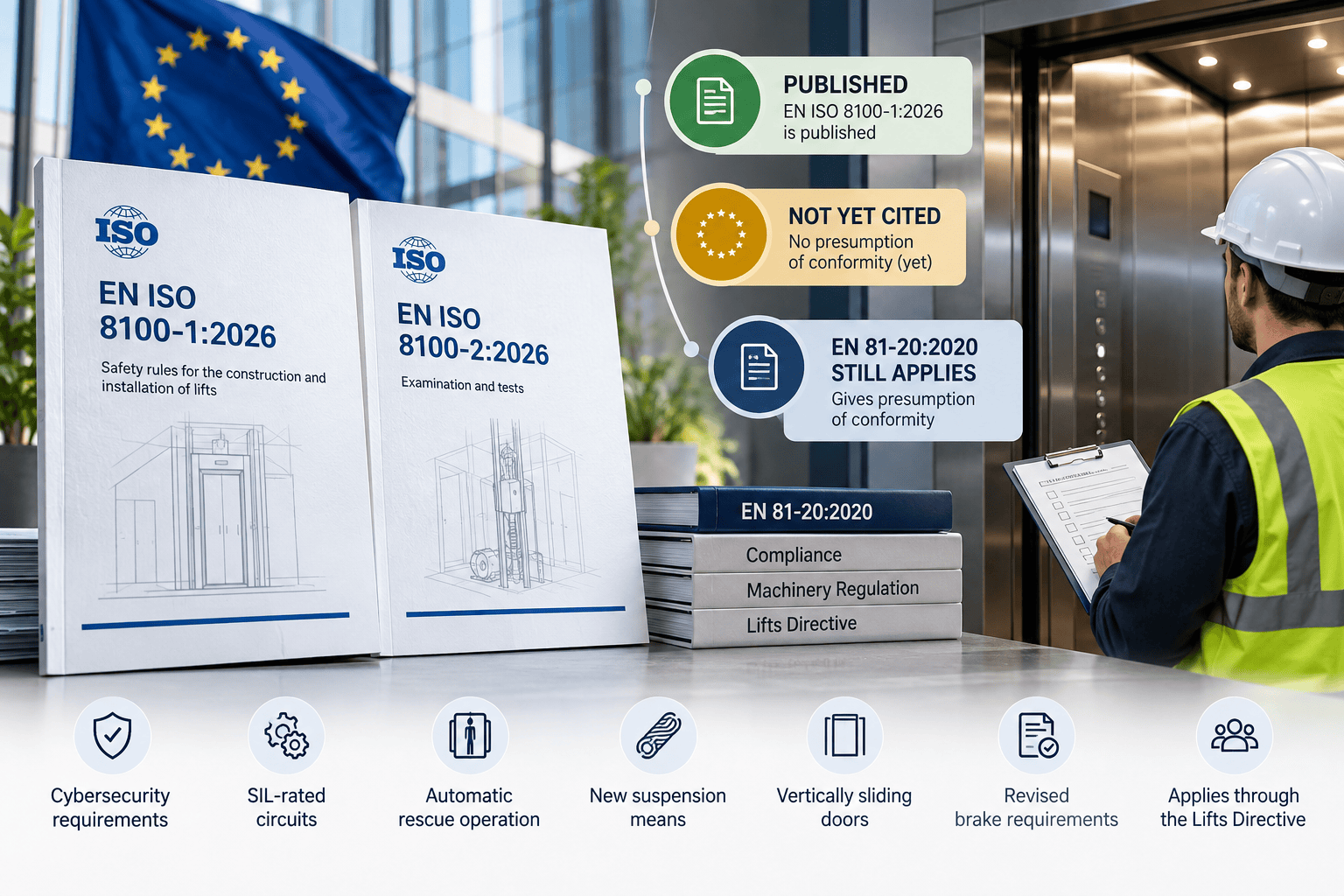
- Published is not the same as cited. EN ISO 8100-1:2026 is not yet cited in the Official Journal, so it currently confers no presumption of conformity. EN 81-20:2020 remains the standard that does.
- The dates most people quote are wrong. CEN approved it on 1 March 2026. The European Commission records publication on 17 June 2026. The "1 July 2026" figure circulating widely is an Estonian national adoption date, not a European one, and the "2 July 2026" date we ourselves published previously has no source behind it at all.
- National standard status by December 2026, withdrawal of conflicting standards by June 2029. That June 2029 date is the practical date of withdrawal for EN 81-20:2020.
- This is not a renumbering exercise. New technical content includes cybersecurity risk requirements, SIL-rated circuits replacing PESSRAL, automatic rescue operation, and suspension means other than steel wire ropes.
- Lifts are not excluded from the Machinery Regulation. From 20 January 2027, Regulation (EU) 2023/1230's essential health and safety requirements reach lifts through the Lifts Directive.
What this guide covers: the real dates · published versus cited · what actually changes · the Machinery Regulation · what to do now · a correction to our own material · FAQs.
The dates, precisely
This has been reported inconsistently everywhere, including by us, so it is worth setting out in order.
| Event | Date |
|---|---|
| ISO 8100-1:2026 Edition 2 published by ISO | 27 March 2026 |
| Approved by CEN | 1 March 2026 |
| EN version front matter dated | June 2026 |
| European Commission records publication | 17 June 2026, "but not yet cited" |
| Published under BSI authority | 30 June 2026 |
| National standard status required by | December 2026 |
| Conflicting national standards withdrawn by | June 2029 |
The CEN approval date precedes the ISO publication date because CEN votes on the text at the enquiry stage, before ISO issues the final international edition. The two dates are not in conflict.
There is no 2 July 2026 publication date, and there is no 2023 edition. The 2019 ISO editions were never the European harmonised standards, which is a separate source of confusion.
Published, cited, and why the difference matters
This is the part that determines what you actually have to do today.
A harmonised standard gives presumption of conformity only once it is cited in the Official Journal of the European Union. Until then it is a published technical document with no legal effect on conformity assessment.
EN ISO 8100-1:2026 is published. It is not cited. The European Commission's own lifts page records it as published "but not yet cited."
So as at today, EN 81-20:2020 remains the standard giving presumption of conformity for new lift installations in the EU. A manufacturer building to EN ISO 8100-1:2026 today is building to a good standard that does not yet carry the legal presumption.
That is not a reason to ignore it. It is a reason to be precise about what you claim. "We comply with EN ISO 8100" and "we have presumption of conformity" are currently two different statements.
👉 Tracking which standard applies to which installation across a mixed estate? Our free checklist and report templates are structured so the applicable standard stays recorded per unit.
What actually changes
The most common shortcut in commentary on this transition is that it is a restructuring and renumbering exercise, with the substance carried across. That is not what the change list says.
Structural changes are real. The document was reformatted to ISO/IEC Directives Part 2, and building-interface requirements moved into an annex.
But Part 1 also introduces genuinely new technical content:
- Cybersecurity risk requirements: new to this family of standards
- SIL-rated circuits replacing PESSRAL
- Automatic rescue operation
- Suspension means other than steel wire ropes
- Vertically sliding landing and car doors
- Traction lifts with increased car area
- Pit working platform requirements
- Hand-dragging protection in doors
- Revised brake requirements and brake monitoring
- Pit ladder specifications
- Cable fire classification
- Revised emergency operation
Part 2 changes too, with corrected traction calculation formulae, verification methods for non-steel suspension means, discard criteria, and a terminology shift from "examinations" to "verifications."
If your engineering team has been told this is a paperwork change, that briefing was wrong.
The Machinery Regulation, and a correction worth making
A claim we have seen repeatedly, and which is wrong: that lifts are excluded from Regulation (EU) 2023/1230.
Article 2 of the Machinery Regulation lists its exclusions at points (a) through (q). There is no lift exclusion.
Lifts in buildings are regulated under the Lifts Directive 2014/33/EU, but that Directive's Annex I point 1.1 refers to the Machinery Directive's essential health and safety requirements. So from 20 January 2027, when the Machinery Regulation becomes applicable, its Annex III requirements reach lifts and lift safety components through that reference.
The requirements most relevant to lifts include 1.1.9 on cybersecurity and 1.2.1 on control systems, alongside 1.1.2(e), 1.1.6, 1.2.6 and 1.3.7.
One practical consequence: the Machinery Regulation's Article 52 transition arrangement does not apply to lifts. Certificates addressing the new requirements can only be issued from 20 January 2027.
So two things land close together. New standards moving toward citation, and new essential requirements arriving via a different instrument. The cybersecurity thread runs through both.
The Annex III clauses, and why Article 52 doesn't help
The Machinery Regulation (EU) 2023/1230 sets out its essential health and safety requirements in Annex III, and several apply directly to lifts once the Regulation takes effect on 20 January 2027: 1.1.9 (cybersecurity), 1.2.1 (control systems), and 1.1.2(e), 1.1.6, 1.2.6 and 1.3.7 (a set of design and risk-assessment provisions). It's tempting to look for relief in Article 52, the Regulation's transition arrangement, but Article 52 does not apply to lifts. Lifts move straight to the new requirements on the effective date, with no grace period carried over from the Lifts Directive.
What EU law does and does not cover ?
Worth restating, because it shapes what any of this means for a maintenance business.
The European Commission is explicit:
The Lifts Directive governs the design, manufacture and installation of lifts… EU legislation does not cover the maintenance and modernisation of lifts. That is the responsibility of the national authorities in EU countries. However, the Lifts Directive does apply to lifts that were substantially modified.
So for a service company, the transition matters at three points: new installations, substantial modifications, and whatever your national regime requires you to record. Germany's BetrSichV, France's contrôle technique and Italy's verifica periodica are unaffected by this transition in themselves, because they are national operational regimes rather than product law.
How member states actually enforce it: Germany, France, Italy ?
EU-level standards set the design and construction requirements, but in-service inspection remains a member-state responsibility, and each country runs its own regime. Germany enforces its inspection cycle under BetrSichV, with intervals set by the employer's own hazard assessment rather than a fixed statutory number. France uses the contrôle technique system under the Code de la construction et de l'habitation, on a five-year cycle. Italy runs verifica periodica under DPR 30 aprile 1999 n. 162, on a two-year cycle. A lift manufacturer or operator working across borders needs to satisfy the design standard once, but the in-service inspection regime separately, per country.
What to do now
The useful work is not rewriting your specifications this month.
- Record which standard applies per installation. A unit commissioned under EN 81-20:2020 keeps that reference. New work will eventually cite EN ISO 8100-1:2026. A mixed estate is the normal outcome of any transition, and the failure mode is not knowing which unit sits where.
- Watch for the OJEU citation, not the publication announcement. The publication has already happened. The citation is the event that changes what you can claim.
- Brief the engineering team on the substantive changes, particularly cybersecurity and the move to SIL-rated circuits, because those are design decisions with lead times rather than documentation updates.
- Diarise January 2027 for the Machinery Regulation, separately from the standards transition.
A correction to our own material
We previously published this in more than one place, that EN ISO 8100-1:2026 and 8100-2:2026 were "published on 2 July 2026, replacing EN 81-20:2020 and EN 81-50:2020." We are correcting it today (12 September 2026).
Both halves of that were wrong. The date has no source behind it, and the replacement has not yet taken effect in the sense that matters, because the new standards are not cited in the Official Journal. We have corrected it, and we are flagging it here because we have seen the same framing repeated across the industry.
Frequently asked questions
1. Has EN ISO 8100 replaced EN 81-20?
Not yet in the sense that matters. EN ISO 8100-1:2026 is published but not cited in the Official Journal, so it does not yet confer presumption of conformity. EN 81-20:2020 remains the cited standard. Conflicting national standards are withdrawn by June 2029.
2. When was EN ISO 8100-1:2026 published?
ISO published Edition 2 on 27 March 2026. CEN approved the European version on 1 March 2026, with front matter dated June 2026. The European Commission records publication on 17 June 2026.
3. What is the withdrawal date for EN 81-20:2020?
Conflicting national standards are withdrawn at the latest by June 2029, which is the practical date of withdrawal.
4. Is the change to EN ISO 8100 just a renumbering?
No. Alongside restructuring, Part 1 introduces cybersecurity risk requirements, SIL-rated circuits replacing PESSRAL, automatic rescue operation, suspension means other than steel wire ropes, and revised brake requirements, among others.
5. Are lifts excluded from the Machinery Regulation (EU) 2023/1230?
No. Article 2 contains no lift exclusion. From 20 January 2027 its essential health and safety requirements apply to lifts through Lifts Directive Annex I point 1.1, which references the Machinery Directive's requirements.
6. Does EU law regulate lift maintenance?
No. The European Commission states that EU legislation does not cover the maintenance and modernisation of lifts, which is the responsibility of national authorities. The Lifts Directive does apply to lifts that have been substantially modified.
7. Can we claim compliance with EN ISO 8100 today?
You can state that you build to it. You cannot currently claim presumption of conformity on the basis of it, because it is not cited in the Official Journal.
8. Which standard should a mixed estate record?
Whichever applied at commissioning or last substantial modification, held per unit. Transitions produce mixed estates by definition, and the risk is losing track of which unit sits under which reference.
The industry has moved faster than the legal position. EN ISO 8100 is published, genuinely different from what it supersedes, and worth understanding now. It is also not yet the standard that gives you presumption of conformity, and saying otherwise is a claim that will not survive scrutiny from a notified body.
The honest position is more useful than the confident one, and it is also more differentiating. Much of the commentary in this market still cites the superseded standard entirely. A page that names EN ISO 8100 accurately, including the citation caveat, reads as written by someone who actually opened it.
The practical requirement underneath all of it is unchanged: know which standard applies to which unit, and be able to show it.
👉 See the applicable standard held per unit across a multi-country estate. Book a demo →
Related reading
- Elevator service software for Europe
- Zwei Jahre ist keine Frist: Was BetrSichV bei Aufzügen wirklich verlangt
- Elevator Maintenance Software Ireland 2026: EN 81 and Growth
- Elevator Safety Regulations and Audits: EU Compliance Guide
About the author. Nutan Mandal is part of the ElevatorPlus team, which builds the Elevator Business Operating System used by 200+ elevator companies across 20+ countries. Compliance reviewed by Mr. Sumeet Katariya.
Sources: ISO 8100-1:2026 · European Commission, Lifts, single market and economy pages · EN ISO 8100-1:2026 preview, front matter (PDF) · Liftinstituut, EN ISO 8100 development · European Lift Association, EN ISO 8100 comparison to EN 81-20/-50 (PDF)
👉 Follow ElevatorPlus on,
Instagram LinkedIn Facebook YouTube Qoura Substack Twitter