The 20–40 Year Obligation in Elevators (2026)
By Mr. Sumeet Katariya, Founder & CEO, ElevatorPlus · Published 28 July 2026 · Last updated 28 July 2026 · ~6 min read
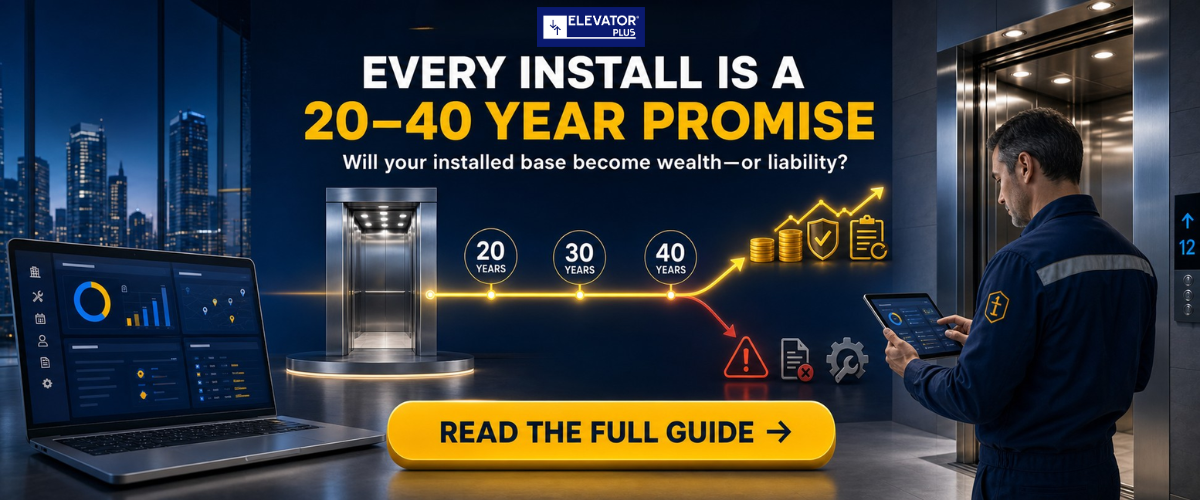
In short: In most industries, a sale ends when the invoice is paid. In the elevator industry, it begins a 20-to-40-year relationship. Every lift you install is a long-term service obligation and if you treat installs as closed sales, you're quietly accumulating liability instead of building wealth. Here's how to reframe it.
Key takeaways
- An elevator install is not a closed sale it's the start of 20–40 years of maintenance, parts, safety and renewals.
- Treated well, that obligation is cumulative wealth (recurring revenue); treated badly, it's cumulative liability.
- Growth in this industry is cumulative obligation, not linear sales sell more without structure and you grow the risk.
- Managing the obligation well is an operations capability: tracking every unit, renewal and service for decades.
- ElevatorPlus runs AMC and service operations for 200+ elevator companies across 20+ countries.
What this guide covers: why an install is an obligation · wealth vs liability · how to manage it · FAQs.
📲 Join our WhatsApp channel for compliance tips, updates: ElevatorPlus - Business Automation Tool
Why is every elevator install a 20–40 year obligation?
The day you commission a lift, you take on responsibility for keeping it safe and running for its entire service life often three or four decades. That means maintenance visits, spare parts, safety compliance, breakdowns and AMC renewals, year after year, for every single unit you've ever installed. The sale was the easy part; the obligation is the business.
Cumulative wealth or cumulative liability?
Here's the fork. If you manage that obligation well renewals tracked, service documented, revenue collected each installed lift becomes a small annuity, and your installed base compounds into predictable, growing recurring revenue. If you manage it badly renewals slipping, service reactive, records lost each lift becomes a liability: a building that calls you for free breakdowns, a contract you forgot to renew, a safety record you can't produce. Same installs, opposite outcomes.
How do you manage a decades-long obligation?
You can't hold 20–40 years of obligations across thousands of units in anyone's head. It requires a system: every unit with its history, schedule, contract and parts; renewals that trigger themselves; service that's documented; revenue that's tracked. That's the difference between an installed base that's an asset and one that's a slow-burning risk.
| Install as 'closed sale' | Install as managed obligation | |
|---|---|---|
| After commissioning | Forgotten until it breaks | Tracked for its full life |
| Recurring revenue | Leaks away | Compounds |
| Safety records | Patchy | Complete, retrievable |
| Installed base | Growing liability | Growing asset |
This is the thesis behind protecting your AMC book.
👉 Turn your installed base into an asset. Book an ElevatorPlus demo →
Frequently asked questions
1. Why is an elevator installation a long-term obligation?
Because once commissioned, you're responsible for keeping the lift safe and running for its entire service life often 20–40 years with maintenance, parts, compliance, breakdowns and renewals for every unit.
2. How can the same install be wealth or liability?
Managed well (renewals tracked, service documented, revenue collected) each lift is recurring revenue; managed badly (renewals slip, records lost) it's free work and risk. The difference is operations.
3. What does 'cumulative obligation, not linear sales' mean?
That growth in this industry adds long-term responsibility, not just one-off revenue so selling more without structure grows your liability faster than your profit.
4. How do you manage obligations across thousands of units?
With a system that tracks every unit's history, schedule, contract and parts, and automates renewals because no one can hold decades of obligations in their head.
Every lift you install is a 20-to-40-year promise. Keep it well and your installed base becomes the most valuable, predictable asset you own. Forget it, and it becomes a liability that grows with every sale. The choice is operational and it's yours.
👉 Build the system to carry the obligation book a demo →
Related reading
About the author : Mr. Sumeet Katariya is the Founder & CEO of ElevatorPlus, the Elevator Business Operating System used by 200+ elevator companies across 20+ countries. He is the author of "ElevatorPlus How to run your operation stress-free and 3x your business."
Sources: Elevator service-life and lifecycle-obligation thesis "ElevatorPlus" (Sumeet Katariya, 2026); installed-base economics ElevatorPlus Global Market Intelligence 2026.
👉 Follow ElevatorPlus on,
Instagram LinkedIn Facebook YouTube Qoura Substack Twitter